
(Kitco News) – Gold prices will reach $5,000 per ounce by September 2026, and any increase in political or economic turmoil surrounding the U.S. midterm elections could push the yellow metal to $5,400, according to commodity strategists at UBS.
In a new report published on Monday, the Swiss banking giant announced that it was raising its gold price target to $5,000 per ounce for the first three quarters of 2026. UBS strategists then expect the gold price to pull back to $4,800 per ounce by the end of 2026 – $500 higher than the previous forecast of $4,300 per ounce.
UBS expects demand for gold will steadily increase in 2026, supported by low real yields, ongoing global economic concerns, and domestic policy uncertainties in the United States – particularly those related to the midterm elections and mounting fiscal pressures.
“If political or financial risks increase, the gold price could climb to $5,400 per ounce (previously expected at $4,900 per ounce),” the strategists wrote in the report.
On Nov. 27, UBS said demand for gold will rise even further in the coming months, driven by rate cuts, falling bond yields, fiscal challenges, and U.S. political turmoil.
“Gold has recently recouped part of the decline from late October, and we expect rising demand for the precious metal to support higher prices ahead,” wrote the Chief Investment Office of UBS. “Further interest rate cuts by the Federal Reserve, lower real yields, increasing fiscal risks, and changes in the domestic US political environment should extend the current strong buying trends of central banks and investors, in our view.”
And on Nov. 20, UBS raised its 2026 mid-year gold target price to $4,500/oz – up from $4,200 previously. The bank also raised its upside target for gold by $200 to $4,900 per ounce on a possible spike of political and financial risks, but maintained its downside case at $3,700 per ounce.
UBS analysts said the worsening U.S. fiscal outlook will likely support central bank and investor gold purchases and they expect demand for exchange-traded funds (ETFs) to remain strong in 2026.

On the other hand, they warned that potential Fed hawkishness and the risk of central bank gold sales remained key challenges to their bullish outlook.
And on Nov. 3, UBS analysts said the pullback in the gold market would only be temporary, and they see an upside scenario driven b y intensifying geopolitical or market risks.
“The much-anticipated correction has taken a breather,” they wrote in a research note. “Outside technical factors, we see no fundamental reason for the sell-off.”
The Swiss banking giant noted that “fading price momentum triggered a second leg down in futures open interest,” but they emphasized that underlying demand remains strong.
UBS analysts also cited the World Gold Council’s Q3 Gold Demand Trends report, which confirmed “very strong and accelerating buying” from both central banks and individual investors.
“Central bank purchases of 634 metric tons this year have been slower than last year’s pace but are picking up in Q4, in line with our forecast of 900–950 metric tons for 2025,” they wrote.
ETF inflows of 222 metric tons and bar and coin demand above 300 metric tons for the fourth consecutive quarter demonstrate that investor appetite has also strengthened. “Jewellery demand was also not as weak as feared,” UBS noted.
“We like to buy the dip in gold,” the analysts said, adding they continue to believe that investors “remain underallocated” to the metal. UBS recommends a mid-single-digit allocation to gold within investor portfolios.
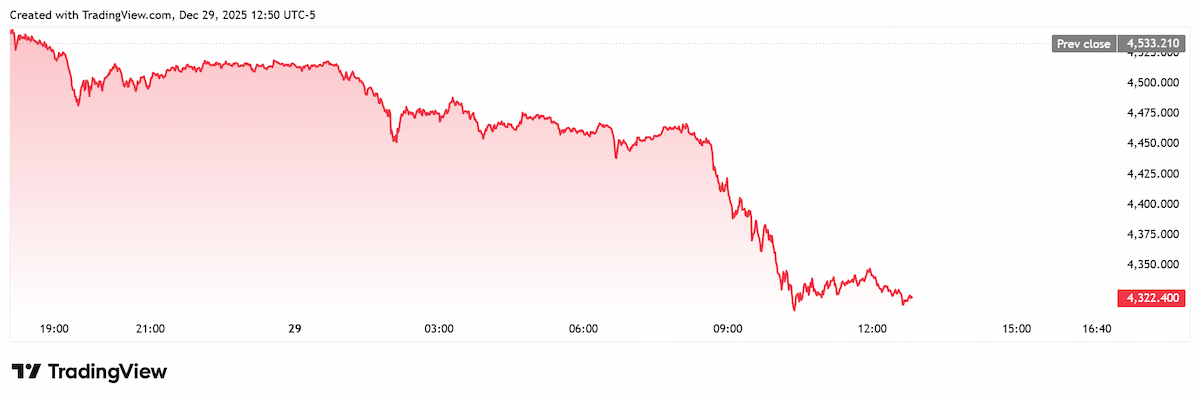
Gold prices are seeing pronounced weakness to start the week, with spot gold last trading at $4,322.40 per ounce for a loss of 4.65% on the daily chart.
Sponsored by Discovery Silver Corp. - Learn more about the company, its latest news, and investor materials.
Visit https://discoverysilver.com/

