

(Kitco News) - Gold is trading near session highs after the latest data showed the U.S. manufacturing sector weakening last month.
The Institute for Supply Management (ISM) announced on Monday that its Manufacturing Purchasing Managers Index fell to 47.9 in December after posting a 48.2 reading in November. The headline number was lower than expected, as consensus forecasts looked for a reading of 48.3.
“In December, U.S. manufacturing activity contracted at a faster rate, with pullbacks in the Production and Inventories indexes leading to the 0.3-percentage point decrease of the Manufacturing PMI,” said Susan Spence, MBA, Chair of the Institute for Supply Management’s Manufacturing Business Survey Committee. “Those two subindexes increased in November, so their contraction this month continues the short-term ‘bubble’ of improvement indicative in the last several months of PMI data — and a hallmark of recent economic uncertainty in manufacturing.”
“Although the demand indicators are still in contraction, improvement in three indexes (New Orders, Backlog of Orders and New Export Orders) and the Customers’ Inventories Index remaining in ‘too low’ territory (and at an accelerated rate) are positive signs for December, but several consecutive months of gains in these indicators are necessary for a longer-term recovery,” she added. “A ‘too low’ status for the Customers’ Inventories Index is usually considered positive for future production.”
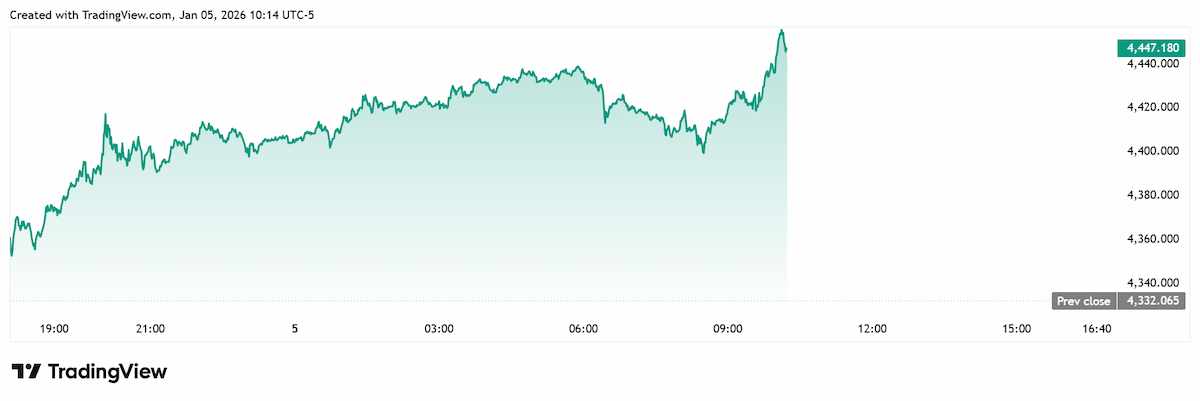
Spot gold spiked to a session high of $4,455.77 in the minutes after the 10 am EDT release. Spot gold last traded at $4,447.14 per ounce for a gain of 2.66% on the day.
The components of the report showed a mixed picture. The ISM noted steady inflation pressures, with the Price Index remaining at 58.5 December, while the New Orders Index rose to 47.7, up from the 47.4.
The ISM also noted strengthening in the labor market, with the Employment Index rising to 44.9 from 44 the previous month, while the Production Index fell to 51 from November’s 51.4 reading.
““Regarding output, the Production Index is still in expansion but slipped 0.4 percentage point, likely due to last month’s drop in the New Orders and Backlog of Orders indexes,” Spence said. “The Employment Index contracted at a slower pace, with 63 percent of panelists indicating that managing head counts is still the norm at their companies, as opposed to hiring.”
“Finally, inputs (defined as supplier deliveries, inventories, prices and imports) were mixed, with the Supplier Deliveries Index indicating slower deliveries, the Inventories and Imports indexes contracting strongly, and the Prices Index with the same reading as in November.”
