
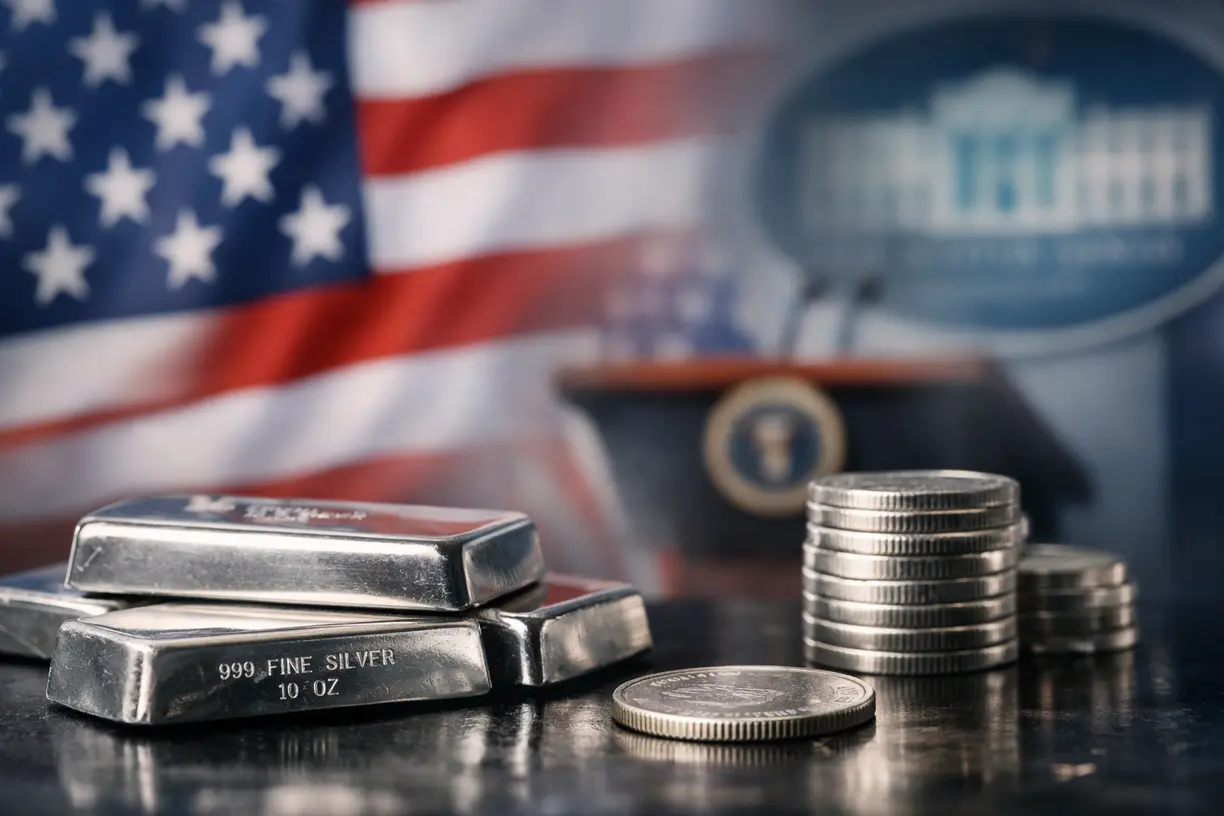
(Kitco News) - After rising 30% in the early days of the new year, silver continues to see extraordinary volatility and some technical selling pressure as a long-awaited decision from President Donald Trump confirms that the precious metal will not face import tariffs just yet.
In several proclamations published Wednesday evening, the White House announced that it would not be imposing any tariffs on processed critical minerals and their derivative products (PCMDPs). Instead, based on recommendations from the Secretary of Commerce, the administration is looking to build new trade agreements to increase imports of critical metals.
“The Secretary recommended a range of actions, including actions to adjust the imports of PCMDPs so that such imports will not threaten to impair the national security,” the White House said in the statement. “For example, the Secretary recommended that I negotiate agreements with foreign nations to ensure the United States has adequate critical mineral supplies and to mitigate the supply chain vulnerabilities as quickly as possible. The Secretary also suggested that it may be appropriate to impose import restrictions, such as tariffs, if satisfactory agreements are not reached in a timely manner.”
The Trump administration noted that while the nation produces critical minerals, it lacks sufficient production capacity and relies on imports of processed minerals. The statement added that as of 2024, the U.S. was 100% net-import reliant for 12 critical minerals and 50% or greater net-import reliant for a further 29 critical minerals.
According to some analysts, Trump’s announcement could help ease liquidity issues in the silver market and potentially cap the nearly year-long supply-crunch-induced short squeeze.
Silver prices saw significant selling pressure overnight after hitting a high of $93 an ounce. Spot silver last traded at $90.09 an ounce, down more than 3% on the day. However, prices are off their lows near $86 an ounce, showing some resilience in the marketplace.
“In the near-term, prices may consolidate in a range as tariff risks are reassessed and positioning normalises. However, structural deficits, tight physical availability, and ongoing policy uncertainty suggest downside might be limited, with silver likely to remain well-supported on dips,” said Ewa Manthey, Commodities Strategist at ING.
Market participants have been eagerly awaiting this announcement from Trump. In November, silver and Platinum Group Metals were added to the U.S. Geological Survey (USGS) 2025 List of Critical Minerals. The decision triggered a Section 232 tariff investigation, and the government had 90 days to make a ruling. Trump’s proclamation came nine days before the deadline.
Gold, silver, and PGMs were exempt from the global tariffs Trump imposed last year because of their role as precious metals. However, there were fears that silver, platinum, and palladium could still face tariffs due to their importance as industrial metals.
Although many analysts saw tariffs on silver as an unlikely scenario, the looming long-shot threat forced market participants to maintain elevated U.S. stockpiles through most of 2025, putting significant pressure on the metal’s global supply chain. The lack of free-floating metal created liquidity issues in the global physical market as renewed investment demand and industrial consumption competed for dwindling supplies in London and China.
Although liquidity issues are expected to ease through 2026, analysts note that dwindling stockpiles and demand significantly outstripping supply will continue to support higher prices through the year.
“The immediate heat may be off silver, but we can’t expect the tightness to ease dramatically, especially as it’s now tight in Asia as well,” said Rhona O'Connell, head of market analysis at StoneX, in a note Thursday.
Market analysts at BMO Capital Markets also see some short-term weakness in silver; however, they noted that global supply issues are far from resolved.
“As expected, we are seeing a reactionary sell-off on this news, silver especially, but as Trump has not categorically ruled out tariffs, we would expect this to be transient,” the analysts said.
While supply issues in the U.S. have been temporarily resolved, the physical silver market remains vulnerable to other disruptions, such as China’s new restrictions on exports. However, commodity analysts at Metals Focus said many of these market fears are overblown.
“Exporting silver from mainland China has always required a licence, and the list of qualifying companies is reviewed every two years. As a result, this policy should not be interpreted as an export ban or a material shift in China’s stance on silver exports. Instead, it represents a move towards stricter management of export licensing,” the analysts said in a note.
“Eventually, as stocks in London continue to recover and Chinese silver exports remain in line with previous years, the dislocation in the silver market is likely to ease gradually. This may introduce some short-term price downside, but in our view this downturn will be quickly absorbed by investors, resulting in further upside for the silver price over the foreseeable future,” the analysts added.
Looking ahead, Metals Focus expects supply issues to continue creating volatility in the silver market.
“Despite an increase in silver scrap in Western markets, a shortage of high-grade refining capacity has limited the speed at which this material can be returned to the market,” the analysts said. “Combined with an ongoing structural deficit in 2026, above-ground bullion inventories have not been rebuilt as quickly as might have been expected.”
