
(Kitco News) - The gold market continues to attract significant interest as investors look to hedge against geopolitical uncertainty.
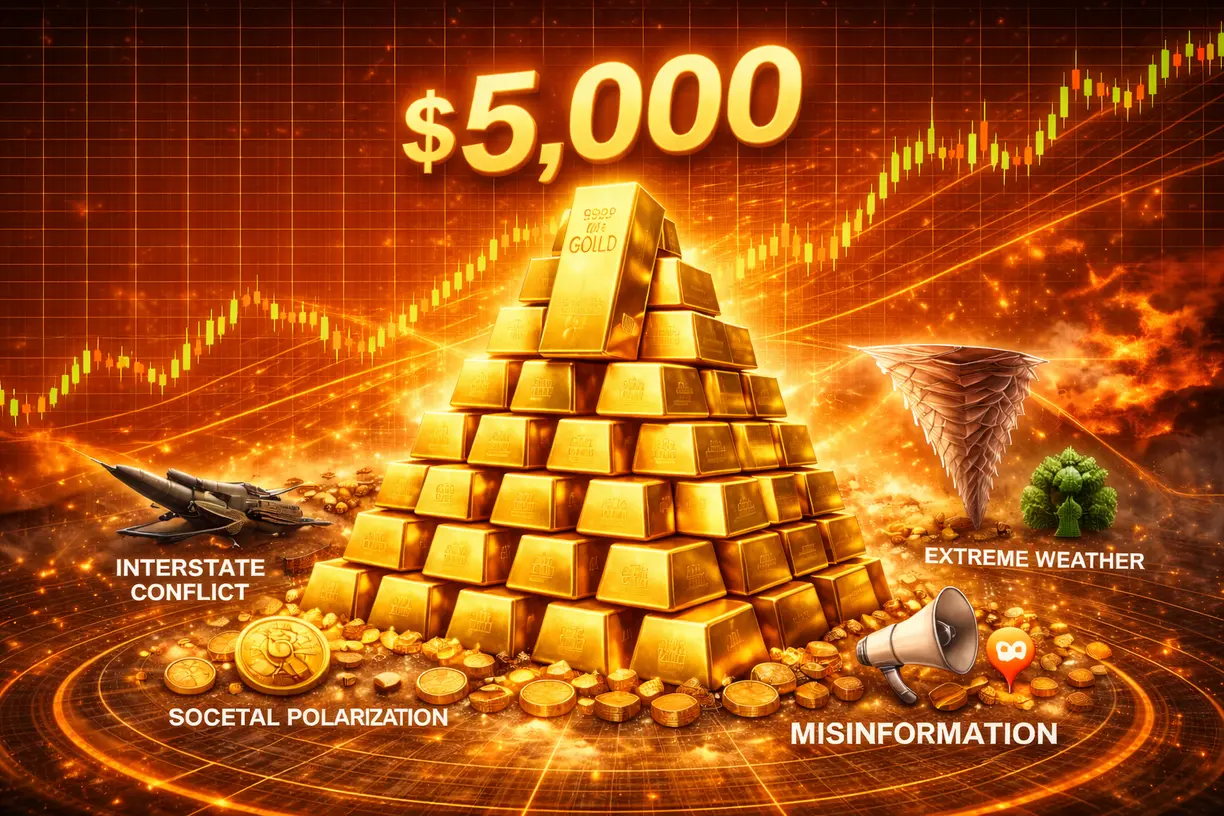
The precious metal could maintain its robust uptrend as the world’s economic leaders identify geoeconomic confrontation as the top risk for the year, followed by interstate conflict, extreme weather, societal polarization, and misinformation and disinformation, according to the latest report from the World Economic Forum.
The WEF kicks off its annual conference Monday, with business and political elites converging on Davos, Switzerland. Ahead of this year’s gathering, the organization published its Global Risks Report 2026, which highlights deep concern among leaders and experts.
The global economic conference comes just days after President Donald Trump launched a new salvo in his ongoing global trade war. In a social media post, Trump reignited tensions with Europe, threatening to impose 10% tariffs—rising to 25%—on Denmark, Norway, Sweden, France, Germany, the United Kingdom, the Netherlands, and Finland in a bid to pressure them into supporting his push to annex Greenland.
Following the threat, members of the European Parliament announced they would freeze ratification of the trade deal that Mr. Trump and Ursula von der Leyen, president of the European Commission, struck last summer.
According to a survey from the WEF, this geopolitical and economic uncertainty is expected to remain a key fixture in the global economy.
The Global Risks Report said that roughly 50% of WEF members surveyed anticipate a turbulent or stormy world over the next two years, up 14 percentage points from last year. A further 40% expect the two-year outlook to be unsettled at the very least, while 9% expect stability and 1% predict calm. Looking out over the next 10 years, 57% expect a turbulent or stormy world, 32% expect conditions to remain unsettled, 10% predict stability, and 1% anticipate calm.
“A new competitive order is taking shape as major powers seek to secure their spheres of interest. This shifting landscape, where cooperation looks markedly different than it did yesterday, reflects a pragmatic reality: collaborative approaches and the spirit of dialogue remain essential,” said Børge Brende, President and CEO, World Economic Forum. “Our Annual Meeting in Davos will serve as a vital platform for understanding risks and opportunities and for building the bridges needed to address them.”
This uncertainty is one critical factor explaining why many commodity analysts expect gold prices to hit—and potentially surpass—$5,000 an ounce within the first half of the year. The precious metal has already made a strong start. Spot gold last traded at $4,671.40 an ounce, up 1.6% on the day.
In an interview with Kitco News, Aakah Doshi, Head of Gold Strategy at State Street Investment Management, said geopolitical uncertainty has become more than just headline risk in the marketplace. He noted that it has evolved into an embedded threat that will continue to provide long-term support for gold.
Although gold prices look elevated in relative terms, he said the metal remains undervalued in broader terms.
“ I would be more concerned if the S&P 500 was at March or April 2025 levels and gold was trading at 4,500. But the fact that the S&P has touched 7,000. This gives me more confidence to hold gold because when there is a drawdown or volatility shock or liquidity event, gold can really benefit as a hedge against those tail risks.”
Linh Tran, Senior Market Analyst at XS.com, said that although gold prices may look technically overbought, the rally is no longer driven by speculative momentum.
“The fact that prices continue to set new highs suggests that the current upside momentum is no longer anchored to short-term economic cycles, but rather to confidence in the global financial and policy framework,” she said in a note on Monday.
“I believe gold is no longer merely reacting to tariff headlines or Fed-related developments, but is entering a phase of strategic revaluation within global portfolios. As risks stemming from unpredictable policy actions intensify and confidence in fiat currencies is increasingly tested, gold is gradually transitioning from a defensive hedge into a core asset within risk management strategies. This implies that any pullbacks, should they occur, are more likely to reflect technical adjustments or position rebalancing rather than a reversal of the broader long-term trend,” she added.
