
(Kitco News) – Geopolitical and macroeconomic fears are pushing sovereign yields into dangerously high territory – with gold the chief beneficiary – while commodities, small caps and international equities will likely steal Big Tech’s thunder ahead of the midterms, according to Michael Zinn, managing director and senior portfolio manager at UBS.
In a Tuesday interview with BNN Bloomberg, when Zinn was asked how concerned he was about the ongoing market impacts of U.S. threats toward Greenland, he said markets appear more concerned with fixed income yields in Japan.
“This seems like it's going to be a year of policy uncertainty and that's just another example of it,” he said. “It's a midterm election here in the United States. I would say that wasn't necessarily on our bingo card a week or two ago. I think what's driving markets, maybe a little more profoundly today is what's going on in Japan, where we are seeing yields surge a little bit. That, I think, is a little bit more of a concern, because rising bond yields in Japan have been tugging on global yields for a while now.”
“Days like today, where they push the top end of the ranges and push U.S. rates to the top ends of their ranges, those begin to discourage investors from taking risks and encourage them to go into other things like gold.”
Zinn said he wasn’t seeing much improvement in market conditions toward the end of Tuesday’s trading, with U.S. and Japanese 10-year yields remaining high and stocks languishing near session lows. “You're seeing gold near its high of the day,” he noted. “That probably means investors might be advised to be a little bit patient, see how this works out.”
“We think this is all landing in a fundamentally pretty strong backdrop,” he added. “I don't think this is going to haunt us for the rest of the year by any means. But these kinds of yield-spawned sell-offs can be sharp declines, and you want to just be mindful of patience sometimes being rewarded.”
Turning to which sectors may perform well in 2026, Zinn said the opportunities will be found less in tech and more in commodities.
“It's a change in the music, I think, from the previous couple of years,” he said. “Of course, in the past, tech has been leading the charge, and the Mag 7, of course, have been on the top of everyone's favorite playlist. This year does feel a little different.”
“First of all, the rest of the world is doing perfectly fine, as it did last year,” he said. “Tech is lagging this year. We're seeing energy do very, very well, materials do well, small caps do well, housing do relatively well. So other sectors, the ‘also magnificent 493’ are coming to the fore. We're having a lot of fun looking in other sectors, a little bit away from tech, things like materials and energy are areas that we're looking at a lot.”
Zinn also pointed to the U.S. midterm elections in the fall as a driver of increased volatility, and another reason for investors to be cautious.
“There's more volatility,” he said. “In the four-year cycle, it's typically the least rewarding year on average – that's seasonality analysis, which is certainly no guarantee. But we're seeing, with the affordability push here in the U.S. there are a lot of crosscurrents, we're obviously seeing notes about credit cards and the levels of rates that they can charge. Last week, the power producers were singled out, and they're talking now about having a different kind of auction, and the big data center hyperscalers needing to underwrite their own construction, potentially, of power plants to power their stuff. I think there are some potential policies, more populist haymakers that can be disrupting markets.”
Zinn said this kind of short-term volatility typically leads to good buying opportunities, but investors need to be patient.
He also said the Trump administration’s push to lower rates will also have a significant impact – and could escalate if yields continue to rise.
“There's an emphasis from the administration on keeping rates lower, and they have different levers they can pull in order to achieve that,” he said. “They can do things like getting the government-sponsored entities to buy mortgage bonds. Obviously, they have some influence on who the next Fed chair is going to be, and what their policies are.”
“Days like today, where you see yields surge, are concerning,” Zinn said. “You also maybe want to be on the lookout for some level of intervention, where there's a response from the government in order to keep rates low, in order to keep affordability improving.”
The U.S. 10-year Treasury yield rose to the very edge of 4.3% earlier today in the runup to President Trump’s speech at the World Economic Forum, but it has since pulled back following his assurances that the United States would not use military action to annex the territory of Greenland.
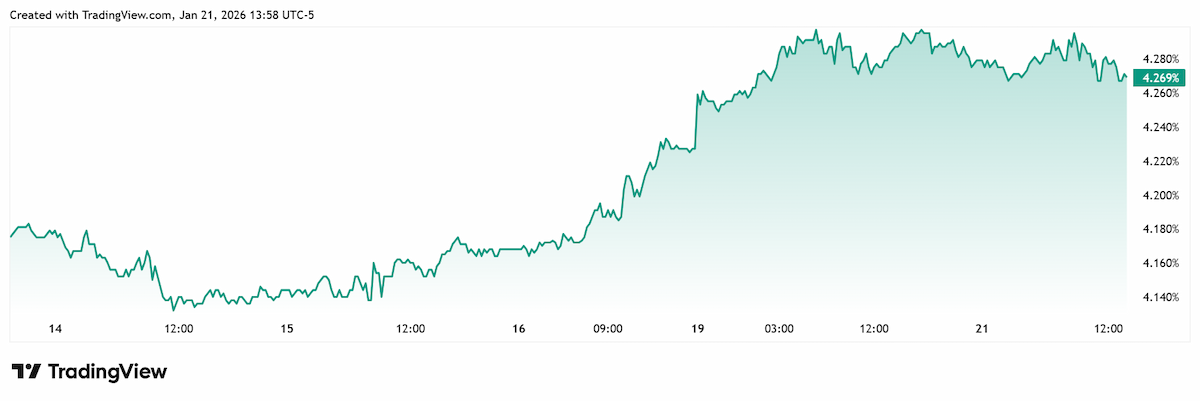
The 10-year yield last traded at 4.269% and is down 0.61% on the 24-hour chart.
Gold, meanwhile, has remained elevated and within striking distance of its fresh all-time high of $4,888.54 set around 1:30 am EST in overnight trading.
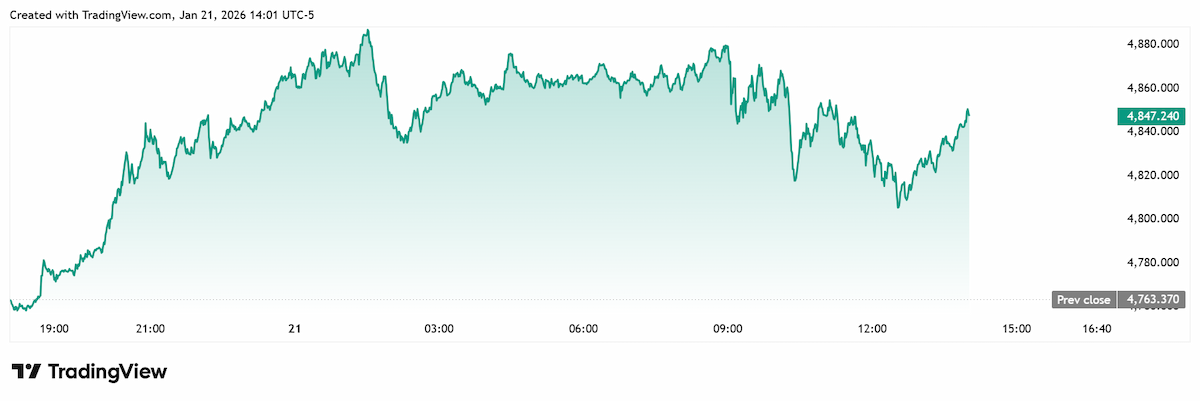
Spot gold last traded at $4,847.58 per ounce for a gain of 1.77% on the day.
