
(Kitco News) - The gold market is approaching its earlier session highs ahead of the weekend after the latest data showed consumer sentiment in the U.S. improving, even as longer-term inflation expectations ticked higher.
The University of Michigan announced on Friday that the final reading of its Consumer Sentiment survey for January was 56.4. The data was better than expectations, as the consensus forecast of economists called for a reading of 54, the same as the preliminary reading, and it was also above December’s final reading of 52.9.
“Consumer sentiment lifted about 3.5 index points this month, with minor gains seen across all index components,” said Surveys of Consumers Director Joanne Hsu. “While the overall improvement was small, it was broad based, seen across the income distribution, educational attainment, older and younger consumers, and Republicans and Democrats alike. However, national sentiment remains more than 20% below a year ago, as consumers continue to report pressures on their purchasing power stemming from high prices and the prospect of weakening labor markets.”
“Aside from tariff policy, consumers do not appear to be connecting foreign developments to their views of the economy,” she added. “Note that interviews for this release concluded on January 19th, two days after Trump’s social media post announcing additional tariffs on eight countries in Europe.”
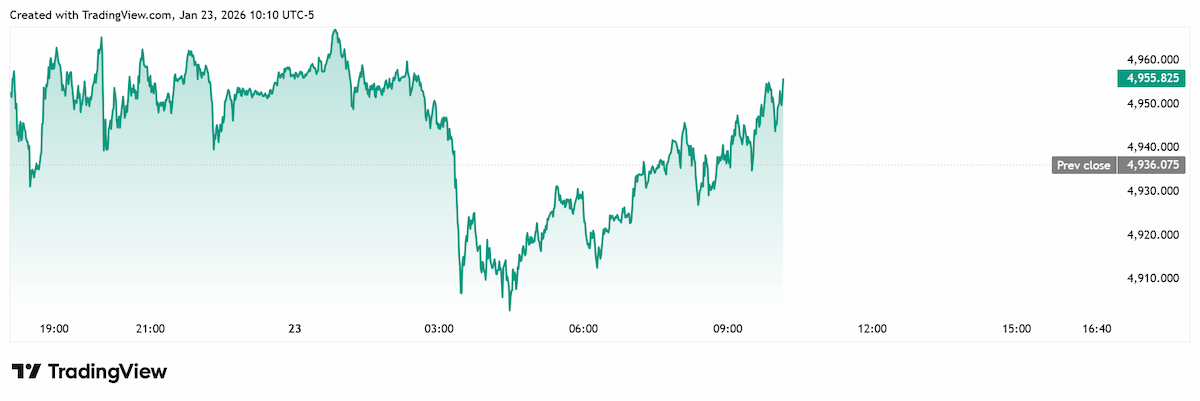
Gold prices are once again approaching session highs following the 10 am EST data release, with spot gold last trading at $4,955.58 per ounce for a gain of 0.40% on the day.
The January index showed some improvement in short-term price pressures, but longer-term inflation expectations ticked higher.
“Year-ahead inflation expectations fell back to 4.0% this month,” Hsu noted. “This is the lowest reading since January 2025 but remains well above that month’s 3.3%. Long-run inflation expectations inched up from 3.2% last month to 3.3% this month. In comparison, readings ranged between 2.8% and 3.2% in 2024, and were below 2.8% throughout 2019 and 2020.”
“[U]ncertainty over short-run inflation expectations, as measured by the interquartile range of responses, has fallen from mid-2025 but has remained considerably elevated in recent months, comparable to levels seen in 2022,” she said.
Jamie Cox, Managing Partner for Harris Financial Group, said strong recent U.S. growth data are buoying consumer sentiment.
"The wealth effect is alive and well with consumers," he said. "It's hard to be negative with GDP over 4%."
