
(Kitco News) – Geopolitical anxieties drove gold to a fresh all-time high ahead of Trump's Davos speech on Wednesday, but the apparent resolution of the Greenland crisis was not enough to prevent the yellow metal from a late-week rally to the very edge of $5,000 per ounce.
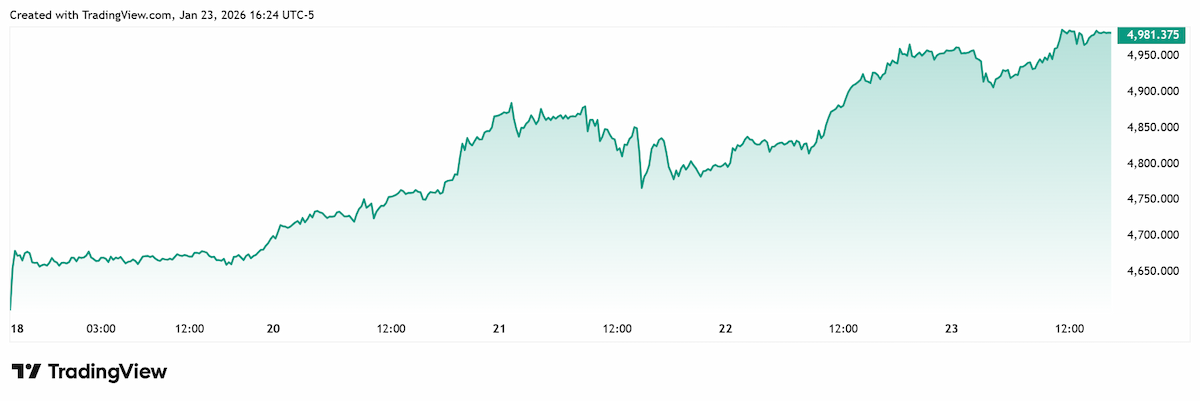
Spot gold kicked off the week trading at $4,654.24, and after a quick run up to $4,680, the yellow metal settled into a narrow trading range with U.S. markets closed for Martin Luther King Jr Day.
The Asian session on Monday evening saw the first significant move higher, with spot gold rising from $4,671 per ounce at 10:00 p.m. to $4,714 just before 1:00 a.m. Eastern, and a peak of $4,735 per ounce during the European session.
But it was the return of American traders that really kick-started gold's momentum this week. Spot gold was already trading at $4,750 per ounce 15 minutes before Tuesday’s North American open, and by 1:00 p.m., the yellow metal was trading at $4,763 per ounce.
After hovering near the $4,760 level for a few hours, the next big push came from Asia, with spot gold rising from $4,758 per ounce at 6:00 p.m. all the way to $4,837 per ounce by 10:00 p.m., before setting a fresh all-time high of $4,885 per ounce by 1:15 a.m. Eastern.
Much of the volatility, both in precious metals and the broader markets, surrounded worries about what U.S. President Donald Trump would say about his Greenland ambitions at the World Economic Forum in Davos, Switzerland on Wednesday morning. Gold prices hovered in an elevated range between $4,885 and $4,830 in the run up to his speech, but once the President made it clear that military force was off the table, equities rallied, and after a final push higher failed at the $4,850 level just after 2:00 p.m., gold fell all the way back to $4,766 per ounce half an hour later.
The bounce proved to be nearly as strong as the decline, however, with gold quickly reclaiming $4,835 per ounce by 4:30 p.m., and overnight trading saw the precious metal settle into a consolidation pattern near the middle of its weekly range.
But Thursday morning brought fresh momentum to gold, with the spot price rocketing from $4,813 per ounce at 8:30 a.m. right through resistance at $4,900, and all the way to a new all-time high of $4,965 by 7:45 p.m. Eastern.
After multiple attempts to break higher overnight failed, gold dipped back down to test the $4,900 per ounce level as support for the first time just after 4:15 a.m. Traders found gold attractive at this level, and the yellow metal was off to the races once again.
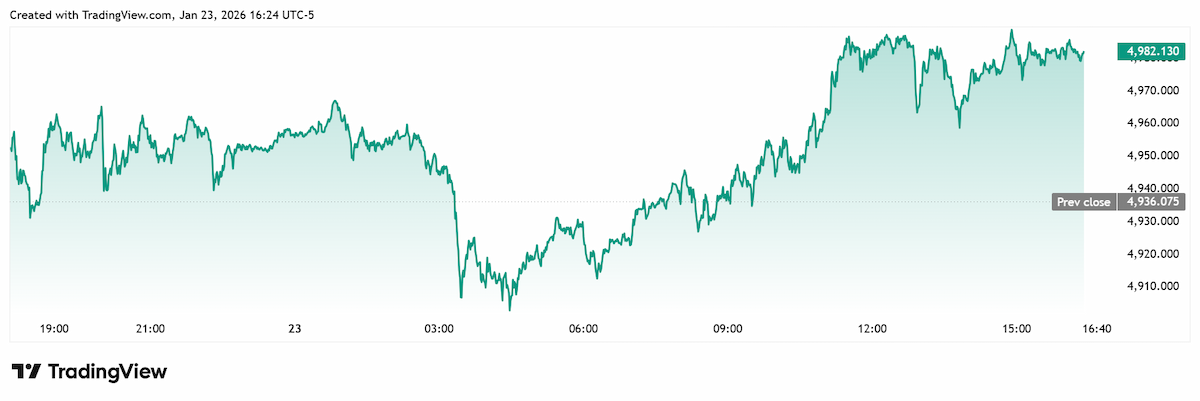
Friday saw the yellow metal rocket to the very edge of $5,000 per ounce, ultimately topping out at $4,989.88 before settling into consolidation near the $4,980 level heading into the weekend.
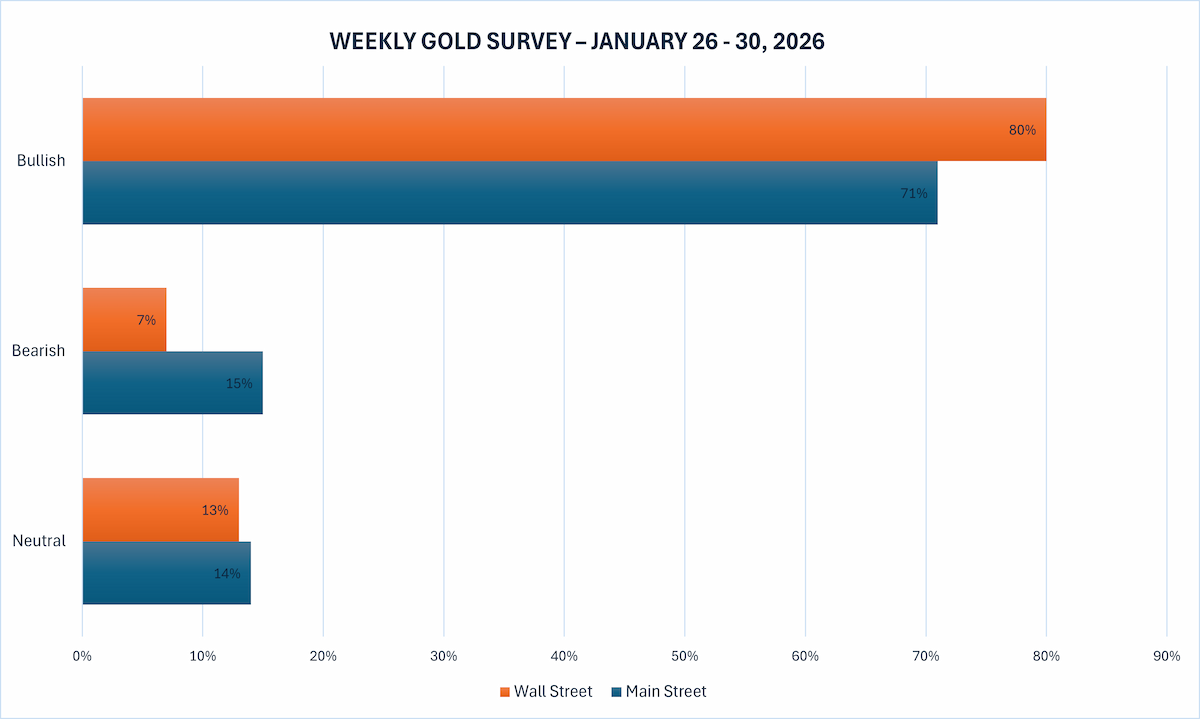
The latest Kitco News Weekly Gold Survey showed Wall Street extremely bullish on gold’s near-term prospects, while Main Street investors scaled back their bullish majority bias.
“Up,” said Rich Checkan, president and COO of Asset Strategies International. “At some point, we will see a pullback. I don’t believe that will be next week. Geopolitics is more strained than ever. The concerns over political influence over the Fed remain. Concerns over equities valuations and momentum in commodities all suggest gold will move higher. The trend is your friend… until it is not.”
“Up,” said James Stanley, senior market strategist at Forex.com. “There’s no point in flipping biases now. The 5k level might slow the run, or pause it, or maybe even bring a pullback, but there’s still no evidence that buyers are finished here yet, and the way gold reacted to $4900 on a pullback shows me that there could still be much more left in the tank.”
Colin Cieszynski, chief market strategist at SIA Wealth Management, told Kitco News he is neutral on gold for the coming week.
“Now that it is approaching $5,000 for the first time, technically it is looking due for a pause,” he said.
But Cieszynski said that he expects the medium and long-term drivers that have propelled gold thousands of dollars per ounce higher in recent years to continue – with short-term fuel like Greenland providing additional boosts.
“What we're seeing is what I call the flashpoint of the day,” he said. “Some things come, and then they go. One week it’s Venezuela, one week it’s Greenland. But one thing that hasn't gone away is the whole thing with Persia. That has not gone away, and you're seeing that in the oil market. That is, that has not gone away. The Ukraine thing has not gone away. And at the end of the day, despite this immediate flashpoint settling down, the U.S. is still not going to be getting along with the Davos crowd. The underlying tensions between the U.S. and China are not going away.
“The underlying tensions have not gone away,” he said. “And I think that's what we're seeing in gold, that it's still going.”
Cieszynski said the biggest driver undergirding the gold rally is probably still the ongoing weakening of the greenback.
“The U.S. dollar has been consistently weakening for what, nine, 10 months? The better part of a year now,” he said. “That has not changed. And that fundamental tailwind behind gold and silver of a weakening U.S. dollar, until that trend changes, that has not changed. In that context, looking at this or that specific geopolitical flashpoint or driver or tension is secondary. It'll give a short-term boost, but the overall trend remains up, and next week it'll be another country. Next week it'll be another dispute.”
Even the Greenland dispute is far from over. “What we're talking about is the increased militarization of Greenland,” Cieszynski said. “The underlying issue, which is increasing competition in a multipolar world, is not going away. We're not talking about world peace breaking out here.”
And while there’s been talk of Europe and others pushing back against U.S. initiatives by selling Treasuries, Cieszynski said this is not a viable avenue.
“Maybe a smaller player, like a Denmark or a Sweden, could play around the edges, but when you're talking about the big holders, you'd have a big problem if people tried to dump treasuries,” he said. “People have talked for a long time about this, going back over a decade. ‘What happens if China dumps their treasuries?’ Yeah, good luck. They’ve got a problem too.”
Still, Cieszynski conceded that the incremental selling of Treasuries – whether for geopolitical leverage or debt sustainability – is likely contributing to the dominant trend of U.S. dollar weakness. “And some of that capital is quietly finding its way into gold.”
Looking ahead to the Federal Reserve’s meeting next week, Cieszynski said that in the absence of a change in interest rates, the central bank’s analysis – and their independence – will be what’s scrutinized.
“What is more important to me from the Fed is going to be what they have to say about the economy, what they have to say about interest rates… were there any dissenters?” he said. “And even then, is it really going to matter until the next Fed chair gets named? Because that's going to change as well. Is it going to be somebody who's going to be friendly to the White House, or are they going to want to stake out their independence like Powell has?”
“It could be another year to get a sense of where the new Fed chair stands.”
This week, 15 analysts participated in the Kitco News Gold Survey, with Wall Street back on the bullish bandwagon as markets finished within spitting distance of $5,000 per ounce. 12 experts, or 80%, expect to see gold prices break through $5,000 during the week ahead, while one, representing 7%, predicted a price decline. The remaining two analysts, or 13%, expected the yellow metal to consolidate next week.
Meanwhile, 272 votes were cast in Kitco’s online poll, with Main Street investors growing more cautious after this week’s standout performance. 193 retail traders, or 71%, looked for gold prices to rise higher next week, while another 40, or 15%, predicted the yellow metal would lose ground. The remaining 39 investors, representing 14% of the total, expected prices to trade sideways during the week ahead.
The main economic news event next week will be the Federal Reserve’s monetary policy meeting, but markets are not expecting any rate adjustment until June. Still, investors will be on the lookout for any signs of dissension in the voting, and for any signs of defiance during Powell’s press conference.
On Monday, markets will receive U.S. Durable Goods orders for November, with U.S. Consumer Confidence coming out on Tuesday morning.
Wednesday’s news will be dominated by central banks, with the Bank of Canada’s monetary policy decision announced in the morning and the Federal Reserve’s monetary policy decision coming in the afternoon.
Then on Thursday, traders will keep an eye on weekly jobless claims data, and the week ends with the Friday morning release of the U.S. Producer Price Index for December.
“Gold reached a new record today,” said Marc Chandler, managing director at Bannockburn Global Forex. “The easing of the tensions over Greenland and calmer JGB bond market failed to deter the gold bulls. $5000 has been a widely cited target, but it does not appear that the forces that have lifted the yellow metal will stop at that psychological level. Momentum indicators are getting stretched, but pullbacks like we saw on January 22, are short-lived, suggesting buying on dips continues.”
Kevin Grady, president of Phoenix Futures and Options, told Kitco News that the precious metals look unstoppable in the current environment.
“When equities are selling off, gold rallies,” he said. “When equities are rallying, gold rallies.”
“I think right now gold and silver have a mind of their own,” Grady said. “I think this is one of those rare instances where you have natural buyers who are not getting out, and you have sellers who don't want to sell. The people that are producing don't want to sell, and they're not hedging their forward production. Now what's happened is the trend-followers have gotten involved as well. You can see open interest is increasing dramatically. I think the people are just riding this wave.”
“$5,000 was a target, they were going for it,” he added. “I don't think there was anyone out there who traded the space who didn't think we were going to be touching $5,000 in this area up here. It's just one of those things that was out there.”
“As a trader, you look at [the Comex Commitments of Traders reports] and, when everyone gets to one side of the boat, a lot of times it tips over,” Grady said. “There are a lot of longs right now, but this is a unique situation where the fundamentals are strong. Gold is holding its own. Silver is holding its own. And I think there's valid reasons for being here. It's not just speculators pushing it. There's valid reasons to be trading at these levels.”
Looking back at the tumultuous week at the World Economic Forum in Davos, Grady said he believes Trump was using Greenland as a gambit to force Europe to face its strategic weakness.
“The elephant in the room is that China and Russia are trying to expand their reach,” he said. “They are waging an economic battle with the United States, and thereby Europe, and Europe has gotten caught sitting on its hands. I think they've been exposed. The last administration lauded them, saying, ‘You're doing such a great job, this is awesome, this is what we believe too.’ And this administration is saying, ‘You can't defend yourself.’”
“That's a strategic point, and that's what he hammered home in his speech.”
Grady said that while markets and other leaders tend to overreact, this is just Trump’s way of negotiating. “He goes all in: ‘I'm going to take everything from you. That's it. Period.’ Now let's start negotiating; let's work our way back. That's the way he does it. And a lot of people disagree with that, but I always believe it's a deal to make, and I think the importance of Greenland cannot be discounted. As glaciers are melting in the Arctic, more ships are able to come in.”
Alex Kuptsikevich, senior market analyst at FxPro, told Kitco News that he sees gold prices trending lower next week.
“Gaining nearly 7% since Monday, gold is recording its strongest nominal growth in history and one of its most powerful weeks in terms of momentum,” he said. “Gold is now within striking distance of the psychologically important $5,000 per ounce mark, which was unthinkable just a couple of years ago when the market was resting at $2,000.”
Kuptsikevich said the gold rally is being driven by “geopolitics, fiscal problems, the associated debasement trade, lower rates, and capital outflows from other markets.”
“As interest rates fall, money will flow into other assets,” he said. “But to where? Stocks are fundamentally overbought, and Bitcoin has fallen out of favour due to declining volatility. Precious metals, on the other hand, are shining.”
“On the other hand, such an explosion of volatility after a prolonged rise is often the last impulse before a global reversal,” he warned. “The problem is understanding exactly when the turning point will occur. The current growth of more than 25% over the past 11 weeks is comparable to what happened at the end of the rally in 2011, and this week's growth dynamics are similar to what happened during the last week of sharp growth a decade and a half ago.”
“But history also teaches us patience: gold cautiously retested its highs for another three weeks, even though the downward slumps were becoming increasingly fierce,” Kuptsikevich concluded. “We may see something similar this time around.”
Analysts at CPM Group issued a Buy recommendation on Thursday, with an initial Target Price of $5,100 before February 6 and a stop Loss at $4,800.
“Gold prices have risen sharply over the past two weeks,” they wrote. “The markets remain extremely volatile, reflecting the enormous political and economic risks and uncertainties that have actually grown more acute in the first three weeks of 2026 than they had been in the final four months of 2025.
“Given this volatility, and CPM’s half-century of experience in precious metals and commodities markets, we have had “Stand Aside” ultra-short-term trade recommendations for much of the past couple of months,” the analysts said. “We continue to suggest this for many investors who do not want to follow the gold market minute by minute, but are issuing a Buy Recommendation now for several reasons.”
“The most important factor may be the continued unsettled political environment, which has a great potential to worsen in the near term,” they said. “Another factor is the momentum in the markets.”
A third reason is the large open interest in front-month gold futures. “There are 24.3 million ounces of open interest in the active February Comex gold futures contract, which becomes deliverable in six trading days,” the analysts said. “There will be a very active roll of these contracts out of February into April during the next few days, which could push gold prices sharply higher, toward $5,200, briefly.”
On a longer-term basis, CPM expects gold prices to move higher over the coming months and beyond. “The political and economic factors that are driving investors to buy enormous volumes of gold, silver, PGMs, and base metals are not likely to dissipate any time soon,” they wrote.
CPM warned, however, that at these extreme levels, the chances of a sharp correction increase.
“Even within the context of such a high probability of higher prices in the next week or so, the potential for a spike down to $4,500 or even lower before that exists,” they said. “This sort of risk is what has prompted CPM’s Recommendations to stand aside over the past few weeks.”
Michael Moor, founder of Moor Analytics, believes gold prices will move higher next week.
“In a Higher time frame: I cautioned on 8/16/18 the break above $1,179.7-$1,183.0 warned of renewed strength,” he wrote. “We have seen $3,786.3. In a Medium time frame: The break above 31482 brought in $1,821.8 of strength. The trade above 32214 brought in $1,748.6 of strength. The trade above 32236 brought in $1,746.4 of strength. The trade above 32392 projected this up $115 (+)—we attained $1,730.8. The trade above 33411 brought in $1,628.9 of strength. The trade above 33850 brought in $1,585.0 of strength. The trade above 34186 brought in $1,551.4 of strength. The break above 35640 brought in $1,406.0 of strength. The trade above 36658 brought in $1,304.2 of strength. The trade above 37143 brought in $1,255.7 of strength. The break above 37725 brought in $1,197.5 of strength. The trade above 38828 brought in $1,087.2 of strength.”
“On a lower timeframe basis: The trade above 39732 brought in $996.8 of strength,” Moor said. “The trade above 40701 brought in $899.9. The trade above 41738 brought in $796.2. On 11/5 we also left a medium bullish reversal. The trade above 42758 brought in $694.2. The break above 45675 (+10 per/hour) has brought in $402.5 of strength.”
“NOTE: We are likely in the last stretch of triple timeframes from the move up from 16183, 39013, and 32843 with possible exhaustion at 49631-889, 50689 and higher—we are holding the lower of these with a 49700 high and rolled over $68.1, but are reapproaching it again,” he warned. “Decent trade below 48874 (+30 per/hour starting at 6:00am) will warn of decent pressure, but this is steep and risk would move against you quickly as a short. Decent trade below 47865 (+6.5 tics per/hour) will warn of decent pressure.”
And Kitco senior analyst Jim Wyckoff noted that gold and silver are both hitting new all-time highs. “Ongoing safe-haven demand and chart-based buying amid firmly bullish technicals continue to drive the precious metals prices north,” he wrote.
“Technically, February gold futures bulls’ next upside price objective is to produce a close above solid resistance at $5,000.00,” Wyckoff said. “Bears' next near-term downside price objective is pushing futures prices below solid technical support at $4,539.10. First resistance is seen at the overnight record high of $4,970.00 and then at $5,000.00. First support is seen at $4,900.00 and then at $4,850.00.”
At the time of writing, spot gold last traded at $4,982.09 per ounce for a gain of 7.86% on the week and 0.93% on the day.