

(Kitco News) - Gold prices stayed strong after the latest data showed U.S. consumer sentiment declining more than expected this month.
The Consumer Confidence Index dropped to 84.5 in January, well below economists’ consensus forecast for a 90.9 reading and also down from the upwardly revised 94.2 print from December, the Conference Board announced on Tuesday.
The Present Situation Index—based on consumers’ assessment of current business and labor market conditions—dropped 9.9 points to 113.7 in January. The Expectations Index—based on consumers’ short-term outlook for income, business, and labor market conditions—fell by 9.5 points to 65.1, well below the threshold of 80 that usually signals a recession ahead. The cutoff for preliminary results was January 16, 2026.
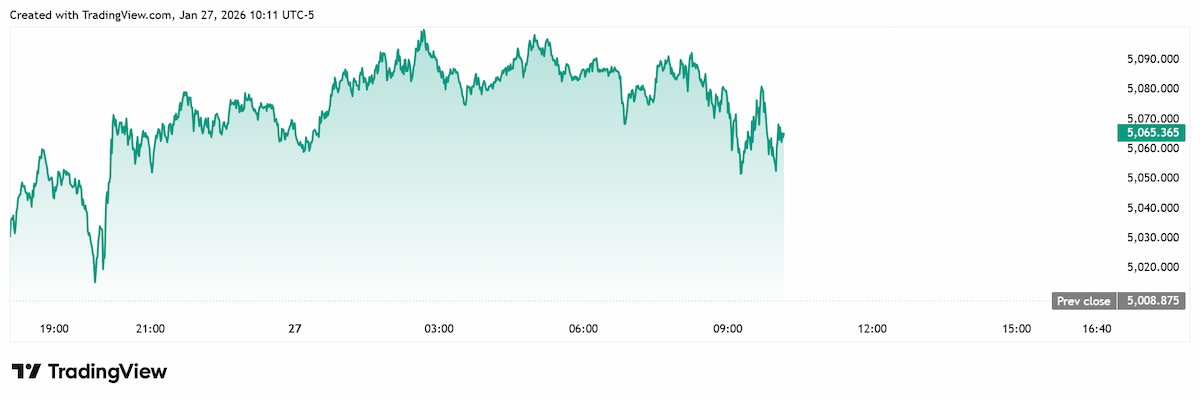
Gold prices continued to trade in the upper third of their daily range following the 10 am EST data release, with spot gold last trading at $5,065.36 per ounce at the time of writing for a gain of 1.12% on the daily chart.
“Confidence collapsed in January, as consumer concerns about both the present situation and expectations for the future deepened,” said Dana Peterson, Chief Economist at The Conference Board. “All five components of the Index deteriorated, driving the overall Index to its lowest level since May 2014 (82.2)—surpassing its COVID-19 pandemic depths.”
The report noted that the Present Situation Index fell, as net views on current business conditions dwindled to just barely positive, at +0.1%. "Perceptions of employment conditions also edged lower, with the labor market differential—the share of consumers saying jobs are “plentiful” minus the share saying jobs are “hard to get”—continuing to flag," they wrote. "All three Expectations Index components also weakened in January. Expectations for business and labor market conditions six months from now fell further into negative territory. The outlook for household incomes became less positive."
"Among demographic groups, confidence on a six-month moving average basis dipped for all age groups in January, although consumers under 35 continued to be more confident than consumers age 35 and older," the Conference Board said. "Confidence among all generations trended downward in the month, but Gen Z remained the most optimistic of all generations surveyed. By income, confidence on a six-month moving average basis ticked downward for all brackets, and consumers earning less than $15K remained the least optimistic among all income groups. Consumer confidence continued to fade in January among all political affiliations, with the sharpest decline among Independents.
“Consumers’ write-in responses on factors affecting the economy continued to skew towards pessimism," Peterson added. "References to prices and inflation, oil and gas prices, and food and grocery prices remained elevated. Mentions of tariffs and trade, politics, and the labor market also rose in January, and references to health/insurance and war edged higher.”
Jeffrey Roach, Chief Economist for LPL Financial, told Kitco News this morning's Consumer Confidence Index shows the economy is pivoting "from strong growth to just good growth," but downside risks could be growing.
"The massive hit to consumer confidence is likely a result of a faltering job market," he said. "The labor differential (individuals reporting plenty of jobs available less those saying jobs are hard to get) fell the lowest since 2016, outside of the pandemic."
Roach also noted that more consumers expect business conditions to get worse or stay the same in the next six months. "Perhaps this was driven by the drama at Davos," he said. "Demand for homes – both new and existing – has trended lower but the decline in housing demand has been partially offset by stable demand for high-ticket household items. This is an interesting relationship to unpack."
"Given this latest data, expect the unemployment rate to rise," Roach said. "My expectation is the domestic economy could approach 4.6% unemployment in Q2 with upside risks later in the year. This will weigh on retail sales in these coming months."
