
(Kitco News) – Despite one of the sharpest corrections seen in precious metals in over a decade, the dramatic late-week gold and silver selloff represented a reset rather than a reversal, according to Ewa Manthey, Commodities Strategist at ING.
In the bank’s monthly update, Manthey noted that gold and silver have already recovered a substantial portion of their recent losses amid a weakening dollar and a stabilizing market.
“While near-term volatility is likely to persist, we view the recent move primarily as a positioning-driven reset rather than a fundamental turning point,” she said.
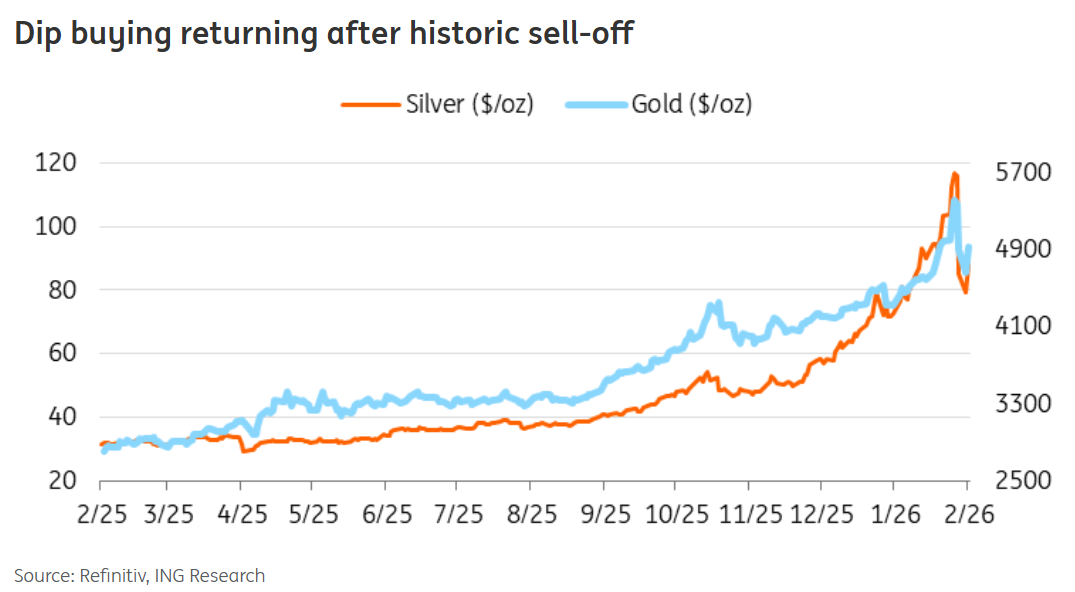
Manthey said that the selloff in precious metals was historic, both in speed and in magnitude.
“On Friday, gold experienced its steepest one-day decline since 2013, while silver recorded its largest daily drop on record,” she noted. “The sell-off in silver and gold on Friday was followed by further weakness on Monday as investors unwound stretched long positions.”
“The selloff comes after an extraordinary three‑month rally in which gold surged from $4,000/oz to over $5,500/oz and silver jumped from around $50/oz to near $120/oz,” she added. “The move was largely fuelled by a wave of speculative buying from China, from retail traders to larger equity funds rotating into commodities, with fresh flows pushing prices to extreme levels before last week’s abrupt reversal.”
Manthey pointed to President Trump’s announcement that he would nominate Kevin Warsh as the next Fed chair as the near-term catalyst for Friday’s reversal.
“Warsh is viewed as the most hawkish candidate, which has sent the US dollar sharply higher and prompted widespread profit‑taking among investors who had been positioned for a weaker dollar,” she wrote. “As positioning became crowded and volatility picked up, exchanges and brokers began raising margin requirements - a warning sign that the market was becoming overstretched.”
“The move appears to have been driven largely by the unwinding of crowded speculative positions and forced liquidation, rather than a deterioration in macro or fundamental conditions,” she added.
And as the stress in metals markets eased on Tuesday, prices rebounded. “Spot gold recovered more than 6%, while silver rose by around 8%, retracing part of the earlier decline,” she said. “This rebound suggests that the sell-off had overshot, amplified by momentum-driven trading and leverage.”
Manthey said that in the medium term, the correction has helped to reset positioning and reduce market froth. “However, it also serves as a reminder that precious metals remain sensitive to shifts in liquidity, positioning and broader risk sentiment,” she said. “The recovery in metals coincided with a broader improvement across financial markets. At the same time, the US dollar weakened, reversing some of the strength seen during the initial phase of the sell-off.”
She also noted that the inverse relationship between precious metals and the U.S. dollar has reasserted itself, making gold and silver particularly sensitive to near-term currency moves. “Looking ahead, the dollar is likely to remain a key driver of short-term price action, with precious metals broadly moving in the opposite direction,” she said.
Turning to silver, Manthey noted that the gray metal has earned its nickname ‘gold on steroids’ because it tends to move far more than gold in percentage terms.
“Its smaller market size and exposure to both investment and industrial demand tend to amplify price moves in both directions, she said. “This dynamic was evident during the sell-off and in the subsequent rebound.”
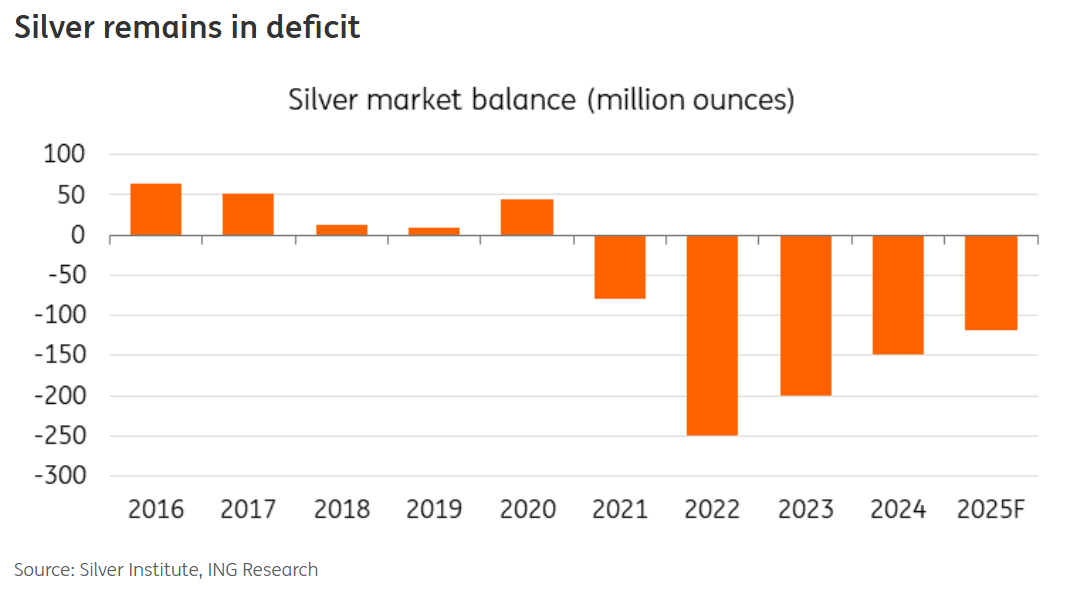
Manthey said that while she expects silver’s price volatility to remain elevated, its medium-term fundamentals remain essentially unchanged. “Industrial demand linked to electrification, alongside structurally tight physical balances, continues to underpin the market,” she said. “At the same time, silver’s higher volatility means it is likely to remain more sensitive to shifts in sentiment and positioning than gold.”
“However, for silver to build a more durable recovery, ETF outflows will need to stabilise,” she warned. “Holdings have fallen for eight straight days, and ETF demand remains a crucial driver of prices.”
Manthey said that gold’s fundamentals also remain strong, and ING does not believe the recent correction reflects a change in the underlying macro story.
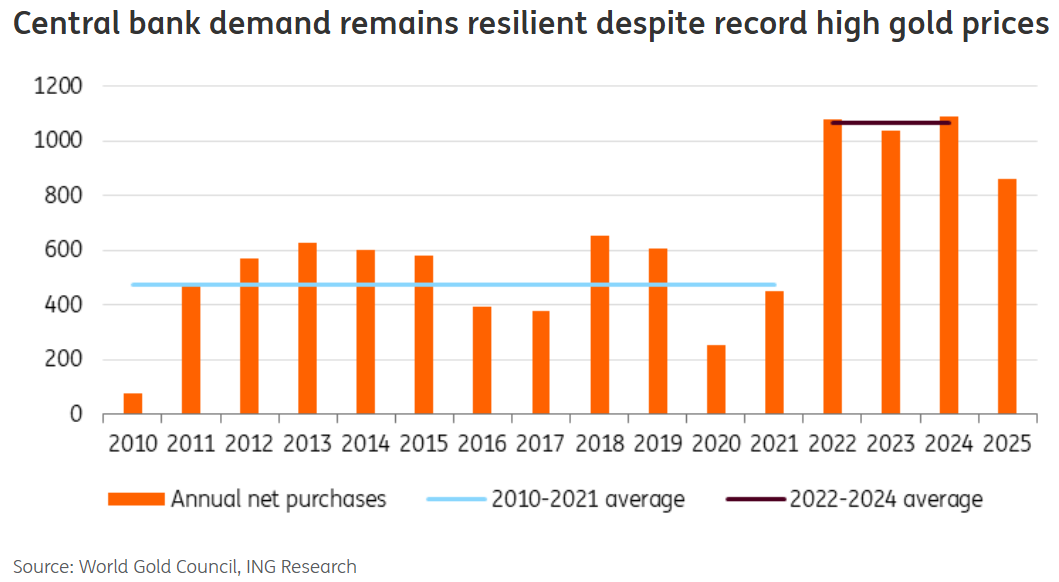
“Safe-haven demand, ongoing central bank purchases, and the outlook for real rates remain supportive over the medium term,” she wrote. “While shorter‑term drivers triggered the latest rally, the foundation of gold’s multiyear uptrend remains the steady accumulation by global central banks. This phase began in 2022 following Russia’s invasion of Ukraine, which prompted a reassessment of reserve security and diversification strategies. Since then, that 'official sector' demand has been a consistent and stabilising force in the gold market.”
And even though central bank purchases pulled back from their record-breaking clip in 2025, she said institutions remain significant net buyers – and the purchases are likely to rise again with prices off their highs.
“Their demand tends to be strategic, long-term and largely insensitive to short‑term price swings, reinforcing gold’s structural support over the medium term,” she wrote. “That said, near-term price action is likely to remain driven by macro data, policy expectations and dollar movements, rather than a smooth continuation of the rally.”
Looking ahead, Manthey said the metals’ price volatility is likely to stay elevated in the near term as market positioning continues to adjust.
“Without a material shift in macro fundamentals, we expect the recent sell-off to prove corrective rather than structural,” she said. “However, the pace and sustainability of any further recovery will depend on developments in the US dollar, interest rate expectations, and broader risk sentiment.”
“[P]recious metals are more likely to climb at a steadier, less linear pace from here, rather than repeat the explosive rally seen over the past few months.”
