(Kitco News) - Investment demand continues to be a driving force in the gold market, and analysts note that its influence in the evolving digital landscape is growing faster than in traditional markets, including in gold-backed exchange-traded funds.
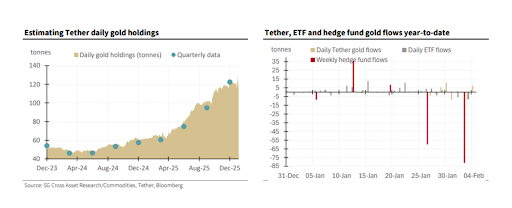
Tether and its gold-backed stablecoin, Tether Gold (XAU₮), have been attracting significant attention since the company announced its official gold holdings last month. The leading stablecoin company, according to analysts’ estimates, holds between 125 and 150 tonnes of gold.
“Tether remains the largest non-sovereign buyer of physical gold and now ranks within the top 30 global gold holders, surpassing countries like Australia, UAE, Qatar, South Korea, and Greece,” said Fahad Tariq, Senior Vice President, Equity Research at Jefferies, in a note Monday.
Not only is Tether Gold the world’s largest gold token, but the company also holds large amounts of gold as a reserve asset to back its U.S. dollar stablecoin. Roughly 7% of its total holdings are in gold.
Last month, Tether CEO Paolo Ardoino said that the company is also planning to increase its gold exposure to 10% to 15% of its portfolio.
But Tether is not just competing against sovereign national banks. Commodity analysts at Société Générale said that XAU₮’s holdings would rank as the eighth-largest ETF globally in terms of tonnage held, despite not being an ETF at all, but rather a digital-asset issuer.
The French bank said that, according to its analysis, flows into XAU₮ in December were the second-highest among all global ETFs, behind only SPDR Gold Shares (NYSE: GLD), the world’s biggest gold-backed ETF.
SocGen also noted that Tether flows are competing with speculative interest among hedge funds.
“In the last week of January, Tether’s flows became dominant and were a clear driver of market behavior into month-end, especially compared to ETFs,” the analysts said. “But aggregate hedge funds still dominated the influence on prices into month end and early February. After the sharp price decline on Friday the 30th, Tether added a further 11 metric tonnes — effectively ‘buying the dip’, and the flows by Tether outsized those of ETFs but certainly not hedge funds.”