
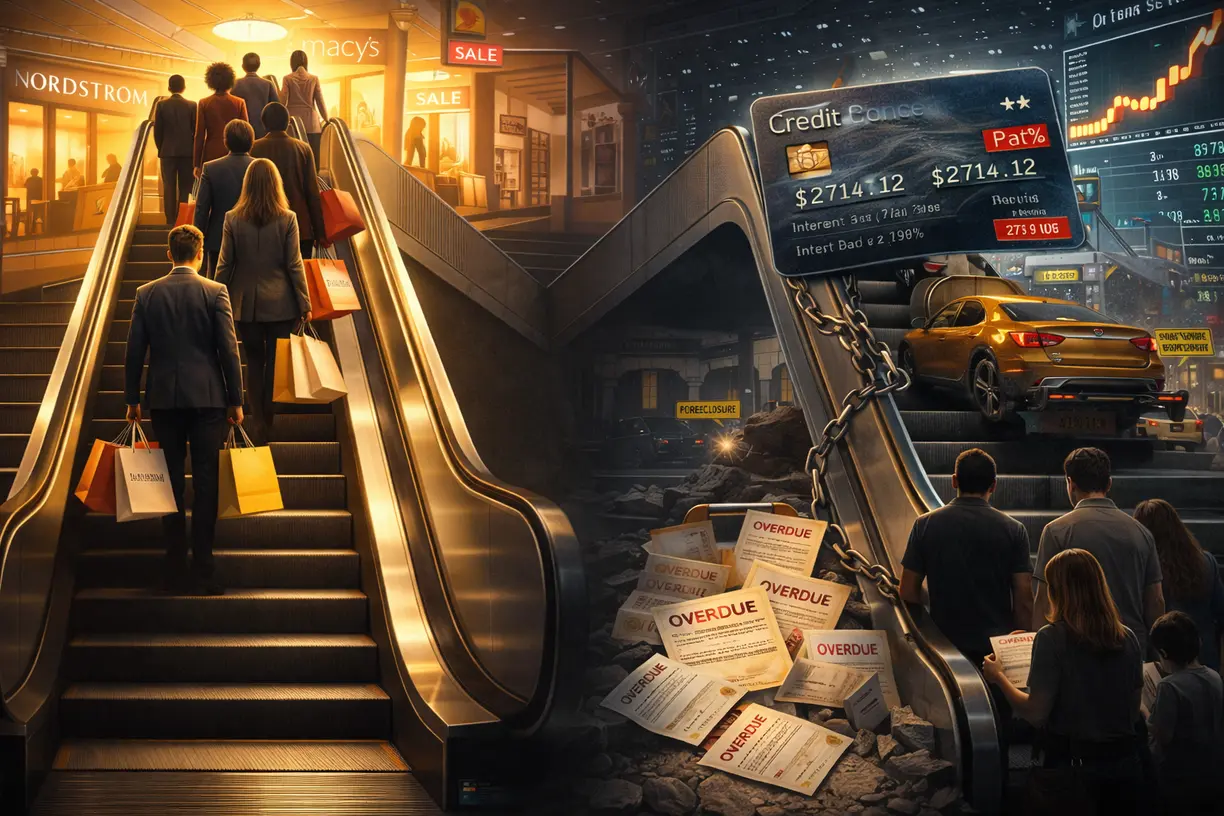
(Kitco News) - Overall consumer spending continues to rise, supporting the appearance of broader economic resilience. But beneath the surface of steady retail sales and solid GDP prints, more Americans appear to be falling further behind on their bills.
According to Matt Layton, senior vice president of consumer analytics at LegalShield, traditional measures of economic health may no longer be telling the full story.
“We like to follow consumer spending. Is that a good gauge of the economy? I don’t know that it is a positive metric any longer,” Layton said in an interview. “When you combine those increases in consumer spending every single quarter, and then you see revolving credit at an all-time high, credit card delinquencies increasing every single month, auto loan delinquencies — people are slowly getting further behind.”
LegalShield’s Consumer Stress Legal Index, which tracks more than 150,000 monthly legal consultations, rose 4.4% in the fourth quarter of 2025, marking the third straight quarterly increase and pushing the index 10.4% above 2024 levels.
The company said the index is now at its highest sustained level since the early pandemic. However, Layton noted that financial stress remains well below the record highs seen in 2008 during the Great Financial Crisis.
He described the current environment as a “slow burn” of rising stress that is not expected to change in the next three to four months. He added that much of the spending may be driven by necessity rather than confidence.
“Credit has become so available,” he said. “Especially some of these alternative credit products — buy now, pay later, payday loans. Folks are just relying on those to live, regardless of their household income. That’s what’s scary.”
Total U.S. household debt climbed above $18.59 trillion at the end of the third quarter of 2025, up more than $650 billion from a year earlier. At the same time, the share of outstanding debt in some stage of delinquency rose to 4.5%, up from 3.5% a year earlier, while average credit card interest rates remain near 21% to 22%.
Bankruptcy inquiries point to a difficult summer for the U.S. economy
One of the clearest warning signs in LegalShield’s data is the rise in bankruptcy-related inquiries.
The bankruptcy subindex climbed 19.9% in the second half of 2025 and rose 15.6% year over year. Layton emphasized that the company’s bankruptcy data has historically been a strong leading indicator of federal court filings.
“Our bankruptcy index predicts bankruptcy filings as reported by the U.S. courts, with something like a 0.95 correlation,” he said.
Layton said the leading nature of the index suggests more stress is still ahead.
“We’re a two- or three-quarter leading indicator,” he said. “Nothing in our data would lead us to suggest over the next two to four months that there’s going to be any great improvement.”
The report also noted that foreclosure-related legal inquiries rose 15% year over year, signaling that housing costs remain a persistent strain even without a housing crash. LegalShield providers report homeowners are grappling with elevated insurance, tax, and escrow costs, even on fixed-rate mortgages.
While tax refunds could provide a seasonal boost to household balance sheets, Layton doubts they will meaningfully reverse the broader trend.
“Historically in February, March, April, we do kind of see a softening in consumer stress trends,” he said. “But I don’t know if it’s going to be the fix anyone is waiting for.”
For now, he sees no imminent break — just continued pressure.
“The consumer seems like they understand their situation and they’re finding ways to get by,” Layton said. “But we’re going to continue to see the stress slowly creep up in some of these different areas.”
