
(Kitco News) - Gold and silver prices are higher in early U.S. trading Wednesday, as safe-haven bidding has resumed amid a major war playing out in the Middle East, with its final outcome still very much uncertain. April gold was last up $59.20 at $5,182.70. March silver prices were up $2.147 at $85.015.
Trump pledges ships will have safe passage in Middle East. President Trump on Tuesday said the U.S. will ensure safe passage of oil from the Middle East to head off a potential energy crisis caused by the war in the region. “The U.S. International Development Finance Corporation will offer insurance to help ensure the flow of energy and other commercial trade in the Gulf, and the U.S. Navy will begin escorting tankers through the Strait of Hormuz if necessary,” said a Bloomberg report. “Trump's assurances helped calm nerves in some markets, but traders remain skeptical the plan will allow oil flows to return swiftly to normal levels in the region,” said the report. ”The shipping industry sees this as only a partial solution to a historic crisis…. Shipowners are cautious about the insurance provision and the cost and say an issue of confidence cannot easily be solved with the U.S. navy, given Iran's continued strikes and limited capacity for escorts.”
Emerging markets in Asia being routed by Middle East war. The war in Iran has swiftly turned emerging markets into one of the worst places to be for global investors, according to a Bloomberg report. “Stocks and bonds that only days ago were at record highs are now under pressure as traders assess how higher oil prices and a resurgent U.S. dollar — twin shocks unleashed by the conflict — weaken the outlook for some of the world’s fastest-growing economies. Panic swept through South Korea’s trading floors as concerns over the Middle East war sent the world’s hottest stock market to its biggest-ever sell off. Asia has borne the brunt of the sell off, with Korean stocks tumbling 18% this week. The abrupt shift is raising concerns about whether the investment case for emerging markets has changed. Before the war, top money managers had been building long positions across Asia, Latin America and parts of EMEA, betting on robust growth, easing inflation and looser global monetary policies. Now, the prospect of persistently higher energy costs and a stronger U.S. dollar risk triggering a rush to cut exposure,” said the report. India’s rupee fell to a record low today amid concerns that rising crude prices may stoke inflation and worsen the country’s widening trade deficit. The Reserve Bank of India intervened after the rupee breached the 92-per-dollar level, selling dollars to steady the currency, according to people familiar with the matter and as reported by Bloomberg. The Taiwan dollar extended losses to its weakest since May, weighed down by heavy foreign outflows. Taiwan’s central bank may have to step in if the local currency’s drop accelerates and especially if it rapidly weakens toward 32 per dollar, said Stephen Chiu, chief Asia FX and rates strategist at Bloomberg Intelligence.
Chinese officials want steady relations with U.S. China’s legislature has signaled a desire for steady relations with the U.S. as the countries prepare for a planned summit between Chinese leader Xi Jinping and President Trump in coming weeks, according to a Bloomberg report. Lou Qinjian, spokesman for the National People’s Congress, told reporters today that “head of state diplomacy” remains the “irreplaceable” driver of bilateral ties. He noted both leaders have maintained regular communication since last year. “China and U.S. both stand to gain from cooperation and lose from confrontation,” Lou said in response to a question from Bloomberg. “China is ready to strengthen communication with the U.S. at all levels and through various channels and create more space for cooperation.” The comments follow reports that U.S. Treasury Secretary Scott Bessent and Trade Representative Jamieson Greer will meet Vice Premier He Lifeng in Paris at the end of next week. Those talks aim to finalize deals before Trump’s expected Beijing visit between March 31 and April 2.
The key outside markets today see the U.S. dollar index a bit weaker, with Nymex crude oil prices slightly higher and trading around $74.75 a barrel. The yield on the benchmark 10-year U.S. Treasury note is presently 4.1 percent.
Note: The gold market operates through two primary pricing mechanisms. The first is the spot market, which quotes prices for on-the-spot purchase and immediate delivery. The second is the futures market, which sets prices for delivery at a future date. Due to year-end positioning market liquidity, the December gold futures contract is currently the most actively traded on the CME.
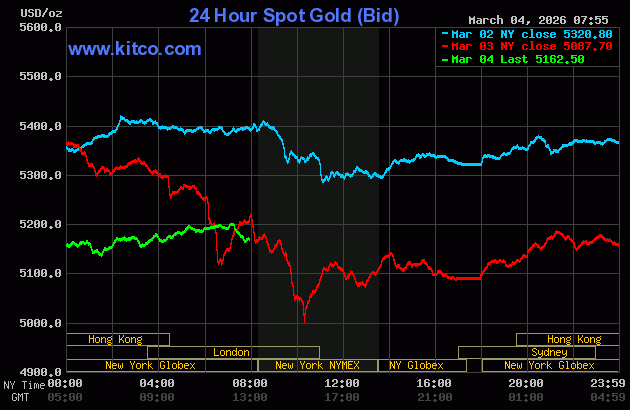
Technically, April gold futures bulls’ next upside price objective is to produce a close above solid resistance at the contract/record high of $5,626.80. Bears' next near-term downside price objective is pushing futures prices below solid technical support at $5,000.00. First resistance is seen at $5,250.00 and then at $5,300.00. First support is seen at the overnight low of $5,092.80 and then at $5,000.00. Wyckoff's Market Rating: 6.5.
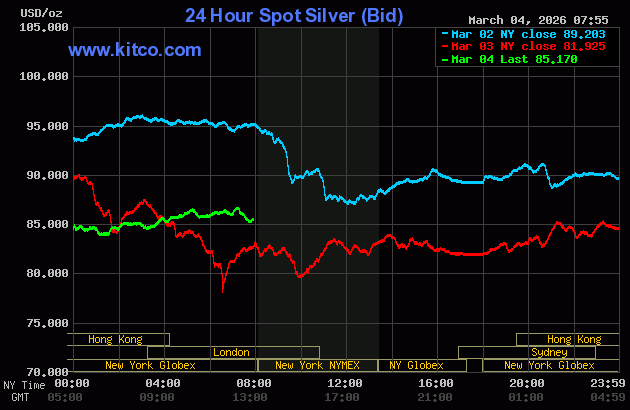
March silver futures bulls see their next upside price objective is closing prices above solid technical resistance at this week’s high of $95.86. The next downside price objective for the bears is closing prices below solid support at the February low of $71.815. First resistance is seen at $87.50 and then at $90.00. Next support is seen at $83.00 and then at $81.00. Wyckoff's Market Rating: 5.5.
(Hey! My “Markets Front Burner” weekly email report is my best writing and analysis, I think, because I get to look ahead at the marketplace and do some market price forecasting. Plus, I’ll throw in an educational feature to move you up the ladder of trading/investing success. And it’s free! Sign up here; it’s real easy. https://www.kitco.com/services)

