
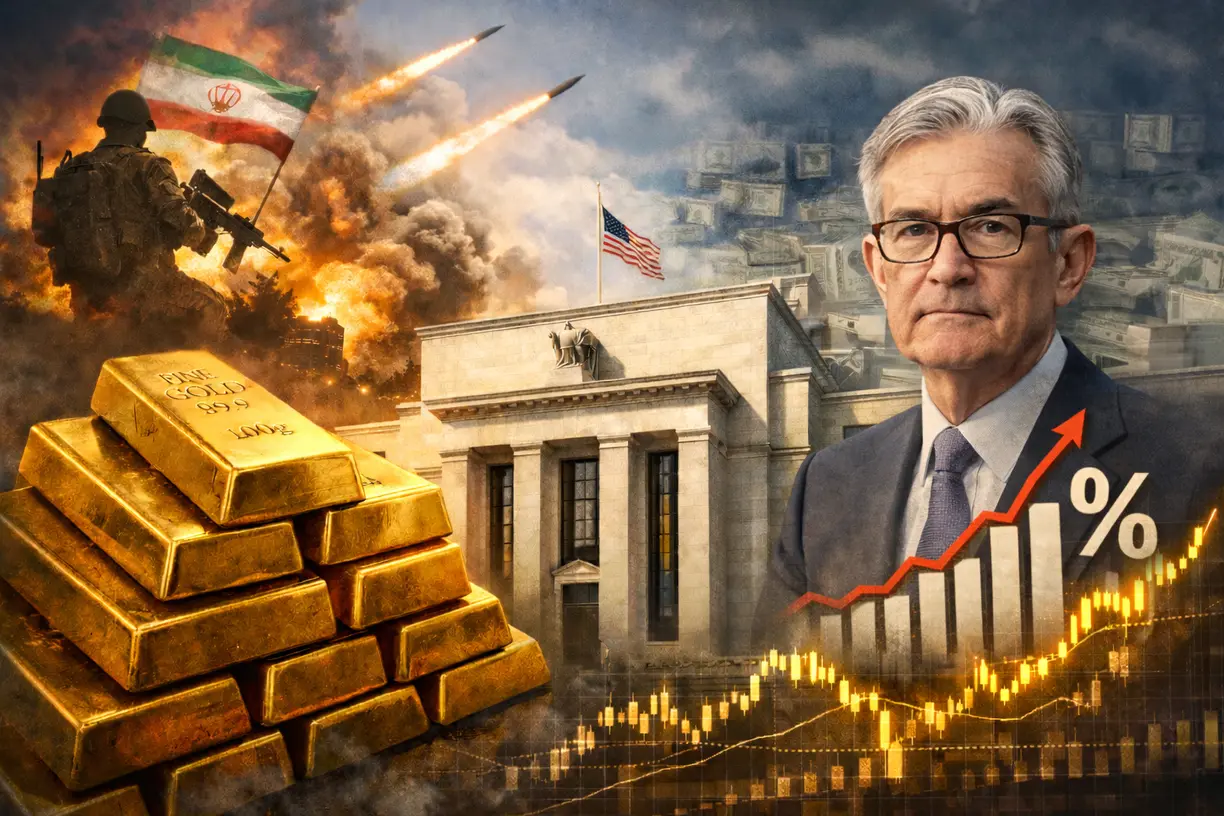
(Kitco News) – The multi-year gold rally is being driven more by structural uncertainty than inflation, but much of the geopolitical premium from the Iran war may already be priced in, and the biggest uncertainty for gold is now Fed independence, according to StoneX.
Speaking on a recent StoneX panel, Rhona O'Connell was asked about the likely direction of gold prices in the current geopolitical environment.
“It's all about uncertainty,” she said. “Historically, gold's been seen as the ultimate hedge against inflation. Now, if you're a professional investor, you'd be much better off using the TIPS index as an inflation hedge as opposed to gold. We only took out the 1980 high in real terms when we got through $3,700 last year, so it's actually underperformed in terms of inflation, certainly in major currencies.”
O'Connell said uncertainty has become the key reason to invest in gold. “Uncertainty encompasses all sorts of different elements, the most important of which is geopolitics – and that's not just armed conflict, it's the ‘T’ word: tariffs.”
Much of this uncertainty is coming from the top of the U.S. administration. “It's not possible, as we speak, to know what kind of policy is going to be coming out of the White House within the next 48 hours, let alone the next four months,” she said, adding that she’s sure Trump is very aware of the “fine balance” in Congress and the need for consistency to create investor confidence heading into the midterms.
O'Connell noted that in relative terms, the recent outbreak of war in the Middle East has had only a limited impact on gold prices.
“The Iran shock itself had little impact on the price beyond a $300 run – which on a base of $5,000 is very little, to be perfectly frank – and it was short-lived, because that geopolitical intensity had already been priced into the market to a large extent,” she said. “What we have seen over the last 18 months or so is that there's been a swathe of investors, both at the retail end and at the professional side of things, who have been looking for dips in the price in order to find value.”
O'Connell pointed out that it’s important to distinguish between price and value when looking at gold.
“They're two very different animals,” she said. “Gold always maintains its value; the price is something different. When those $200, $300 dips did not materialize, people in the end capitulated and got into the market. I feel as if the market, is not necessarily overcrowded, but it's pretty much at critical mass.”
The most significant downside risk to gold prices at these levels, outside of armed conflict, O'Connell said, is the independence of the Federal Reserve.
“The key for me will be the Supreme Court's findings on the Lisa Cook case, not so much in terms of the balance of power within the Fed, because we've all said before that the Fed is not a kingdom, it's a board of governors. Much more importantly, as the cornerstone of the US Constitution is the separation of powers between the legislative, the executive, and the judiciary, if a Supreme Court were to find in favor of the president or the administration's appeal, then that blurs those distinctions and that leads to concerns over monetary policy and the stability thereof. [This] could have a hell of an effect on the Treasury market.”
“If I had to find one particular element that I will be focusing on with a strong lens, it's that one.”
On March 3, O’Connell wrote that the outbreak of war with Iran, fresh uncertainty surrounding Trump’s tariffs, and higher than expected U.S. inflation are all supportive of gold and silver prices on paper, but both metals exhibit overbought conditions and are due for a break.
O’Connell said she sees “little exchange-based speculative overhang in either metal, reflecting profit taking in silver in January and steady liquidation on COMEX.”
“Now this can be argued either way; a) there is less scope for selling into strength than hitherto or b) stakeholders think the markets are overdone,” she wrote. “The answer is probably a combination of the two. Gold is at the top of its uptrend and the RSI is approaching 70. Silver is sitting on a Fibonacci retracement level after its steep correction. Putting all these together suggests that gold and silver may have done enough for now and need to unwind overbought conditions, but the downside remains limited. Barring further geopolitical escalation, it is time for a breather.”
“In this febrile atmosphere the strength in gold and silver should be sustained until conditions settle down,” O’Connell said. “Until then the markets will remain in risk-off mode.”
