(Kitco News) – Gold is being sold to raise cash amid the Iran conflict-induced liquidity crunch, but once the forced liquidations and technical selling cease, fiscal stresses, de-dollarization, and rising stagflation risks will drive prices higher once again, according to Ole Hansen, Head of Commodity Strategy at Saxo Bank.
“Gold and silver remain under considerable pressure as the Middle East war continues to trigger a broad macroeconomic shock across global markets, forcing investors to reprice inflation, rates, growth, and liquidity conditions simultaneously,” Hansen wrote. “After many months of strong outperformance, both metals have become vulnerable, not because their strategic case has fundamentally changed, but because they had become crowded longs at a time when investors suddenly needed liquidity.”
“Equity markets have been selling off amid rising growth concerns as funding costs and bond yields surge amid mounting inflation concerns following what may be the largest disruption to global fuel supply on record,” he said. “With limited remaining conventional military capacity, Iran is delivering a broad retaliatory shock through energy markets, with global spillover effects widening.”
Hansen noted that the U.S. 2-year Treasury yield moved above the Fed funds rate for the first time in three years on Friday, indicating the growing likelihood that the Fed’s next move could be a hike rather than further easing.
“Gold’s return to its 200-day moving average for the first time since 2023 highlights the scale of the reversal,” he said. “In the current environment, gold has emerged as one of the more exposed assets, with the sell-off driven by long liquidation, stop-loss selling, and investors raising liquidity.”
“In effect, gold is being sold because it remains one of the few liquid assets still showing gains over the past year.”
Hansen noted that silver has come under even more pressure than gold, reflecting its higher beta and greater sensitivity to the economic cycle – and the white metal could have further to fall.
“The sell-off accelerated following the break below USD 80, which from a technical perspective opened the way toward USD 40,” he said. “Since then, the unwind of previously popular trades has added further downside momentum. Earlier [Monday], silver almost reached the 0.618 Fibonacci extension target at USD 60.80, a level that may offer initial support. Failing that, the 200-day moving average at USD 57.61 stands out as the next key downside level.”
Hansen acknowledged the magnitude of the ongoing correction, with gold down over 19% in March, and silver losing nearly 31. “However, on a one-year basis, gold remains up 38.3% and silver 90.0%, underscoring how strong the preceding rally had been and why the current liquidation phase is proving so intense,” he said.
“Once the dust settles and the current wave of forced selling runs its course, the outlook for gold in particular may improve again quite sharply,” Hansen said. “Fiscal debt concerns continue to build, while the risk of stagflation is rising as higher energy costs threaten growth while keeping inflation elevated. In such an environment, policymakers face limited flexibility, which may ultimately renew demand for gold as a hedge against macro instability and currency debasement.”
“Silver may also rebound,” he added, “but is likely to remain more sensitive to growth concerns in the near term.”
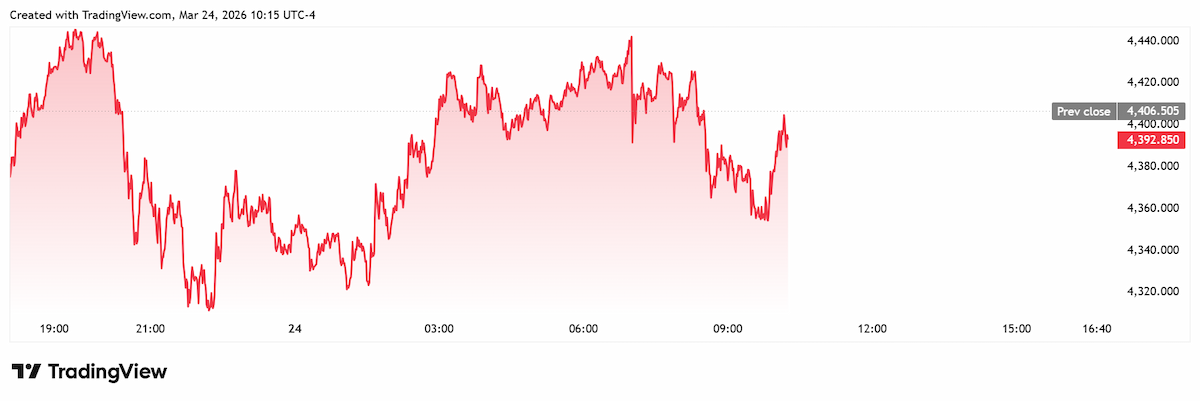
Gold is trading in the middle of its daily range at the time of writing, with spot gold last trading at $4,392.26 per ounce for a loss of 0.32% on the session.
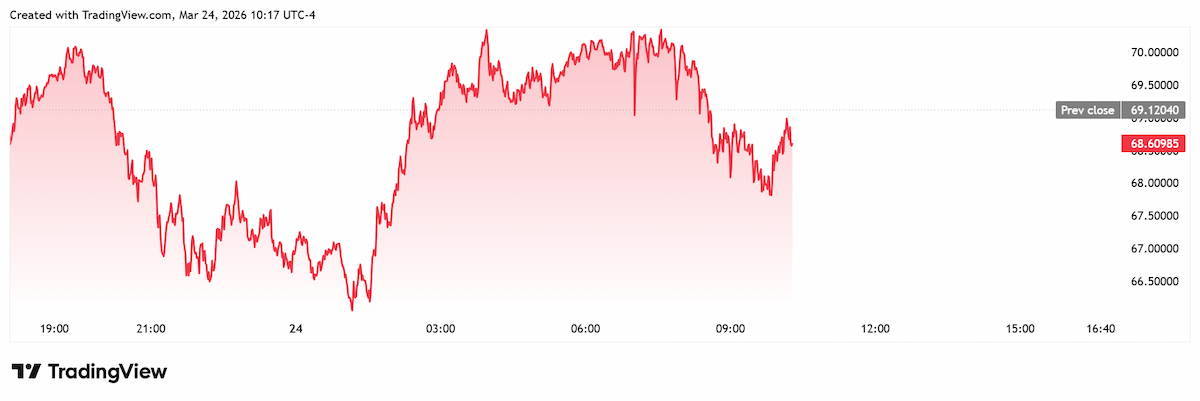
Silver has also seen a fair amount of volatility on Tuesday, last trading at $68.606 per ounce for a loss of 0.74% on the daily chart.