
(Kitco News) – Gold and oil are moving in opposite directions in the wake of the first concrete ceasefire plan since the start of the Iran conflict, but uncertainty remains high and the price and currency impacts of the war have created new complications for the yellow metal, according to commodity strategists at ING.
In a report published Wednesday, commodities strategists Warren Patterson and Ewa Manthey wrote that gold was gaining as energy prices pulled back.
“Oil prices fell sharply on reports of renewed ceasefire efforts, with Brent sinking as much as 7% toward $97/bbl before paring losses, while WTI traded near $89/bbl,” they noted. “Markets reacted to reports that the US has drafted a 15‑point proposal aimed at ending the conflict, reportedly delivered to Iran via Pakistan, although details remain unclear.”
But despite the initial relief, they said market uncertainty remains high amid other signs of escalation. “Tehran fired a fresh wave of missiles at Israel and signalled little willingness to compromise, while Iran also reiterated that foreign ships can transit the Strait of Hormuz only if they comply with Tehran’s regulations and are not supporting acts of aggression,” they said. “Earlier, the US ordered the deployment of around 2,000 troops from the 82nd Airborne Division to the region, underscoring the risk of further escalation.”
“Overall, volatility remains elevated and a geopolitical risk premium persists,” the strategists added. “Ongoing tensions continue to support higher prices, stoke inflation concerns, and reinforce expectations that policymakers may delay easing, or even tighten, monetary policy.”
Meanwhile, gold is extending its gains for a second straight trading session after snapping a nine‑day losing streak, with prices pushing back above $4,600 per ounce early Wednesday morning. “Support came from comments by US President Trump suggesting Iran had offered a goodwill gesture linked to energy flows through the Strait of Hormuz, alongside diplomatic signals from China encouraging negotiations,” they said. “Easing oil prices and a softer US dollar added support.”
In the near term, ING expects gold to remain very sensitive to Fed rate expectations, currency moves and geopolitical developments. “Risks remain elevated as Iran retains control over the Strait of Hormuz and Israel continues operations against Iranian assets,” they warned. “Regional tensions were further underscored by the US decision to deploy an additional 2,000 troops from the 82nd Airborne Division.”
“There are also tentative signs that some central banks, particularly those exposed to higher energy import costs, may tap gold holdings to stabilise currencies,” they added, “with Turkey’s central bank preparing measures to limit war‑related volatility in the lira.”
After hitting a session high of $4,602.64 in overnight trading, gold has successfully retested near-term support around $4,530 per ounce, and continues to trade in the upper half of its daily range.
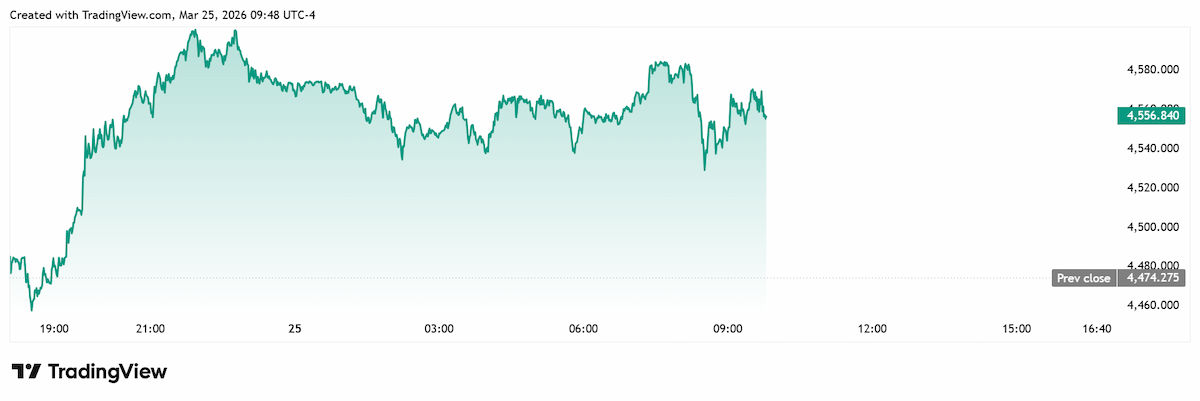
Spot gold last traded at $4,557.93 per ounce for a gain of 1.87% on the session.
