

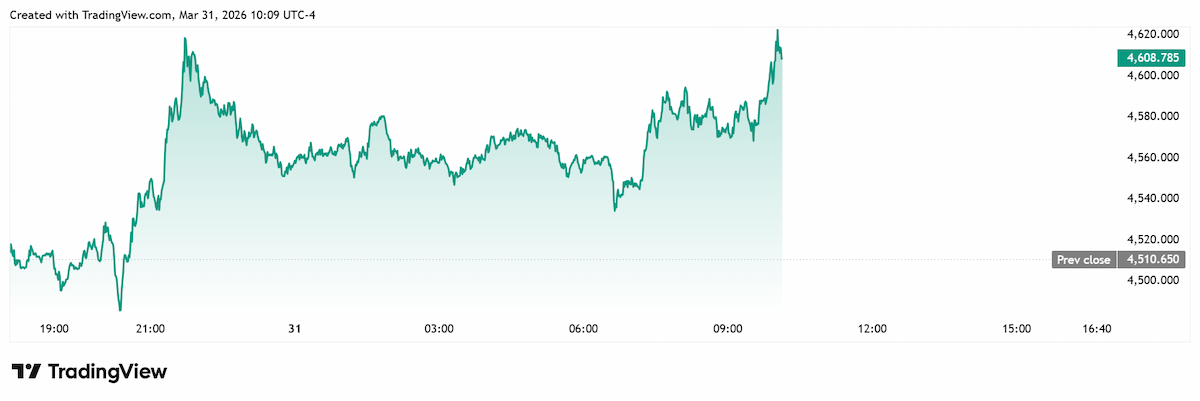
(Kitco News) - Gold prices spiked above $4,600 per ounce after the latest data showed U.S. consumer sentiment inching higher this month.
The Consumer Confidence Index ticked up to 91.8 in March, above economists’ consensus forecast for an 88 reading and also up from the downwardly revised 91.2 print from February, the Conference Board announced on Tuesday.
The Present Situation Index—based on consumers' assessment of current business and labor market conditions—increased by 4.6 points to 123.3,” the report noted. The Expectations Index—based on consumers' short-term outlook for income, business, and labor market conditions—declined by 1.7 points to 70.9. The survey period for preliminary results was March 1 to 24, 2026.
Gold prices made fresh highs following the 10 am EDT data release, with spot gold last trading at $4,610.49 per ounce at the time of writing for a gain of 2.21% on the daily chart.
"Consumer confidence ticked up again in March, as a modest improvement in consumers' views of current conditions outweighed a slight downshift in expectations for the future," said Dana M Peterson, Chief Economist at The Conference Board. "Three of five components of the Index firmed in March, and overall confidence improved modestly for a second month. Nonetheless, the Index has been on a general downward trend since 2021."
The report noted that “the weight of rising costs due to tariff passthrough and spiking oil prices was evident among other measures in the survey like inflation expectations.”
“Among demographic groups, confidence on a six-month moving average basis continued to moderate in March for consumers under age 35 and 55 and over, and virtually unchanged after a multi-month decline for those aged 35 to 54," the Conference Board said. "Respondents under 35 remain the most optimistic and those 55 and over the least. On a six-month moving average basis, Generation Z remained the most confident among all generations, but their optimism slipped in March along with the Silent Generation, Baby Boomers, and Generation X. Only Millennials cited improved confidence in the month.”
"Consumers' write-in responses on factors affecting the economy continued to skew towards pessimism,” Peterson added. “Comments about prices and the cost of goods suggest that the cost of living remained at the top of consumers' minds. As the war in Iran overlapped significantly with the survey sample period, comments about oil/gas and war/conflict spiked, while specific mentions of trade and tariffs decreased notably."
Amid the ongoing Iran war oil shock, consumers' average and median 12-month inflation expectations surged in March to levels last seen in August 2025, when U.S. consumers awaited more tariff announcements from the US federal government. “Consequently, the percentage of consumers stating that interest rates over the next 12 months will be higher on net skyrocketed from 34.9% to 42.4%,” the report said. “Expectations for higher stock prices a year from now plunged.”
