

(Kitco News) – The U.S. service sector declined beyond expectations last month amid growing concern over the eventual impact of higher energy prices through the supply chain, according to the latest data from the Institute for Supply Management (ISM).
The ISM announced on Monday morning that its Services Purchasing Managers Index came in at 54 in March, down from February’s reading of 56.1. The data was also worse than expected, as economists were looking for a reading of 55.
March’s 2.1 percentage point decline still resulted in the second-highest reading since2022, after the 55.5 print in October 2024. Readings above 50 in such diffusion indexes signify economic growth and vice versa. The farther an indicator is above or below 50, the greater or smaller the rate of change.
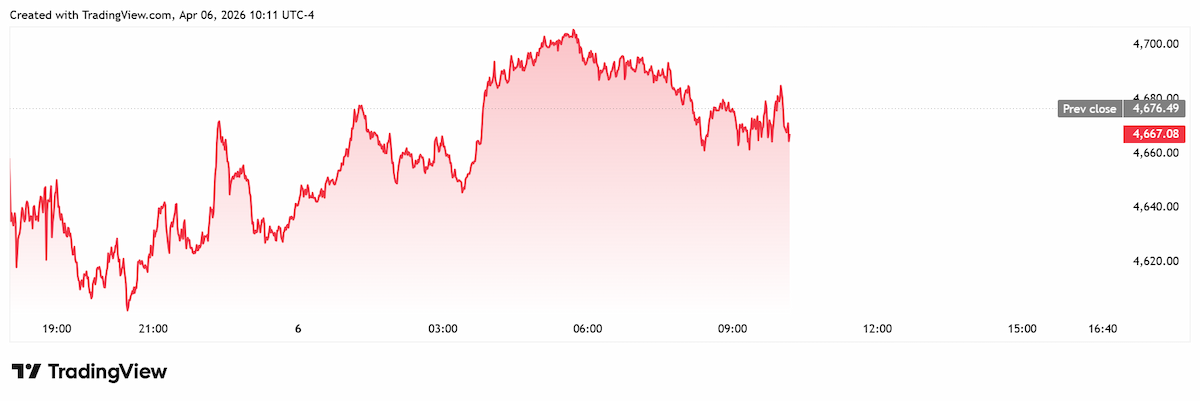
Gold prices continued to trade near the middle of their daily range following the 10 a.m. release. Spot gold last traded at $4,667.05 per ounce for a loss of 0.20% on the daily chart.
“March’s Services PMI features the third month in a row with an increase in the 12-month PMI average, up 0.6 percentage point from 51.7 percent in December 2025 to 52.3 percent,” said Steve Miller, Chair of the ISM Services Business Survey Committee. “However, six of the 10 subindexes decreased month-over-month. The Prices Index increased, as expected, amid higher oil and fuel costs, and the Supplier Deliveries Index indicated slower performance compared to February, also unsurprisingly with shipping issues and flight disruptions due to the Middle East conflict and winter weather.”
“Continuing strength in business activity, new orders and backlog of orders are positive economic signals, so the Employment Index dropping to its lowest level since December 2023 (43.5 percent) was a surprise,” he added.
Miller said the predominant commentary of purchasing managers in March related to “impacts and adjustments due to the conflict with Iran and the expected flow through of higher oil prices at some point.”
“Companies across many industries reported seeing higher gas and diesel pricing, and inventories of multiple goods increased to withstand supply chain disruptions or short-term oil price impacts,” he wrote. “Such construction products as lumber, copper and steel were noted as up in price. Although tariff impacts were still noted by panelists, Iran-related impacts dominated the comments in March.”
Jeffrey Roach, Chief Economist for LPL Financial, told Kitco News it was no surprise that the prices paid component spiked in March from the Iran oil shock, but they didn’t expect to see new orders hit their the highest level since February 2023.
"The mixed signals illustrate the uncertain time for most businesses," he said. "Like the post-pandemic reopening years, healthy supply chains will be key to the growth and inflation outlook for the balance of 2026. This report, which focuses on the services sectors, reveals an economy still spending on capex projects but potentially at a tipping point."
"A prolonged struggle over the Strait of Hormuz into May and June would markedly darken the outlook for the U.S. and the global economy," Roach added. "For now, given last Friday’s payroll numbers, Fed policy makers have the luxury of remaining in 'wait and see' mode."
