
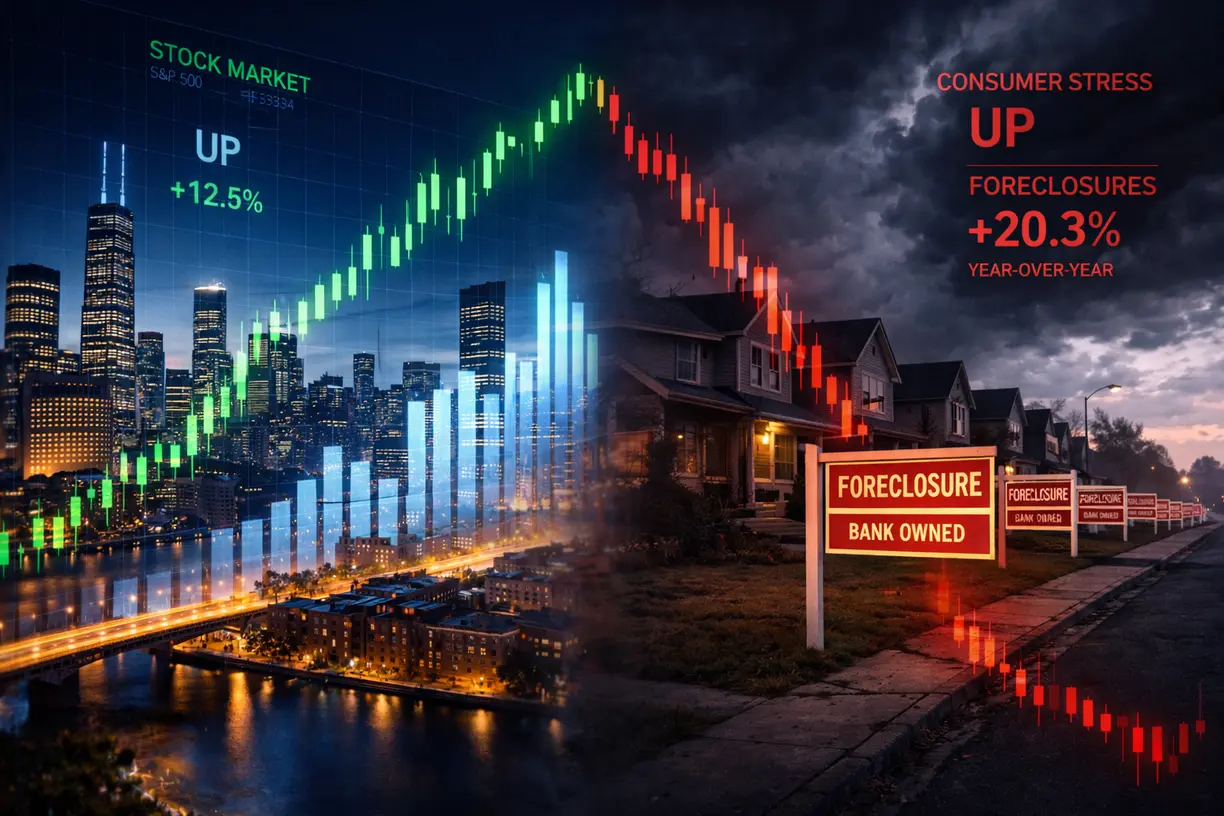
(Kitco News) - America continues to face a widening K-shaped economy, as equity markets remain relatively healthy but households are under increasing financial pressure. Now, new data points to a growing risk of foreclosure and bankruptcy in the months ahead.
According to LegalShield’s latest Consumer Stress Legal Index (CSLI), foreclosure-related legal requests surged sharply in the first quarter, rising 20.3% year-over-year and reaching their highest level since the onset of the pandemic.
The report said the spike reflects a shift from financial concern to concrete distress, as more households seek legal assistance to manage housing-related issues.
The broader index—which tracks more than 150,000 monthly legal consultations—remains elevated at 72.9, up 11.6% from a year ago, signaling persistent strain across multiple fronts of household finances.
In an interview with Kitco News, Matt Layton, senior vice president of Consumer Analytics for LegalShield, said the data gives little indication that conditions will improve in the near term.
“Nothing in our data is currently leading us to expect improvement going forward,” he said.
Layton said the surge in foreclosure activity appears to be driven in part by rising housing-related costs—particularly insurance. The report, quoting data from the Dallas Federal Reserve, said insurance premiums are up approximately 70% since 2019 and now account for 14% of the average monthly mortgage payment.
“Most people don’t even know when that happens,” said Layton. “They just see their March payment jump by $200 or $400—and if they were already struggling, that’s a non-negotiable increase.”
Not only does the index show growing financial stress among consumers, but Layton said there is also a rising risk that this will lead to slower economic activity through the summer.
Layton noted that the company’s foreclosure index is a leading indicator of actual filings, typically by 30 to 45 days.
“At the front end, people are just trying to figure out which bills to pay,” he said. “But as stress persists, they move deeper into that funnel—eventually reaching the point where they may not be able to make their house payment.”
Layton added that the same pattern is emerging in bankruptcy trends. LegalShield’s Bankruptcy Index has more than doubled since the Federal Reserve began raising interest rates in 2022 and continues to climb, suggesting filings will increase through mid-2026.
Layton explained that the bankruptcy index typically leads official filings by up to two quarters, reinforcing concerns about deteriorating household balance sheets.
Although current consumer financial stress levels remain below those seen during the 2008 financial crisis, the trajectory is worrying.
“We’re nowhere near those highs,” Layton said. “But we’re on an upward trajectory in that direction, and our data shows nothing that would suggest that changes.”
He emphasized that multiple indicators—consumer financial stress, foreclosure activity, and bankruptcy trends—are rising simultaneously, a combination that historically precedes broader economic downturns.
“I don’t know how much longer all of these can continue to rise together without triggering some type of recession,” he said.
Persistent inflation is compounding financial strain, particularly through everyday expenses like gasoline. In its Consumer Price Index report published Friday, the U.S. Bureau of Labor Statistics said its gasoline index jumped 21.2% last month and accounted for nearly three-quarters of the monthly all-items increase.
Layton pointed to a recent surge in gas prices as an example of how quickly external shocks can worsen consumer stress.
“Everyone’s got to fill up their car,” he said. “That’s money coming directly out of the same households that are already reporting higher stress.”
