
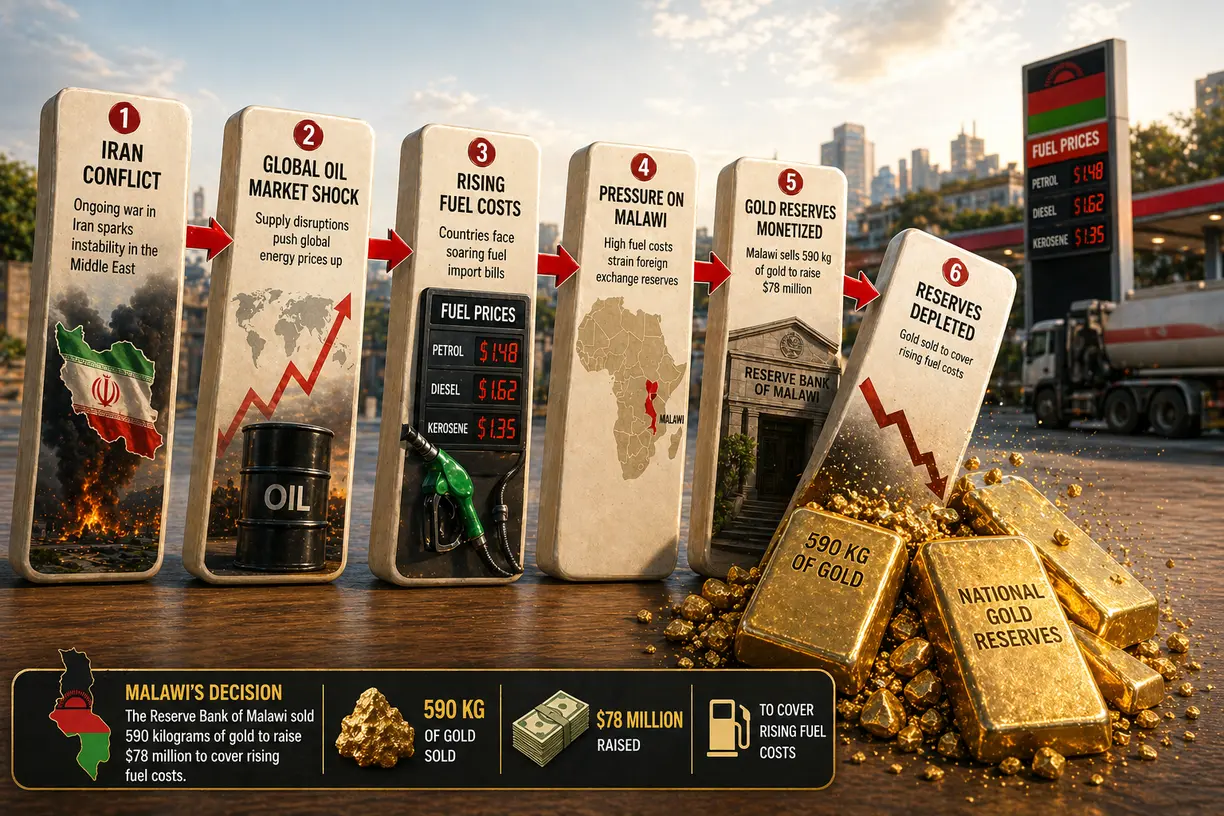
Malawi sells domestic gold reserves to cover rising fuel costs

Kitco Media
By Neils Christensen
Published
Updated
Kitco News
The Leading News Source in Precious Metals

Kitco NEWS has a diverse team of journalists reporting on the economy, stock markets, commodities, cryptocurrencies, mining and metals with accuracy and objectivity. Our goal is to help people make informed market decisions through in-depth reporting, daily market roundups, interviews with prominent industry figures, comprehensive coverage (often exclusive) of important industry events and analyses of market-affecting developments.

Malawi sells domestic gold reserves to cover rising fuel costs teaser image

(Kitco News) - The ongoing war in Iran and the resulting global energy crisis continues to force central banks to monetize their gold reserves.

On Friday, the Reserve Bank of Malawi said that it sold 590 kilograms of gold, more than half a tonne, to raise $78 million to cover rising fuel costs.

In an interview with Reuters, central bank spokesperson Boston Maliketi Banda said that the gold it sold was from local artisanal miners.

“Our pure gold in our international reserves remains not for sale and is in the safe custody of New York Federal Reserve Bank,” Banda said.

According to official reserves, the southeastern Africa nation holds $61 million in gold.

Banda said that it still has 69 kg of artisanal gold it can use to cover fuel costs.

The central bank said it was in talks with Afreximbank for a $120 million loan to help the country buy fuel.

While Malawi has sold most of its domestic gold, the central bank said that it will continue buying the precious metal from small-scale miners to rebuild its stock.

African nations have been taking a more active role in their domestic gold production. Recently Uganda and Kenya, have launched their own domestic gold purchase programs to build foreign reserves.

Although central bank gold sales have been a headwind for gold in recent weeks, adding the selling pressure from speculative traders, analysts have said that the monetization of global reserves is proving a solid use-case scenario for gold as an important monetary asset.

Analysts expect that when the inflation and fuel supply crisis has ended, central banks will continue to increase their official gold reserves.

Kitco Media

Neils Christensen

Neils Christensen has a diploma in journalism from Lethbridge College and has more than a decade of reporting experience working for news organizations throughout Canada. His experiences include covering territorial and federal politics in Nunavut, Canada. He has worked exclusively within the financial sector since 2007, when he started with the Canadian Economic Press. Neils can be contacted at: 1 866 925 4826 ext. 1526 nchristensen at kitco.com @KitcoNewsNOW

Mdi Earth Logo

Share

Disclaimer: The views expressed in this article are those of the author and may not reflect those of Kitco Metals Inc. The author has made every effort to ensure accuracy of information provided; however, neither Kitco Metals Inc. nor the author can guarantee such accuracy. This article is strictly for informational purposes only. It is not a solicitation to make any exchange in commodities, securities or other financial instruments. Kitco Metals Inc. and the author of this article do not accept culpability for losses and/ or damages arising from the use of this publication.