
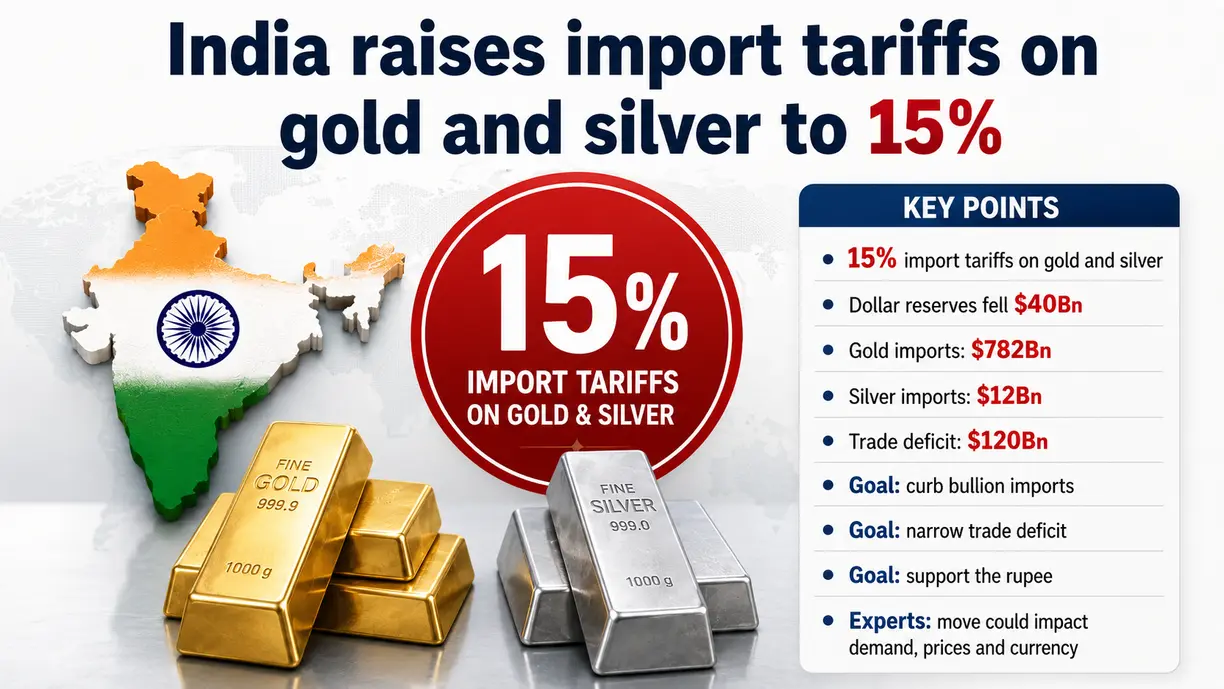
(Kitco News) – The government of India announced this week that they have reversed earlier duty cuts by raising import tariffs on gold and silver in the world’s second-largest precious metals market to 15% as of today – a move that could have a significant impact on precious metals prices and global demand, according to experts and industry insiders.
The Modi government announced the move was aimed at curbing bullion imports, narrowing the trade deficit and supporting the Rupee amid external pressures.
“India's central bank dollar reserves fell $40Bn in the first month after the start of the Gulf war; India's gold imports were $782Bn in fiscal 2026 and silver imports were 12Bn while the trade deficit was $120Bn,” noted Rhona O’Connell, Head of Market Analysis for EMEA and Asia at StoneX. “It is well known that India is one of the key consuming nations when it comes to gold jewelry and bar and coin.”
O’Connnell noted that between 2010 and 2025, Indian demand in these categories combined averaged 795 tonnes per year, though the run to all-time high prices in the early part of last year kept a lid on demand. “That led blew off in the wake of a successful monsoon and harvest, and buying took off,” she said. “For context, gold mine production is ~3,700tpa.”
“The Indian overall trade balance is of concern to Prime Minister Modi and on 10th May he asked the local populace to suspend gold purchases for at least a year, in an effort to conserve FX reserves,” O’Connell wrote. “Gold is the second largest Indian import bill, behind oil. Whether the locals follow his request remains to be seen, given the religious and cultural importance of gold to the population. One leading jeweler commented publicly immediately after Mr. Modi's request, saying ‘A temporary short-term slowdown may happen if the government decides to do something but we don't expect a man to get destroyed in India.’”
“Well the Government has done something, raising import duty to 15% from 6% and the national Secretary of the India Bullion and Jewelers Association postulates that demand could be hit by 10%.”
The new tariff regime is effective as of May 13, 2026, and it reverses the 2024 duty cuts.
"The basic customs duty on gold and silver imports has increased to 10% from 5%, with an additional 5% agriculture infrastructure and development Cess levy aimed at curbing bullion imports, narrowing the trade deficit and supporting the rupee in the face of external pressures," wrote Robert Savage, Global Head of Markets Strategy and Insights at BNY. "Customs duties on precious metal findings and recyclable waste were also revised, with gold and silver findings now at 5%, platinum at 5.4% and spent catalysts at 4.35%."
"The move comes in response to surging bullion imports and a weakening rupee."
Ross Norman, CEO at Metals Daily, characterized the move as “bullish and bearish at the same time.”
“We are now seeing second-order consequences of the Iran war manifest,” he wrote, adding that India “is particularly exposed to energy costs” from the Middle East.
“India is interesting because there are many layers to the motivations for owning gold: weddings, festivals, reliable savings, culture and fashion, and conspicuous displays of wealth,” Norman said. “At its core, however, gold is an asset of last resort — and Indians know that. So when the government takes an action like this — effectively burning the lifeboats to keep warm — you know there is a real problem. There is a whiff of a real panic about this ... and that makes it good and bad for gold simultaneously.”
Norman said that while this could result in a “dramatic reduction in purchases” from the number-two gold and silver consuming nation, “the move also signals that conditions are so severe the Prime Minister felt compelled to ask people not to buy gold one day and impose punitive taxes the next — and in doing so reinforces the fundamental reason for owning gold.”
Norman said that in his view, “closing the door on gold is unlikely to be fully effective — it will be smuggled in through the window.”
“How do we read this? Probably mildly bearish in the short term but well supported by buyers beneath the market; longer term, this reinforces the argument for owning gold — and in our view, that is the only way it should be played.”
