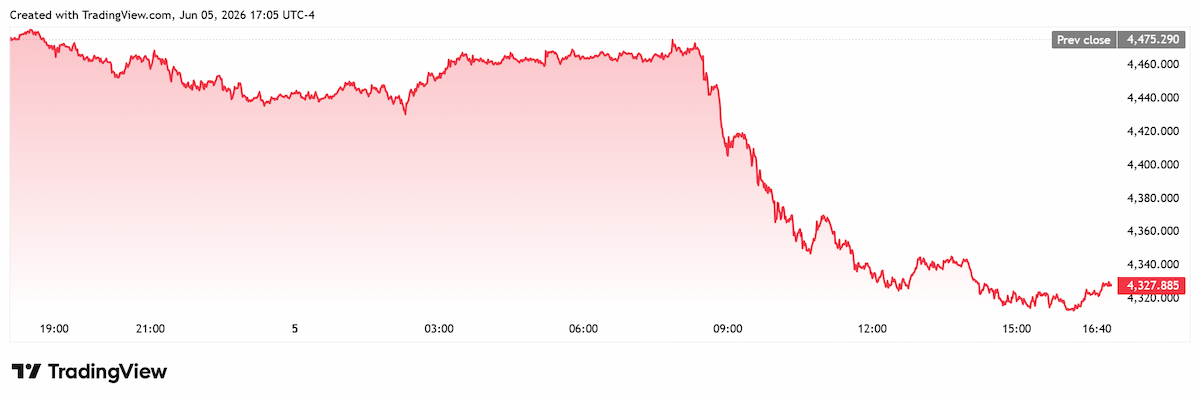

(Kitco News) – Gold prices saw another volatile week as persistent Middle East uncertainty offered only limited safe-haven support, while stronger U.S. labor data, rising Treasury yields, and renewed Fed rate-hike concerns drove the yellow metal sharply lower on Friday.
Spot gold kicked off the week trading at $4,539.42 per ounce on Sunday evening, and the yellow metal briefly pushed higher as traders reacted to fresh uncertainty around Iran and the Strait of Hormuz. But the rally quickly stalled after reports that Tehran was stepping back from talks, sending oil prices, Treasury yields, and the U.S. dollar higher, with gold ultimately setting its weekly high of $4,545.55 per ounce on Monday before sellers took control.
Gold prices attempted to stabilize Tuesday, helped by cautious optimism around a partial Israel-Hezbollah ceasefire, but the recovery faded below $4,550 after April JOLTS data showed job openings jumping to 7.6 million, reinforcing expectations that the Fed would have little reason to ease policy. The pressure continued Wednesday as ADP pointed to steady labor-market conditions, pushing policy-sensitive yields higher and keeping gold on the defensive.
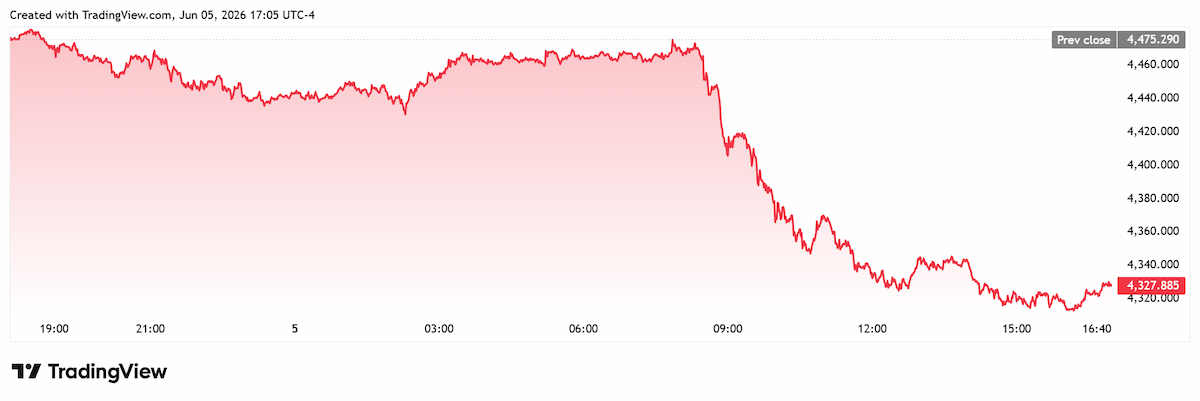
The metal found some relief Thursday as Treasury yields and the dollar eased on renewed hopes for a broader regional de-escalation and progress toward reopening the Strait of Hormuz. But Friday’s stronger-than-expected May jobs report reversed the move, with U.S. payrolls rising by 172,000 and rate-hike fears returning in force. Gold broke decisively lower in the wake of the payrolls data, and set its weekly low at $4,311.93 per ounce on Friday afternoon as the selloff accelerated, with the yellow metal seeing only a slight bump off the low heading into the close.
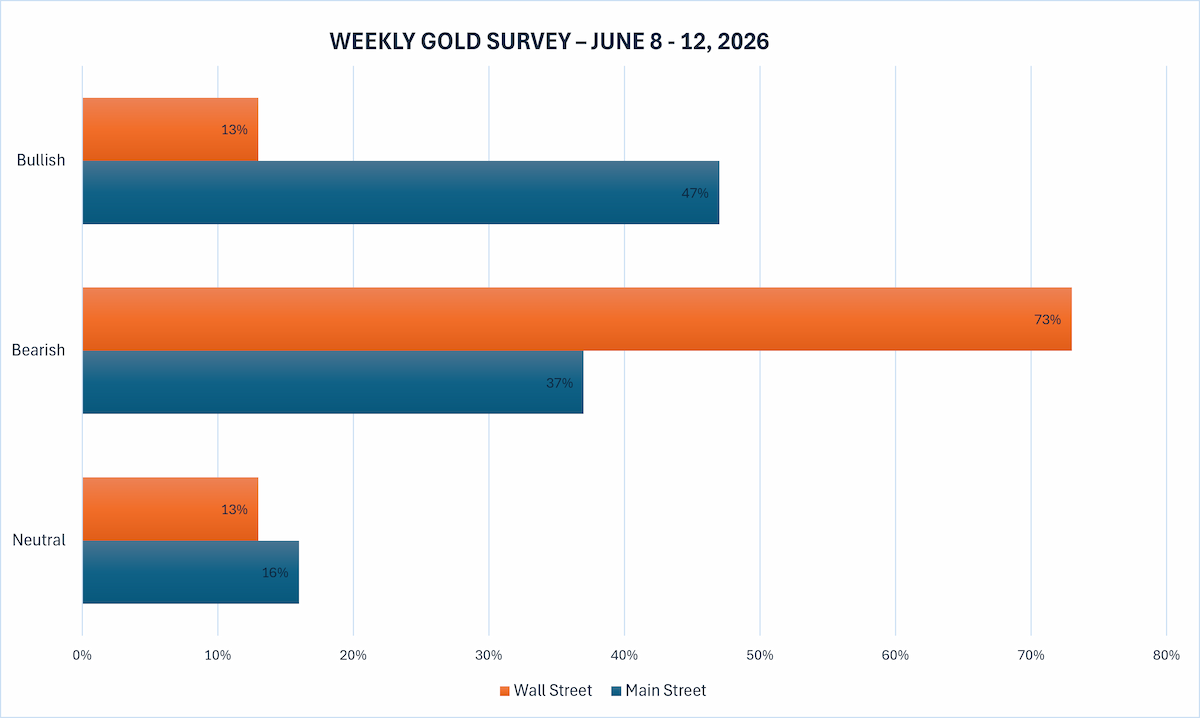
The latest Kitco News Weekly Gold Survey showed Wall Street overwhelmingly bearish on gold’s near-term prospects, while Main Street grew more pessimistic after gold’s week of weakness.
“Gold looks heavy and the stronger-than-expected US jobs growth and the backing up in yields pushed the yellow metal back below the 200-day moving average (~$4428),” noted Marc Chandler, managing director at Bannockburn Global Forex. “It has not settled below it since Nov 2023. May’s low near $4367 is the next obvious technical level of interest.”
“Unchanged,” said Adrian Day, president of Adrian Day Asset Management. “Gold will stay in a trading range until the Iran hostilities end. The conflict boosts the dollar and, by causing the oil price to be high, raises concerns about higher interest rates, both bad for gold.”
“Up,” said Rich Checkan, president and COO of Asset Strategies International. “The sell-off in gold is overdone. The real return on investment for holding term deposits at a bank is negative… with interest rates at 3.5% and inflation at 3.8%... and climbing. We are a long way away from the ‘higher’ interest rates necessary to make owning gold less attractive.”
Eugenia Mykuliak, Founder & Executive Director of B2PRIME Group, said gold prices are at one of their most interesting points over the past year.
“This is the second time the price has tested the 200-day average, and I think it can be the level that often determines the long-term trend,” she said. “However, at first glance, the background can look alarming. The thing is, in May, global gold ETFs lost about $2 billion, and investors continue to take profits and partially withdraw into US bonds.”
There is a nuance to the picture, however. “As long as speculative capital is coming out of gold, central banks continue to buy it,” Mykuliak noted. “In April, the world's central banks returned to net purchases, adding 17 tons to reserves after the March pause. Moreover, gold continues to strengthen its position as a reserve asset and gradually takes away the share of US government bonds in international reserves (especially against investors’ turn to ultra-short bonds).”
Mykuliak said she doesn’t believe gold’s current weakness as the beginning of a bear market. “Instead, I would say that we are witnessing a so-called clash: short-term sales by investors vs. long-term strategic demand from states,” she said. “So, if the 200-day average level holds, gold may well receive an impulse for a new wave of growth. Otherwise, the correction will be delayed, but I believe the fundamental history of gold remains strong, as in any case, it's an undeniable safe-haven.”
Kevin Grady, president of Phoenix Futures and Options, told Kitco News that reports of the economy’s death have been greatly exaggerated, and gold has further to fall before it bounces.
“The numbers are good, and the revisions were up,” Grady said. “Everybody keeps throwing bad stuff at this, ‘Oh, this is gonna be bad, and that's gonna be bad, and the economy is not doing well.’
“It just doesn't appear to me to be the case, he said. “The economy looks like it's in better shape.”
Grady said there’s been a lot of speculation about the rate path, but Friday’s nonfarm payrolls report lowers the temperature on that talk. “Raising rates, lowering rates, Warsh, how is he going to deal with this? I don't think that's an issue for right now,” he said. “I think there's still some data out there that he has to look at.”
As for gold’s selloff in the wake of the payrolls report, Grady said it’s important not to overreact to the price action in either direction when the market is as thin as it is, but the fresh lows could bring an important segment of buyers back into the market.
“Gold stalled up there, and there were no fresh buyers coming in,” he said. “The volume has been anemic. Open interest is very low for gold right now. A lot of people just aren't buying. I think what's happening now is that gold is up at these levels, and now they're saying, ‘Who's the next buyer?’ The reason gold rallied [at the start of the multi-year rally] was because of the central bank buying. I think we have to look and see what that level is, where the central banks are going to come in and buy, because they weren't doing it up at those higher levels, and that's why the market's testing those lows.”
But after Friday morning’s definitive break through the 200-day moving average, Grady believes gold will likely return to test the March 23 low of $4,128 before things turn around.
“There's no reason we couldn't test that level,” he said. “But the lower volumes and lower open interest are a double-edged sword. Slowly, gold has been eroding a tremendous amount of open interest. And with the market higher up like that, the assumption would be that there's a lot of longs in the market. The active contract is August, and the August contract is 263,000 contracts, which is very low.”
Grady said the market is actually thin on both sides, and he doesn’t see any more conviction in Friday’s selloff than he has in the recent moves higher.
“I don't think that you're seeing a massive amount of longs,” Grady added. “I think you're seeing some speculative shorting here. The algos read the data and then they're pushing this thing lower, and I just don't think there's a lot of people right now that are stepping in their way. I don't think this is a mass liquidation. We'll see on Monday, but I don't think you're seeing a mass liquidation of gold.”
He said the larger truth is that people have backed away from the market since March. “The market was up there, and then it stalled,” he said. “Whether you're talking about the upside or downside in any market, when the market stalls like that, it's waiting for the next buyer to come in. Who's the next buyer? No one's coming in. Open interest is diminishing. A lot of the players are starting to back away.”
“I think it was inevitable for us to test these lows.”
This week, 15 analysts participated in the Kitco News Gold Survey, with Wall Street flipping from three-quarters bullish to three-quarters bearish after gold’s failure to maintain critical support. Only two experts, or 13%, expected to see gold prices gain ground during the week ahead, while 11 others, or 74% of the total, predicted a price decline. The remaining two analysts, representing 13%, expected consolidation during the week ahead.
Meanwhile, 49 votes were cast in Kitco’s online poll, with Main Street investors growing more pessimistic after gold’s latest slide. 23 retail traders, or 47%, looked for gold prices to rise next week, while another 18, or 37%, predicted the yellow metal would lose ground. The remaining eight investors, representing 16% of the total, expected gold prices to trend sideways in the coming week.
After a week focused squarely on employment, next week will feature several key inflation metrics that could help market participants firm up their increasingly hawkish interest rate expectations.
The economic calendar kicks off on Tuesday morning with the release of Existing Home Sales for May. On Wednesday, traders will be watching the U.S. Consumer Price Index, along with the Bank of Canada’s monetary policy decision, with markets priced in for a hold.
Then Thursday morning brings the ECB’s monetary policy decision, with traders seeing good odds of a hike this time, followed by the U.S. Producer Price Index and weekly jobless claims.
The week’s economic data wraps up Friday morning with the University of Michigan’s Preliminary Consumer Sentiment Survey for June.
John Weyer, director of the commercial hedge division at Walsh Trading, told Kitco News that the higher-than-expected payrolls data, combined with the upward revisions to prior months, constitute a positive trend for U.S. employment.
“The one concern on the job numbers, 55,000 were local government hires, he noted. “That's a pretty large number, and you would think that's one that won't be sustained. It's an interesting wrinkle, but with the revisions, all of a sudden, you're getting an upward trend here.”
“The one thing you might have a concern about, also pointed out by others, was the idea that those who sustained unemployment is growing, those who've been off work six months longer is continuing to grow. That'll give you some concern. But overall, anytime you get something better than expected, it's always good.”
Weyer said the reaction in the gold and silver market has more to do with the surprise than anything else, and he thinks Friday’s selloff was somewhat overdone.
“When you see gold down $130, if you've been around as long as I have, you think ‘Holy cow! Is the world ending?’ That being said, you can see this making sense,” he said. “There's an issue going on here with Iran and the Strait of Hormuz. But as long as we don't have active bombings or attacks, it is being dealt with, it's a known entity, as opposed to an unknown. Markets can handle good news, they can handle bad news, what they don't like is uncertainty. We got a little bit of certainty there with the current status [of the ceasefire]. Now if that changes, I would expect the metals to get a lot of this back. I won't say it's not a concern, but we've learned how to deal with it.”
“Now you're getting some positive sustained economic data,” he added. “It gives you a reason to say, ‘Hey, metals are not the safe haven play.’”
Weyer said that interest rate expectations adjusted swiftly in the wake of the payrolls report, and whatever easing bias remained in the market has dissipated.
“What I learned being in the trade business, is that I'll go where the people have money on the line,” he said. “Right now [Treasury futures] are down across the board, which means you're definitely not expecting any cuts anytime soon. You wonder how far out they'll go, or how close they'll come, where they say, ‘We have to consider raising rates is on the table.’ But definitely the idea that cut… It’s hard justifying any rate cut right now. I think it's just off the table for a while.”
As for the price action, Weyer views this as a near-term move, and he expects the market will get much of it back in short order.
“There's a whole lot of longs here, meaning people are buying gold because they were too late,” he said. “You're going to see it hold for a bit here, but you're really going to need, I think, more sustained data like we got today” for a sustained trend lower.
Alex Kuptsikevich, senior market analyst at FxPro, expects gold prices to decline once again next week.
“Gold has once again tested the 200-day moving average, from which the price rebounded last week and in March,” he wrote. “However, the increasingly frequent tests of this long-standing support level signal a further shift in global sentiment towards gold. Fundamentally, gold broke through in January and March, confirming a trend reversal, but we are now merely seeing a shift in strategy to ‘sell the growth.’”
“Technically, at the time of writing ($4,380), gold has slipped below the 200-day moving average and is testing last week’s lows and the March support zone, having returned to October’s peak,” Kuptsikevich noted. “We anticipate a further decline in price, with our next area of interest near $4,250, where the 50-week moving average lies. There could be another local shake-out there, comparable to what we have seen over the past two weeks.”
Michael Moor, founder of Moor Analytics, expects to see gold prices lose further ground next week.
“LOWER unless we take out lower timeframe formation mentioned below,” he wrote. “In a Higher time frame: I cautioned on 8/16/18 the break above $1,183.0 warned of renewed strength. We have seen $4,443.1. This is ON HOLD. We held exhaustion at 56192 with a 56268 high and rolled over $1,526.8. This is ON HOLD. On a medium timeframe basis: The trade below 52554 (+15 tics per/hour) projects this down $220 minimum, $740 (+) maximum—we attained $1,155.4. The trade back below 52036 (+13 per/hour) has brought in $1,103.6 of pressure. The trade back below 51606 (+13 per/hour) has brought in $1,060.6 of pressure. The trade below 48530 (+4 tics per/hour) has brought in $753.0 of pressure. These are ON HOLD. We held exhaustion at 40956 with a 41000 low and have rallied $817.7. The trade above 41814 has brought in $736.3 of strength. The trade above 43642 has brought in $553.5 of strength. These roll into (Q) and are OFF HOLD.”
“On a lower timeframe basis: We held exhaustion with a 49177 high and rolled over $554.2,” Moor said. “The break below 48185 projected this down $185 (+)—we attained $455.0. The trade below 47923 projected this down $205 (+)—we attained $428.8. The break below 47420 brought in $378.5 of pressure. On 5/15 we left a medium bearish reversal—we have come off $189.7 from 45532. Decent trade below 44780 (+5 tics per/hour) will warn of pressure, but will stop short of suggesting leaning against this as a short; but if we break below decently and back above decently, look for decent short covering.”
At the time of writing, spot gold last traded at $4,327.88 per ounce for a loss of 4.27% on the week and 3.29% on the day.