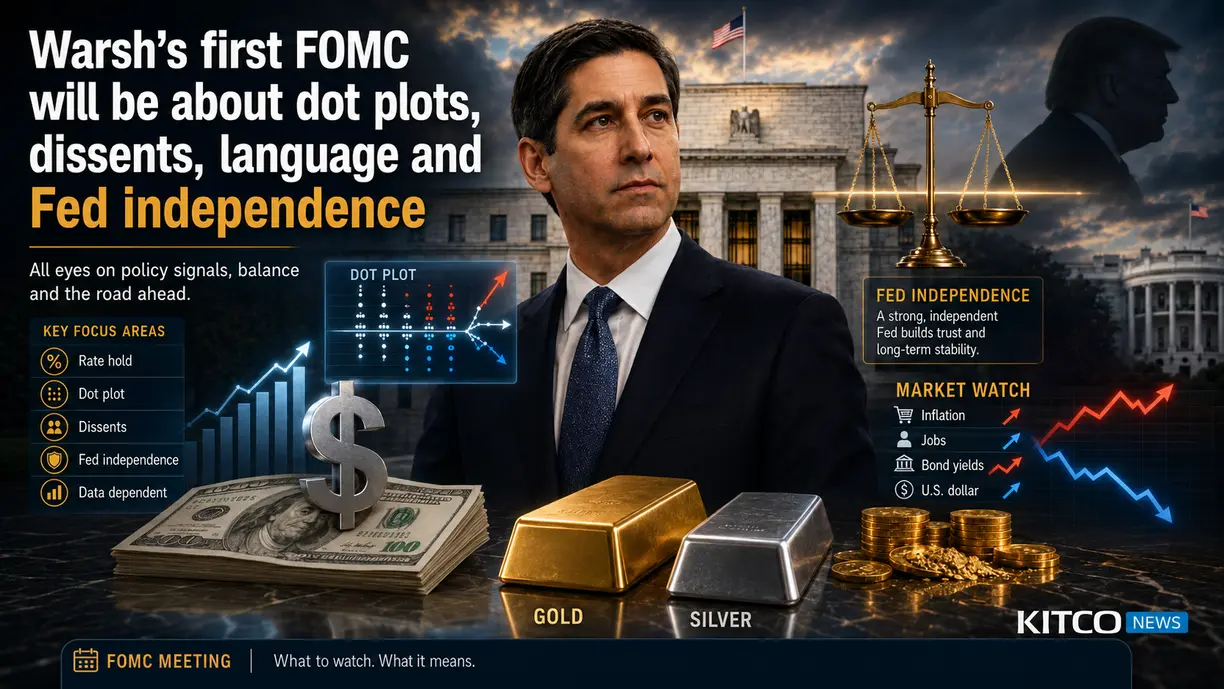
(Kitco News) – With less than 24 hours to go before new Fed chair Kevin Warsh delivers the first rate decision of his tenure, markets are fully priced in for a rate hold. But as traders digest the latest economic projections, experts will be carefully watching the new chair’s choice of words, his characterization of the U.S. economy, the job market and inflation pressures – along with any indication that the world's most powerful central bank has become less independent.
Kevin Grady, president of Phoenix Futures and Options, told Kitco News he doesn’t expect to see a major shift in tone from Powell to Warsh, and he expects the Fed will continue to let the data dictate monetary policy.
“He's going to go by the data,” Grady said. “At the beginning of the year, we had a lot of people talking about rate cuts. The last few weeks, all of a sudden, it's ‘Wait a minute, inflation's starting to tick up again, energy prices are higher. We may actually have a rate increase.’”
“That's why I don't really listen to those pundits. I think he's going to be critiquing the data and looking at it with a clear lens. I think he's going to have a clear picture of where the economy truly is, and I think he's going to act appropriately.”
Grady said he doesn’t expect the Warsh-led Fed to be any more favorable to the Trump administration than it was during Powell’s tenure.
“I think he's going to go with an even balance,” he said. “I don't think it has anything to do with Trump; I think he's going to be pragmatic about it. He's going to look at the situation, and he's going to say, ‘Don't come into this meeting with any preconceived notions. We're going to go in with an open mind. We're going to see where the numbers actually are. I don't want to hear about what people think they could be.’”
Grady said the doom-and-gloom scenarios predicted by many of the economic pundits have simply failed to materialize, and it’s hurt their credibility at this point.
“We've heard it for so long, with tariffs and all this other stuff,” he said. “There's a lot of people, unfortunately, that want to talk the economy down, and they've been doing it for a long time.”
Grady said fears about the Federal Reserve’s continued independence from political interference under Warsh are also exaggerated.
“I think there's going to be a lot of people that will say, whatever he does, ‘Oh, he's listening to Trump,’” he said. “You can't get away from it. But those are the same pundits that have been talking the economy down, and saying how there's no jobs and so on. But the data just doesn't bear that out.”
John Murillo, Chief Business Officer at B2BROKER, told Kitco News on Tuesday that tomorrow’s Fed meeting is about everything but the rate decision.
“The real catalyst will be the Fed's messaging and whether incumbent Chairman Kevin Warsh reinforces the idea that policy will remain restrictive well into 2027,” he said.
Murillo said that if the Fed delivers a hawkish surprise – either through its dot plot or its guidance – the first reaction will likely occur in the Treasury market.
“Higher expected real yields would push bond yields even higher, hurting risk-on sentiment, particularly when it comes to the front end of the curve,” he said. “Once proven true, higher yields will support the U.S. dollar, and a stronger dollar typically creates headwinds for gold. Investors should not be surprised to see a pullback if markets begin pricing out any remaining expectations of policy easing.”
Murillo cautioned, however, that it would be a mistake to confuse a Fed-driven correction with a reversal of the broader trend.
“Gold continues to benefit from several structural forces that monetary policy alone cannot undermine,” he said. “Central banks remain significant buyers as they diversify reserves, geopolitical tensions surrounding Iran continue to sustain demand for defensive assets, and persistent concerns over U.S. fiscal deficits encourage long-term allocation to hard assets.”
For this reason, Murillo said that any weakness in precious metals that follows a hawkish Fed meeting will likely attract buying rather than triggering a sustained bear market.
“In the near term, the sequence to watch is bonds, then the dollar, then gold,” he said. “Over the longer horizon, structural demand remains the dominant factor.”
Darin Newsom, senior market analyst at Barchart.com, told Kitco News that the Federal Reserve has a serious credibility problem, and it will persist long after tomorrow’s meeting.
“The whole thing was laid out when the U.S. President said he loves the inflation,” Newsom said. “It was a very simple statement, basically tipping their hand. The message here is that Warsh is not going to be allowed to raise rates anytime soon. The Fed Fund futures forward curve is saying the next rate hike is pushed back to December, which also makes sense. The next move will be a hike, but it will not occur before the November midterms.”
“It doesn't matter what everybody else feels, what everybody else is doing,” he added. “That's the situation we have right now going into [the Fed meeting].”
Newsom believes Warsh’s job is actually very simple, as he will not be called on to make any difficult decisions.
“There is no decision to be made; all of the decisions are going to be made in the White House,” Newsom said. “That's why Warsh got the job. He has one job, and that is to do whatever the President tells him.”
Regarding the rise in dissenting Fed votes and voices, Newsom acknowledged that Warsh represents only one vote on the FOMC and cannot dictate monetary policy on his own, but he believes Trump has plenty of loyalists on the committee.
“Yes, there's going to be dissent,” he said. “But the U.S. President has enough people on the FOMC that it will do whatever he says. Remember, that is what he campaigned on, is that he wanted final say – not any president, just him, to have final say on any interest rate decisions – and that's what he got. It doesn't matter what Warsh says. It doesn't matter if there's dissent. The decision will come from the U.S. President.”
The key for Trump, Newsom said, is not so much the move itself, but the timing of any move.
“He's not going to get the cut that he wants, so it's probably going to be a hold and no hike, but it’s not going to happen until possibly the end of 2026. We'll see what happens as we get deeper into the fall, what other things occur as far as inflation goes, because that is still the problem, and then maybe it gets pushed back to early 2027.”
As for the language and characterization of the U.S. economy from the new Fed chair, Newsom said he’s expecting to hear the same kinds of caution and concerns as from Warsh’s predecessor, but he thinks it will all be empty posturing.
“He will say all those things,” Newsom said. “He'll say, ‘Oh, yes, we're still independent.’ There's absolutely not one set of investors in the world who believe it anymore. There is no belief, there is no standing, and there's really nothing Warsh can say to change that. He will read from the script he's given: ‘We're independent, we're looking out for the economy, we're watching jobs, we're watching inflation.’ But none of it is real. None of it is true. And the rest of the world knows it.”
“Once Chairman Powell stepped down, the U.S. Fed lost all credibility,” he said. “And that's why central banks are still buying gold.”
Daniel Pavilonis, senior commodities broker at StoneX Group, told Kitco News he expects Warsh will try to rein in interest rates as much as possible through words rather than by resorting to policy changes at this stage.
“I don't think he's going to make any major moves, but he's going to try to condition the market for expectations of being more on the side of rate cuts, talking down [Treasuries], walking the 10-year and 2-year and the 30-year back from the brink.”
“Rather than cutting rates, maybe there's other tricks in the toolbox to push rates lower.”
Pavilonis said there’s merit in the positive and the negative views on the U.S. economy, and the new Fed chair will need to allow for both perspectives to prove true.
“As far as Warsh is concerned, I think it's just basically trying to condition the market for what he's there to do,” he said. “Being data dependent, you can look at the data in different ways: The glass is either half empty or half full. I think that's probably what's going on there.”
Pavilonis said the people worried about inflation shouldn’t discount the possibility that prices could come down quickly if the new Iran deal holds – and the dissent on the Fed could go with it.
“I think that if there is some kind of peace here, you'll see energies sell off even more, and a lot of oil come back onto the market very quickly – maybe over-correct oil further than what was expected,” he said. “All of this can happen pretty quick; When oil hit $147 per barrel, it was trading at $30 a barrel less than four weeks later, so that stuff can happen. If there is an actual deal here, and oil sells off, I think those inflation numbers are really going to reflect that.”
“If that's the case, then a lot of those dissenters might start to neutralize,” he said. “I think that's probably the bottom line there.”
As for the likely direction of the overall market, Pavilonis said he expects the Trump administration will pursue policies that favor equities until after the congressional elections in November.
“I still think they're going to run the markets hot into the midterms,” he said.
