
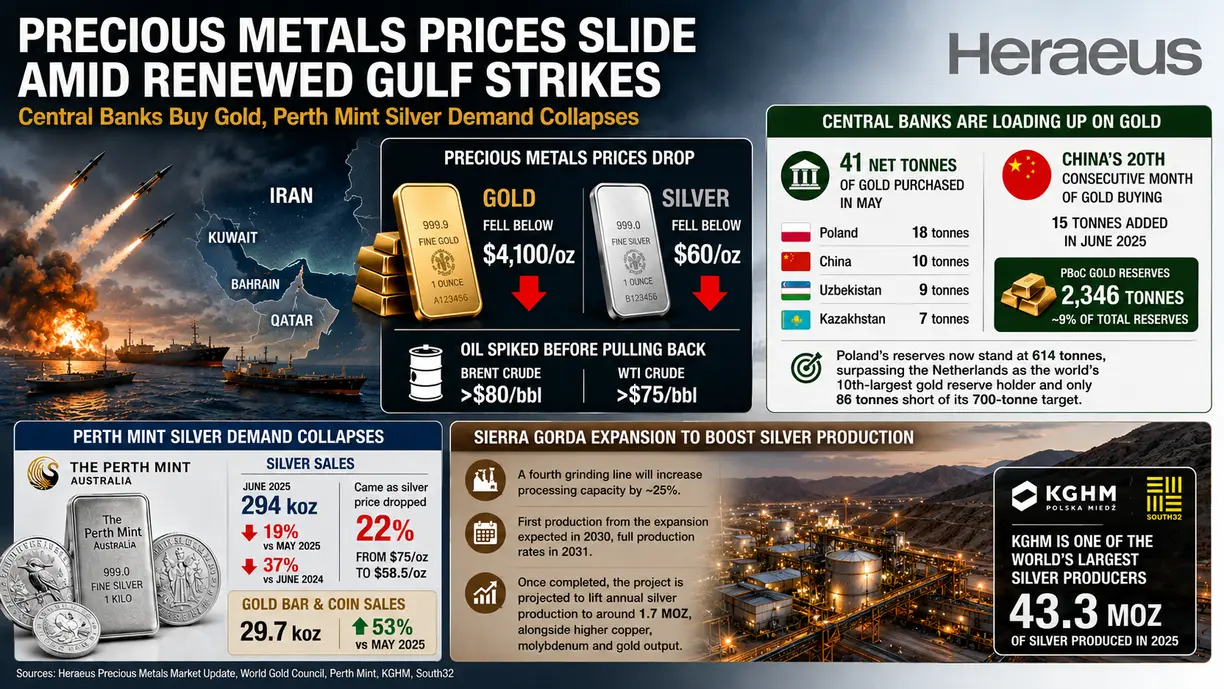
(Kitco News) – Gold and silver prices saw a sharp reversal of their recent fortunes after the latest round of conflict between Iran and the United States, and while central banks are using the opportunity to load up on gold, investors’ appetite for physical silver is evaporating, according to precious metals analysts at Heraeus.
In their latest update, the analysts noted that the latest exchanges of military strikes in the Gulf are putting significant strain on the ceasefire.
“Having signed a Memorandum of Understanding (MoU) on 17 June, Iran and the US held talks that had been progressing peacefully if not smoothly,” they wrote. “The occasional Truth Social post aside, the removal of sanctions on Iranian oil and the lifting of the blockade of the Strait of Hormuz showed that at least a working relationship existed between the sides. This relationship seems to have ended abruptly on 6 July when the Iranian Revolutionary Guard Corps fired missiles at commercial ships, prompting retaliatory strikes from the US. Iran followed with strikes on Bahrain, Kuwait and Qatar.”
The analysts noted that precious metal prices dropped across the board in the wake of these strikes. “The gold price fell back below $4,100/oz and silver below $60/oz,” they said. “Along with this, oil rallied with Brent Crude and the WTI topping $80/bbl and $75/bbl respectively on Wednesday, prompting a resurfacing of fears that the conflict could have an impact on price stability and, ultimately, monetary policy. Since then, oil prices have fallen slightly and precious metal prices have rebounded. This is a clear sign that the market expects this flare-up to be similar to others in which a couple of days of strikes and heightened rhetoric ultimately dissipate back into cautious and slow-moving negotiations.”
Heraeus also pointed out that central banks were strong buyers of bullion in May, purchasing 41 net tonnes of gold.
“The central banks of Poland and China led the way, purchasing 18 tonnes and 10 tonnes, respectively,” they noted. “The National Bank of Poland’s reserves now stand at 614 tonnes, meaning it has surpassed the Netherlands as the tenth-largest gold reserve holder in the world and is only 86 tonnes short of its 700-tonne target.
Uzbekistan and Kazakhstan also increased their reserves by 9 tonnes and 7 tonnes, respectively in May. “These purchases come mainly from domestic production allowed for by Kazakhstan and Uzbekistan’s priority rights to buy gold produced in their countries,” the analysts noted.
Meanwhile, China added to its gold reserves for the twentieth consecutive time last month. “The People’s Bank of China (PBoC) purchased 15 tonnes of gold in June,” they wrote. “This was the biggest monthly addition since October 2023 when it purchased nearly 22 tonnes. The PBoC now holds 2,346 tonnes of gold which makes up around 9% of the value of its total reserves.”
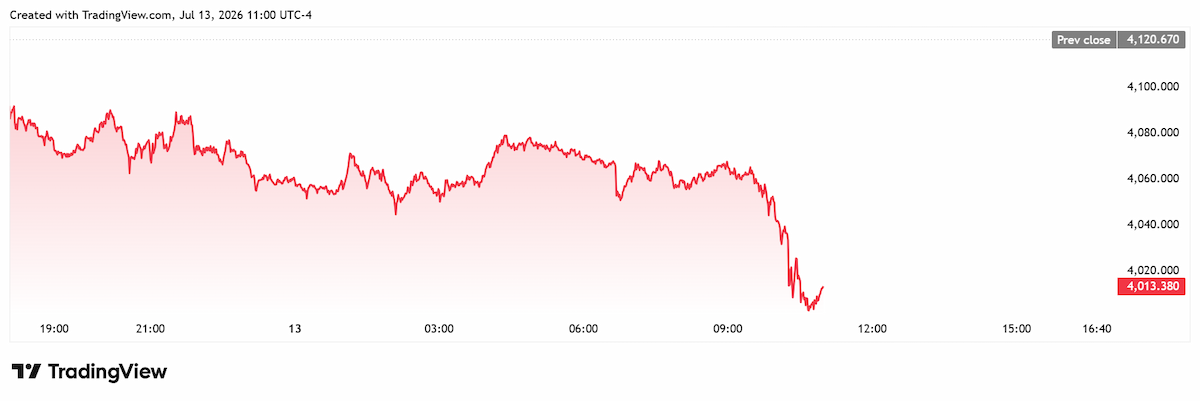
Spot gold slid down to test the $4,000 support level following the North American open, and it continues to trade close to its session low on Monday morning, last trading at $4,013.64 for a loss of 2.60% on the session.
Turning to silver, Heraeus analysts pointed out that demand for bars and coins from one of the world’s leading mints has collapsed during the ongoing price correction.
“The Perth Mint announced silver sales of 294 koz in June, down 19% from 364 koz in May which was itself the lowest monthly total since April 2012,” they wrote. “June’s sales also marked a 37% year-on-year reduction from the 464 koz of silver sold in June 2025. This came as the silver price dropped 22% in June from $75/oz to $58.5/oz. Gold bar and coin sales fared better though, with 29.7 koz sold, an increase of 53% from 19.4 koz in May.”
Sierra Gorda supports longer-term silver production growth. And the expansion of the Sierra Gorda joint venture, owned by KGHM and South32, will add a fourth grinding line to increase processing capacity by roughly 25%.
“The first production from the expansion is expected in 2030 and full production rates in 2031,” the analysts said. “Once completed, the project is projected to incrementally lift annual silver production to around 1.7 moz, alongside higher copper, molybdenum and gold output. KGHM is one of the world’s largest silver producers, with the Group producing 43.3 moz of silver in 2025.”
Silver prices are continuing to test their lows on Monday morning as they flirt with a 3% drop on the session.
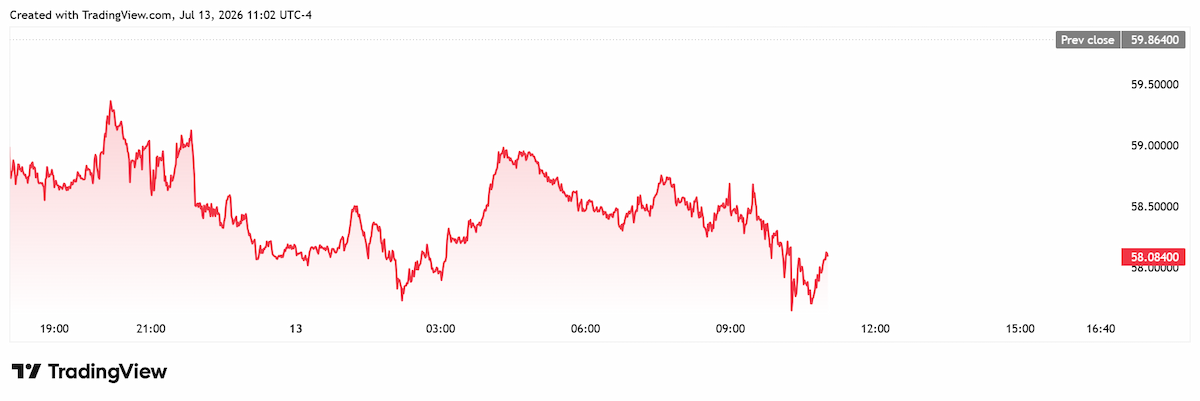
Spot silver last traded at $58.089 per ounce for a loss of 2.97% on the daily chart.
