
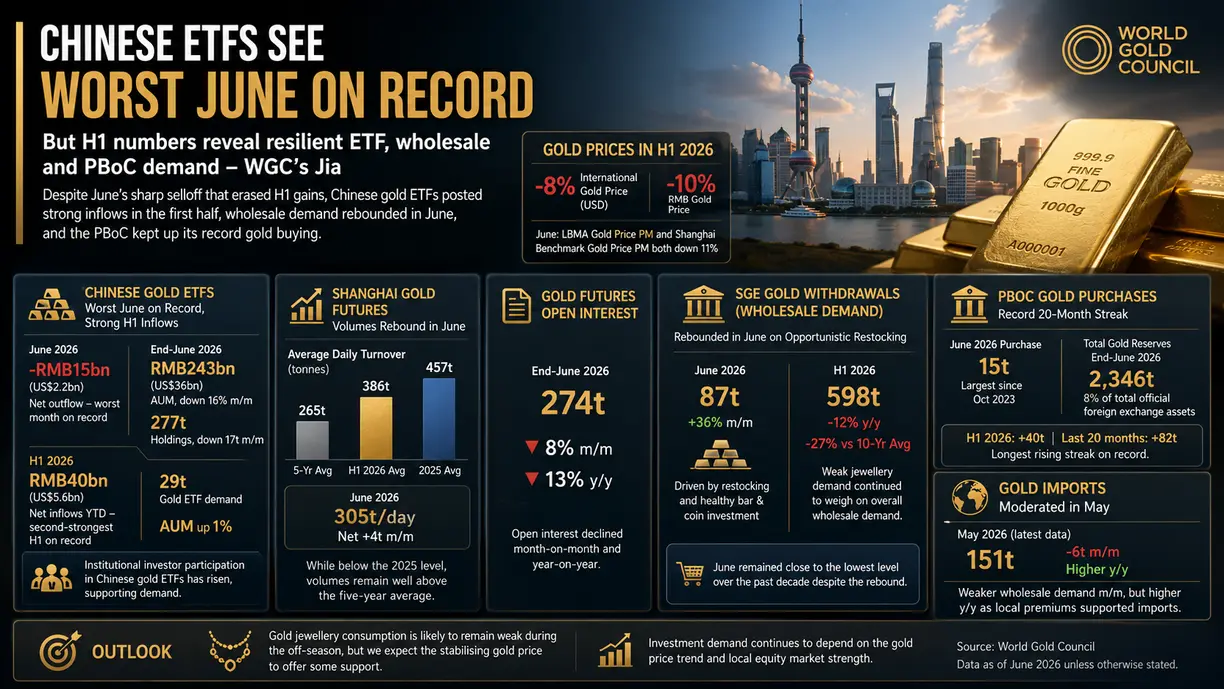
(Kitco News) – Gold’s weakness last month pushed prices into negative territory in H1, but Chinese gold ETFs still saw notable net inflows in the first six months, while wholesale demand rebounded on a monthly basis in June, according to Ray Jia, research head for China at the World Gold Council (WGC).
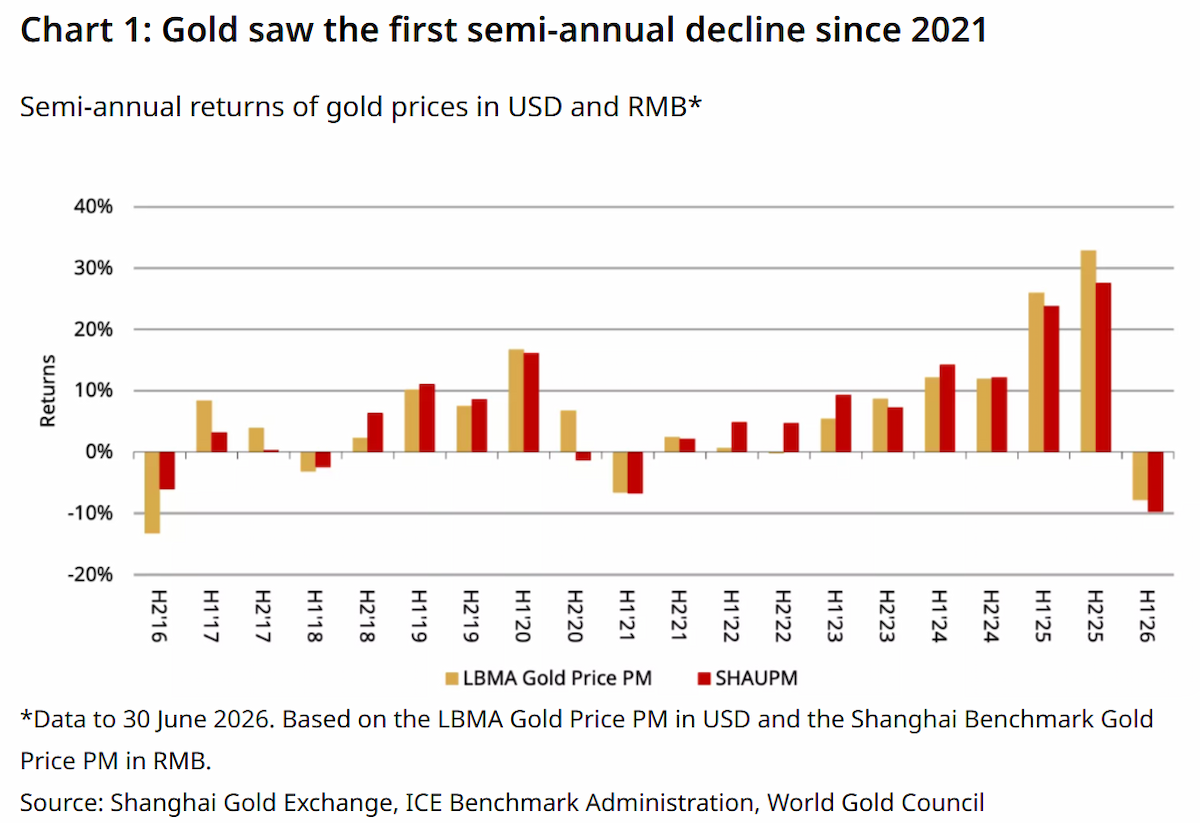
In the WGC’s latest China gold market update, Jia noted that June’s pronounced price weakness erased all of gold’s earlier gains and resulted in the yellow metal ending the first half of 2026 in the red.
“Messages from the new Fed Chair, Kevin Warsh, at the monetary policy meeting last month were seen as hawkish, pushing up real yields and the dollar,” he wrote. “This has led to investors reducing their gold ETF holdings and tilting their option positioning to bearish – rising opportunity costs and cooling momentum were the two major factors denting gold in June. Both the LBMA Gold Price PM and the Shanghai Benchmark Gold Price PM were down by 11%.”
June’s declines also reversed gold’s earlier gains, leading to overall losses in H1. “[G]old has had a roller-coaster ride over the first half year – various risks, changes in investor positioning and opportunity costs explain most of its variability,” Jia said. “The international gold price in USD was down 8% in H1 while the RMB gold price plummeted 10% – the strengthening Chinese currency against the dollar amplified local gold price weakness.”
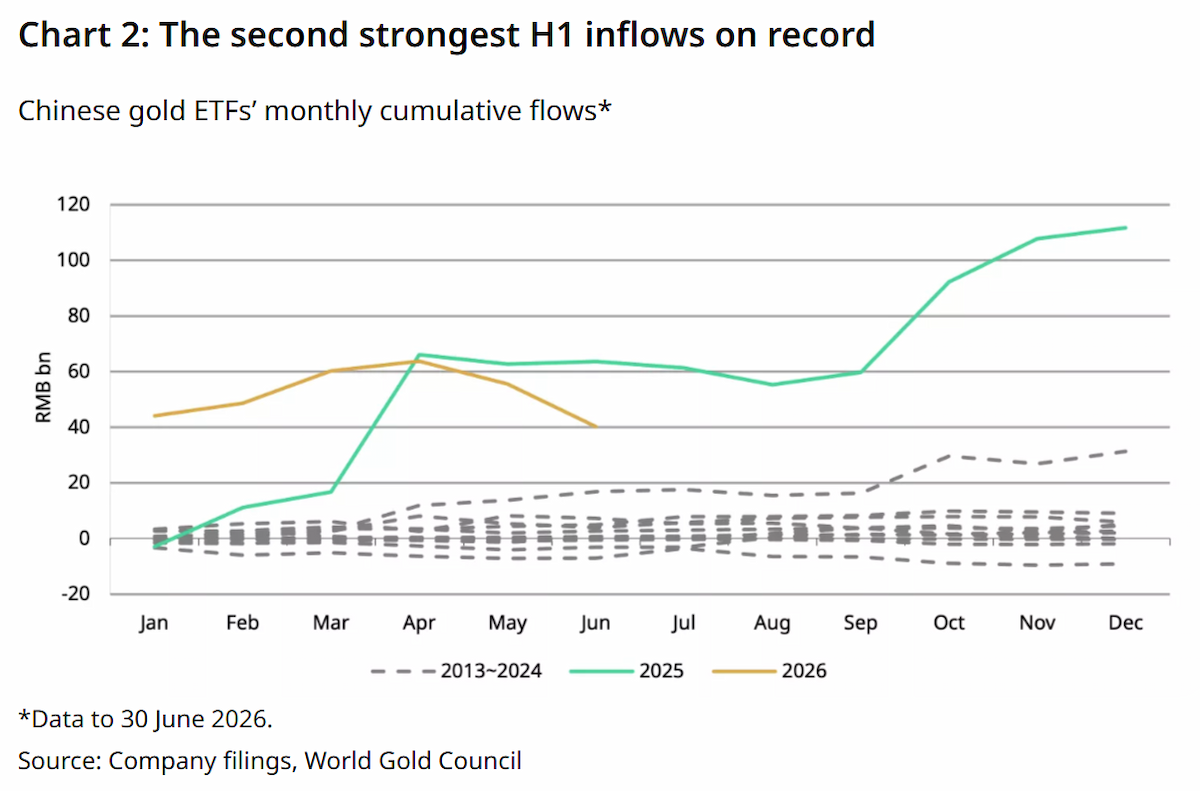
June was a historically bad month for ETF flows as well. “Chinese gold ETFs lost RMB15bn (US$2.2bn) in June, the worst month on record,” he wrote. “The sizable outflow and a falling gold price brought Chinese gold ETFs’ total AUM down 16% to RMB243bn (US$36bn), the lowest level since December 2025. Meanwhile, holdings decreased 17t to 277t. A weaker gold price dimmed local investor interest during the month while their enthusiasm towards equities – reflected in surging new account openings – further diverted attention away from gold.”
Last month’s weakness cut Chinese gold ETF inflows to RMB40bn, or US$5.6bn, year-to date, but the earlier strength meant this was still the second-strongest H1 on record. “In tonnage terms, H1 demand for gold ETFs in China totalled 29t, and their total AUM rose slightly by 1%,” Jia said. “Demand for gold ETFs stayed robust amid growing geopolitical and economic uncertainties, while the PBoC’s non-stop gold purchases continued to provide a supportive backdrop for sentiment. Institutional investor participation in Chinese gold ETFs has also risen, supporting demand for these products.”
Meanwhile, Shanghai futures trading volumes saw a slight rebound in June with a net 4-tonne increase to 305 tonnes per day. “While activities were below the 2025 level (457t per day), they remain well above the five-year average of 265t/day,” he noted. “Over the course of H1 Shanghai gold futures’ turnovers averaged 386t per day – the heightened price volatility as well as rising hedging needs from market participants provided some support, keeping overall volumes elevated.”
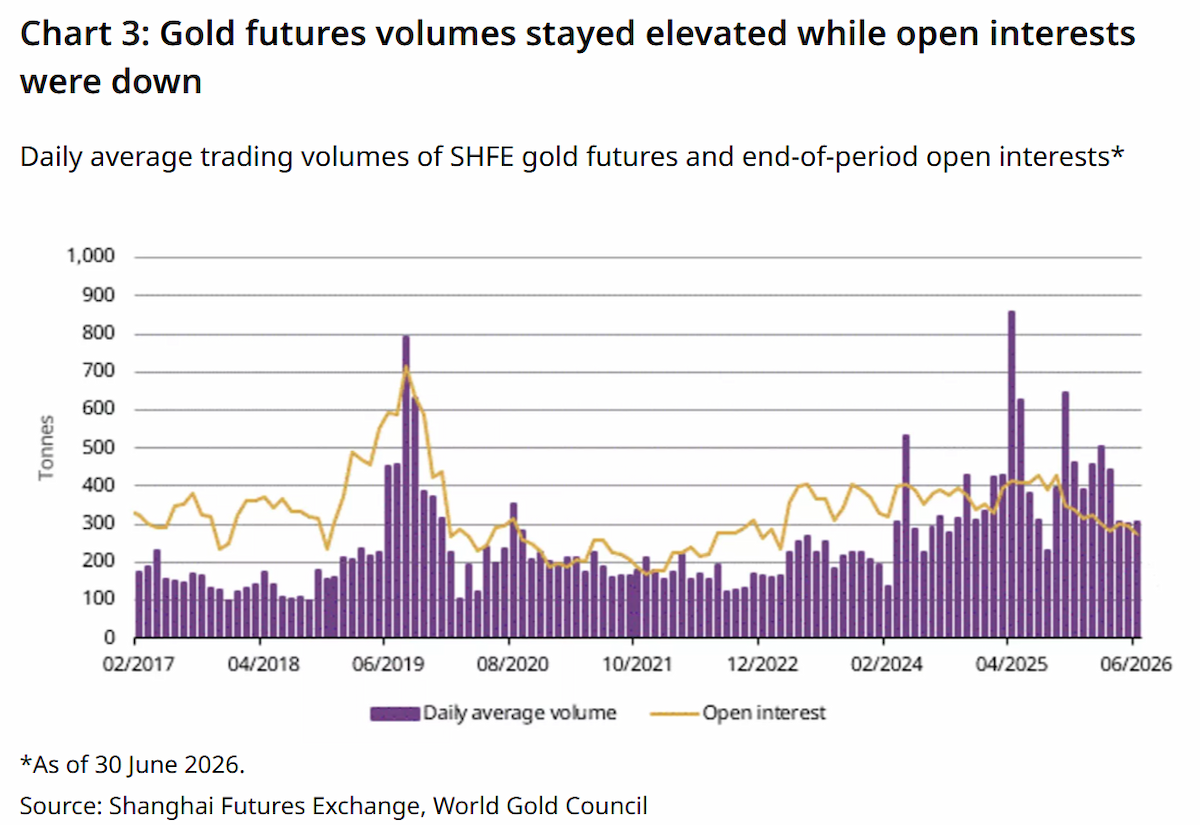
Open interest in gold futures reached 274 tonnes by the end of June, 8% lower than May’s level and 13% lower on the year.
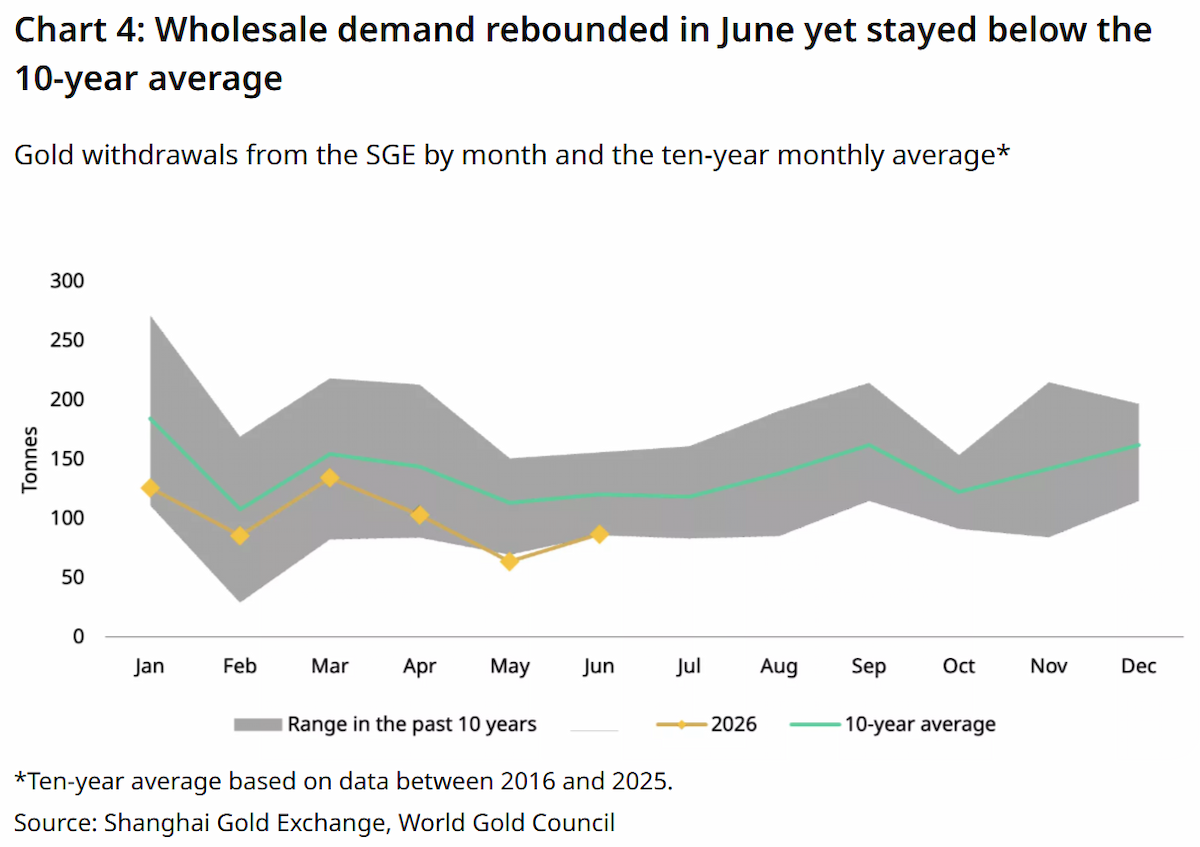
Wholesale demand, on the other hand, ended the first half on a high note. “Gold withdrawals from the SGE rebounded in June, rising 36% m/m to 87t,” Jia said. “The m/m recovery was mainly driven by opportunistic restocking across the supply chain as the gold price fell. Still-healthy bar and coin investment helped too, as retail investors bought on the dip.”
“A very low base – the weakest May in 16 years – also contributed to the m/m rebound,” he pointed out. “Nonetheless, wholesale demand in June remained close to the lowest level seen over the past decade amid ongoing weakness in the gold jewellery sector.
Wholesale demand was still weak in the first half overall, with market participants withdrawing 598 tonnes of gold from the SGE, 12% lower year-over year and 27% below the ten-year average. “As noted previously, while bullion demand remained robust, sustained weakness in jewellery consumption made manufacturers and retailers cautious about replenishing, weighing on overall wholesale gold demand,” Jia said.
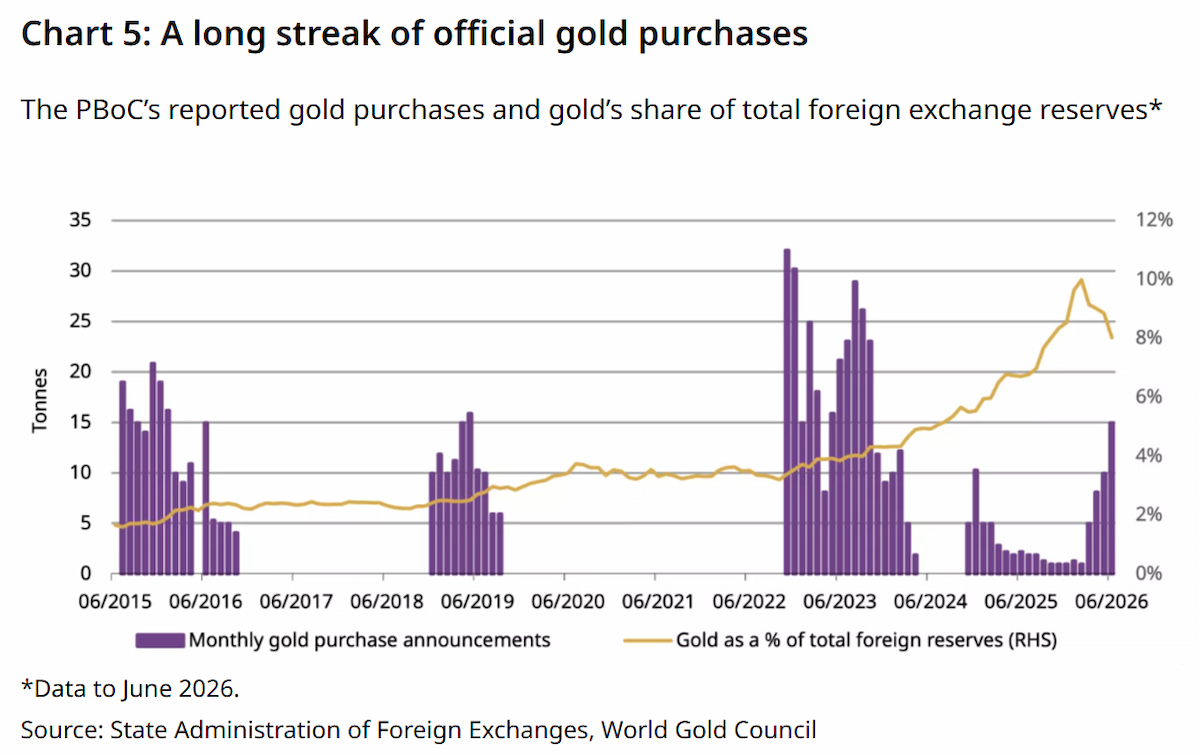
China’s central bank continued to build up its gold reserves amid the price weakness with a 15-tonne purchase in June, the largest since October 2023. “China’s official gold holdings have now increased for 20 months in a row, the longest rising streak on record,” Jia wrote. “June’s sizable addition pushed China’s gold reserves to 2,346t, 8% of total official foreign exchange assets.”
“Notably, purchases by the Chinese central bank went on throughout the first half despite the gold price volatility, accumulating a 40t increase in official gold holdings,” he noted. “Over the past 20 months the PBoC has announced total gold purchases of 82t. During this period global geopolitical tensions, trade orders and financial market volatilities have all heightened, highlighting gold’s strategic edge as a safe, credit risk-free and stable asset – proving that these attributes matter to global central banks.”
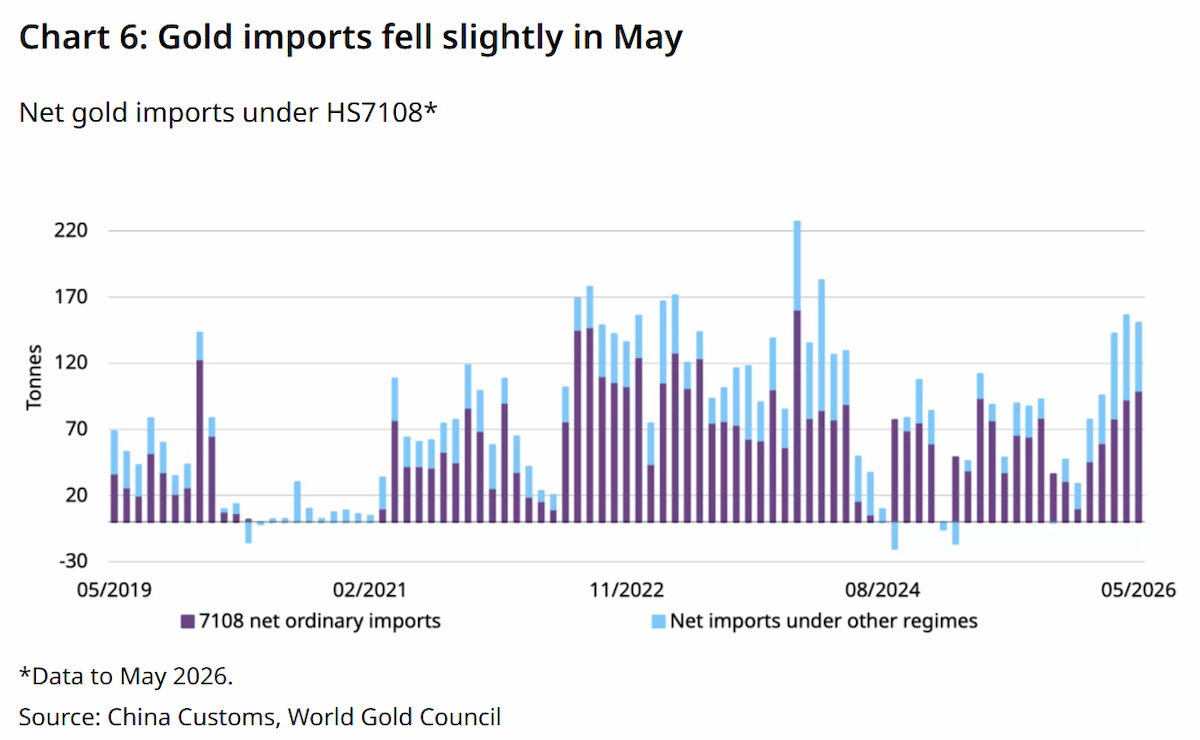
On the imports front, the World Gold Council saw Chinese inflows moderating in May. “China imported 151t of gold in May – latest data available, 6t lower m/m, reflecting weaker wholesale gold demand,” Jia said. “But the amount is notably higher y/y as positive local gold price premiums continued to support importer interest.”
Looking ahead, Jia said that the stabilizing gold price could help with local demand, but the performance of Chinese equities will also be a key factor.
“Gold jewellery consumption is likely to remain weak during the off-season but we expect the stabilising gold price to offer some support,” he said. “Meanwhile, investment demand continues to depend on the gold price trend and local equity market strength.”
