
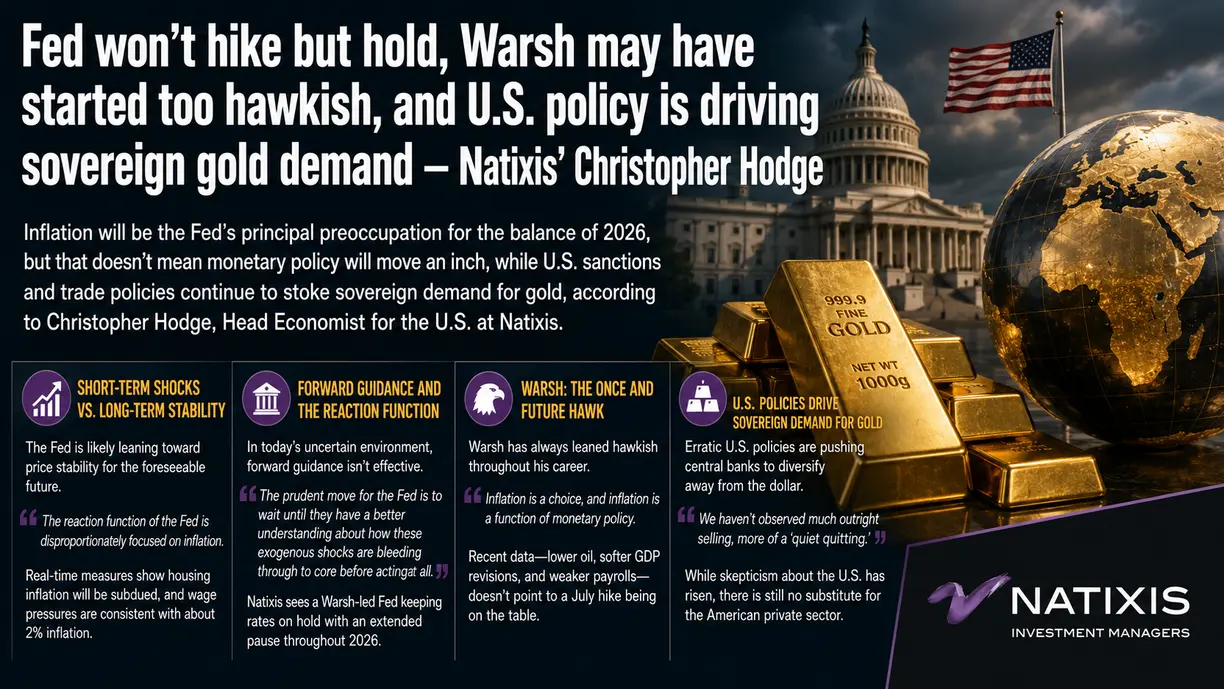
(Kitco News) – Inflation will be the Fed’s principal preoccupation for the balance of 2026, but that doesn’t mean monetary policy will move an inch, while U.S. sanctions and trade policies continue to stoke sovereign demand for gold, according to Christopher Hodge, Head Economist for the U.S. at Natixis.
In an interview with Kitco News, Hodge, who previously served as Principal Economist at the New York Fed and Deputy Director of Europe and Eurasia at the Treasury Department, shared his views on the likely trajectory for interest rates under the new-look Federal Reserve, the difficult position Chair Kevin Warsh has put himself in, and the role U.S. policy has played in pushing other central banks away from the dollar and into gold.
Short-term shocks vs. long-term stability
Hodge acknowledged that the Fed is likely leaning toward the price stability half of its dual mandate for the foreseeable future
“I think it's clear that the reaction function of the Fed, certainly in the near term, probably over the longer term as well, is disproportionately focused on inflation,” he said. “That makes sense; The Fed hasn't been at target inflation in over five years now, and the price pressure shocks that we've seen over the past two years, be it from tariffs or now from the energy shock, have moved prices in one direction, and that is up.”
“From the Fed's perspective, they have to disentangle what are the one-time/exogenous shocks that are not likely to stay persistent versus what is the underlying, domestically generated inflationary dynamic,” he added. “And the coefficient that you apply to those exogenous shocks is very uncertain. I think what's a little bit more certain is the underlying domestic inflationary dynamics. And from my perspective, they don't seem to be heating up.”
Hodge pointed out that housing represents about 35% of the weight in CPI. “Real-time measures indicate that that's going to be fairly subdued, and probably a little bit softer in the coming months,” he said. “Wage pressures, which account for a large percentage of the super core index – core services ex housing – there's a fairly high pass-through from wage pressures to the super core. Wages are running at about 3% to 3.5%. And that's at a level that's consistent with about 2% inflation.”
Hodge said Natixis sees the Warsh-led Federal Reserve keeping rates on hold as they watch for the impacts of the external price pressures to wane.
“I think that it's probably the prudent move for the Fed to wait until they have a better understanding about how these exogenous shocks are bleeding through to core before acting at all,” he said. “And that's why I have an extended pause in my forecast throughout 2026.”
Forward guidance and the reaction function
On the new Fed chair’s dislike of forward guidance and refusal to contribute to the dot plot, Hodge said Warsh has a point, especially in the current economic environment.
“Chair Warsh especially has been pretty parsimonious with any sort of forward guidance,” he acknowledged. “Forward guidance is an effective tool in some circumstances. It's certainly not an effective tool right now. Warsh seems to have an aversion to forward guidance.
at all times, but even if he didn't, even the policymakers that think forward guidance is an effective tool, don't think it's an effective tool now, because they're not certain about what's going to be coming down the road.”
Hodge said one of his worries is that Warsh may have pushed too hard on the hawkish front at the outset, and he may now have less margin of maneuver if and when inflation does tick higher.
“Was Warsh so hawkish in his first meeting, really underlining and putting in bold and italics and an exclamation point that the committee is committed to price stability, especially at the end of the official statement? Is he creating a credibility trap for himself?” he wondered. “If we do get higher than expected CPI for maybe the next two readings, is the Fed going to have to react to that because Warsh sort of painted them into the corner?
Hodge said he’s cautiously optimistic about upcoming CPI prints, but it remains a concern. “These prints are noisy on a month-to-month basis, so you should never derive too much from one print,” he said. “But with this perceived hawkishness, can he afford to not hike into increased inflationary pressures? That's an open question right now that I'm contemplating.”
Warsh: The once and future hawk
On the question of whether Warsh may be overcompensating due to concerns that he’s Trump’s pick and the president is adamantly in favor of rate cuts, Hodge said it’s a possibility, but pointed out that Warsh has always been hawkish on balance.
“I certainly didn't think he was going to come in and cut, partially for that reason,” he said. “I think it's a little from column A and a little from column B.”
“Warsh has been vocally dovish twice in his career,” Hodge explained. “The first time was when he was a finalist for Fed Chair in 2017. The second time was when he was a finalist for Fed Chair in 2025. So I do think there is a level of speaking to your audience right there. And President Trump in particular is very much concerned with the stock market. He says that he's a low-interest-rate kind of guy. We've all said things in job interviews that maybe we don't fully believe, but are trying to make the most of. I worked for a French bank. I once said Amelie was the best film ever made.”
“I don't think it's necessarily that he was being disingenuous, but I think most of the conversation focused on those longer-term implications from AI and why real interest rates can come down in the future,” he added. “I don't blame him for emphasizing that. But I do think that probably did create a little bit of tension among the people that are now his colleagues. He was pretty overtly critical of the Fed.”
Hodge said he sees Warsh’s recent statements more as a representation of who he’s always been than a strategy to demonstrate his independence from the president.
“I think coming in and being hawkish is more of a reversion to the mean about where he's been over his career,” he said. “He’s pretty consistently said – maybe not explicitly as he has recently – that inflation is a choice, and inflation is a function of monetary policy. He repeated those words at his confirmation hearing. He certainly echoed the sentiment at his first FOMC press conference.”
“I'm not saying that he's buffing,” he added. “I'm just saying, when I need to predict forward, well, since the June FOMC, we've had a better than anticipated core PCE reading, we've had oil prices come down, we've had a revision downward in core GDP, and we've had a payrolls print that was much weaker than expected. So there's not a whole lot that leads me to believe that a July hike would be on the table if the Fed didn't pull the trigger and hike in June.”
U.S. policies drive sovereign demand for gold
Turning to gold and its evolving role in the reserves of central banks around the world, Hodge said that while Russia’s full-scale invasion of Ukraine was the catalyst, countries have plenty of reasons to continue and accelerate their gold purchases in the ensuing years, and the United States has been the driver.
“The diversification away from the dollar was indeed prompted by events from 2022, but has also been exacerbated by erratic policymaking in the U.S. since,” he said. “The U.S. is a less predictable international partner, especially vis-a-vis trade, so it stands to reason that, to the extent possible, [central banks are] decreasing exposure to the dollar.”
“We haven’t observed much outright selling, more of a lack of reinvestment in dollar positions – so more of a ‘quiet quitting,’” Hodge added. “But while there may be more skepticism about the U.S. in terms of trade and the fiscal trajectory, there is still no substitute for the American private sector, which remains the most dynamic, flexible, and innovative in the world. This should underpin demand for dollars even if demand for official assets is marginally lighter.”
