
(Kitco News) – The decline of the U.S. dollar is a popular topic of conversation, especially in the wake of the BRICS summit in Kazan. But according to analysts at The Kobeissi Letter, the imminent death of the dollar has been overstated as it just hit its highest share of global payments in 12 years.
“There has been a ton of discussion about the US Dollar losing its dominance as a global currency,” The Kobeissi Letter wrote in a post on X. “However, the data so far continues to suggest otherwise.”
“The US Dollar's share of global payments hit 49%, the most in 12 years, according to SWIFT data,” they said in a follow-up post.
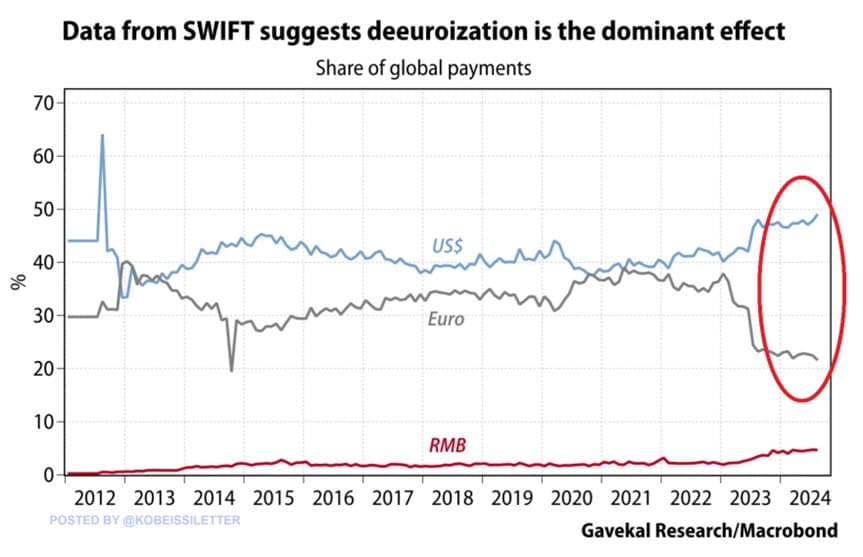
“Over the last two years, US Dollar usage in international payment transactions has jumped by 9 percentage points,” they added. “At the same time, the Euro's share plummeted from ~39% to ~21%, the lowest in a decade. Meanwhile, the Chinese Yuan usage increased from ~2% in 2023 to ~5% currently. What is happening to the Euro?”
“The US Dollar remains the most dominant global currency and it's not even close,” the analysts said. “Can BRICS really dethrone the US Dollar’s dominance?”
Many users were quick to point out that the data used is faulty in that it only tracks transactions on SWIFT, while Russia and its trading partners have been increasingly utilizing other avenues to conduct trade and money transfers.
“This is not a realistic reflection of what is happening with the dollar as it only shows what is happening within Swift, not what trade volumes have recently left Swift,” wrote X user Stay Curious. “Missing is all trade between Russia and India, China, Iran, etc, and the significant growth in direct currency swaps between governments.”
“While it’s true no other government wants the job of global reserve currency, especially China, BRICS will nevertheless likely see between 19.5% and 25.5% of global trade moving out of dollar/euro in the next 5 years, according to French Economist Jacques Sapir,” they added.
“This chart is only measuring SWIFT transactions,” another commentator reiterated. “It reflects a decreasing share of global trade, because anything involving Russia or bilateral BRICS trade is not included. The bigger question is: when will Europe get tired of being a tributary state to the US??”
Robert Avery highlighted, “The Eurozone largely uses the SEPA IBAN payment system, and none of those payments are registered in SWIFT.”
X user Assis added more nuance to the conversation and highlighted the benefit of decentralized cryptocurrencies like Bitcoin.
“The discussion around the U.S. dollar’s dominance is complex, especially as BRICS nations look for alternatives to reduce reliance on it,” he wrote. “While data shows the dollar remains strong, shifts in trade agreements and currency alliances may gradually challenge its dominance. It will be interesting to see how this unfolds over time and what role Bitcoin could play as a truly decentralized global currency.”
Another user highlighted a point that doesn’t get much attention in the BRICS de-dollarization conversation.
“The BRICS countries are struggling themselves,” they said. “Safety is key. Travel South America, and all they want is the dollar.”
Regarding the declining use of the Euro, Finance Insights said it “likely reflects economic stagnation in parts of Europe, political instability, and the complexities of managing a multi-nation currency—all while balancing economic ties with both the U.S. and China.”
Looking at the macro picture, Spencer Hakimian, founder of Tolou Capital Management, highlighted the declining state of all fiat currencies in an era of non-stop money printing by central banks.
“Euro is irrelevant. Yuan is irrelevant. Yen is irrelevant,” he tweeted. “The Dollar is the least dirty shirt in the hamper. The U.S. is very lucky that TINA to the Dollar.”
While the dollar remains the King of Fiat for now, it can’t be denied that its status is on shaky ground amid the increasingly dire state of the U.S. debt situation and rising Treasury yields.
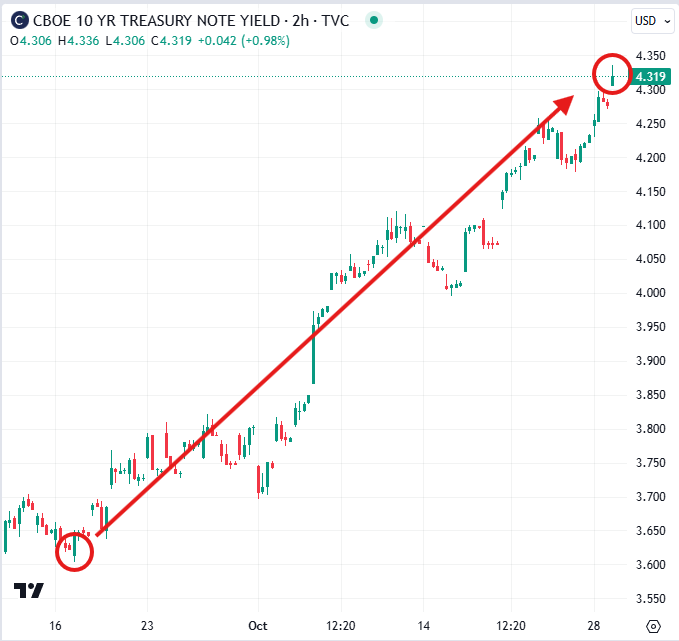
“10-year note yield after a Fed pivot: Now at its highest level since July 5th, up +70 basis points since the Fed rate cut,” The Kobeissi Letter highlighted. “Mortgage rates soaring back above 7.0%, expect new 30+ year lows in mortgage demand. How is this a ‘Fed pivot?’”
“US JUST POSTED THE 3RD LARGEST BUDGET DEFICIT IN ITS ENTIRE HISTORY,” replied Global Markets Investor. “The federal deficit hit a WHOPPING $1.83 trillion in Fiscal Year 2024 ended Sept. 30, or 6.4% of GDP. In other words, the government borrowed a staggering $5 billion A DAY.”
Perhaps that is why, in the background, gold has continued to hit record high after record high while Bitcoin is now eyeing a breakout into uncharted territory.
“Gold funds posted ~$3 billion of inflows last week, the second largest on record,” The Kobeissi Letter said. “This is more than TRIPLE the average amount seen over the last few weeks.”
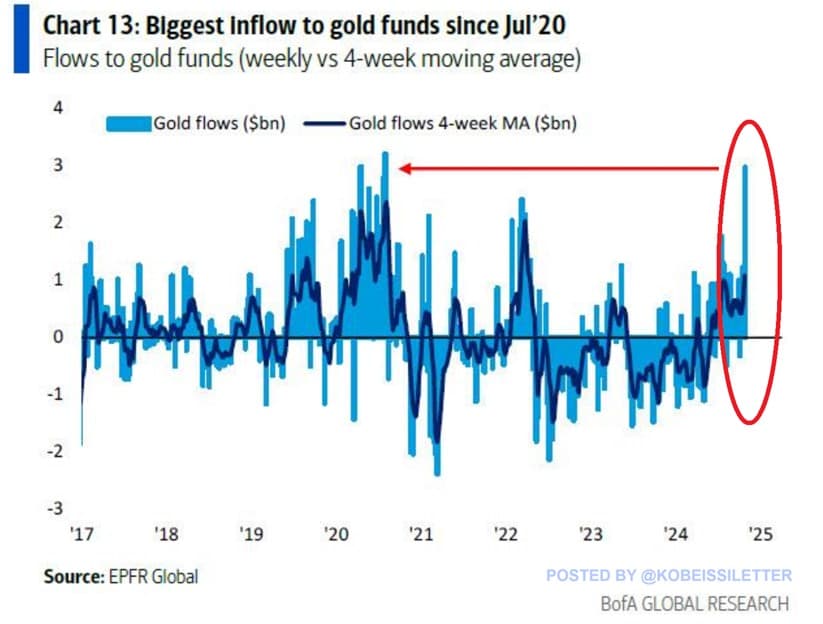
“Massive inflows fueled gold prices, which have rallied 33% year-to-date and are on track for their best year since 1979,” they added. “As a result, gold is currently trading with a new record high market cap of $18.4 trillion. All while central bank gold reserves as a % of the total currency reserves reached 12.1%, the most in over 3 decades. Everyone is piling into gold.”
“Bitcoin prices are skyrocketing: This year, Bitcoin is now up over 60% and on track to be one of the best-performing assets of 2024,” they noted. “Over the last 12 months alone, crypto markets have added $1.5 TRILLION of market cap.”
Stocks also show that traders are doing whatever they can to avoid holding dollars in the current environment.
“This is the most resilient stock market in history: The S&P 500 has been trading above its 200-day moving average for 247 straight sessions, the third-longest streak in 8 years,” analysts at The Kobeissi Letter said. “The previous 2 records were posted in 2016-2018 and 2020-2021 which lasted for 430 and 400 trading days, respectively.”
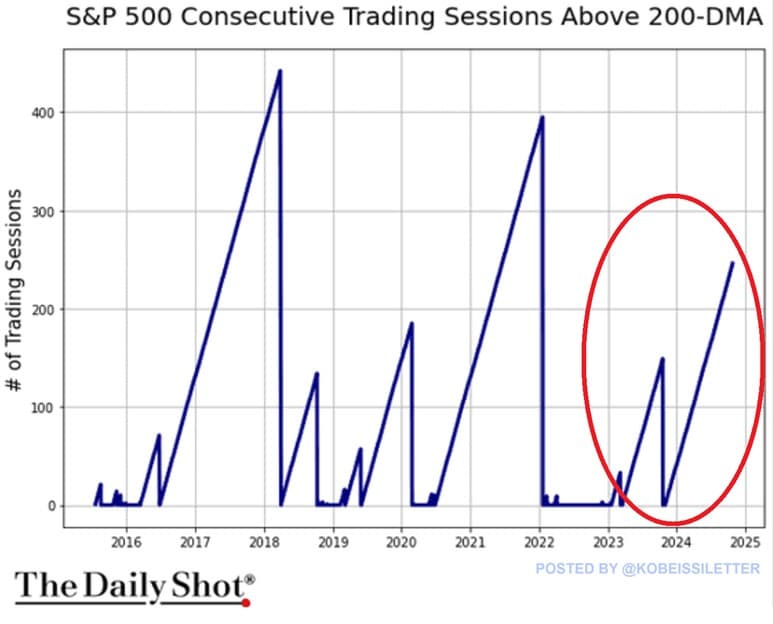
“Over the last 12 months, the S&P 500 is now up over 40%, marking the 4th best 12-month performance this century,” they added. “There have been only three other occurrences since 2000 when the index rallied at least 39% year-over-year: 2004, 2010, and 2021. To put this into perspective, the S&P 500's average annual return since 1957 has been ~10%. We are witnessing history.”
Another worrying sign is that the record highs in stocks are also accompanied by an increasing level of concentration, with the situation now approaching the state of the market during the Great Depression.
“The market is getting even more concentrated: The market cap of the largest US stock is now ~750 TIMES larger than the 75th percentile stock, near the most since 1932,” The Kobeissi Letter wrote.
“Over the last 8 years, this difference has TRIPLED,” they added. “Furthermore, the market is currently even more concentrated than it was during the 2000 Dot-com bubble. The largest US stock in 2000 peaked at ~6000 TIMES larger than the 75th percentile stock.”
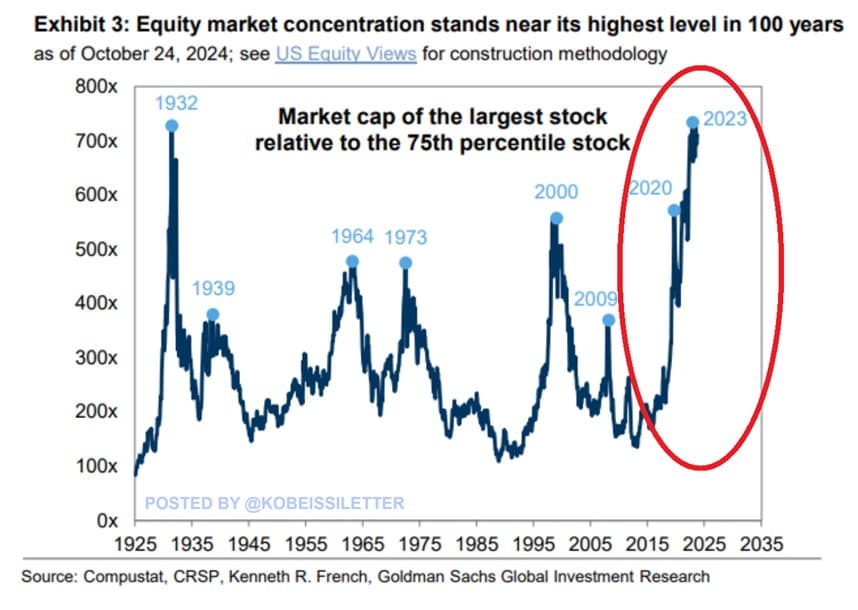
“The only other time that current levels of market concentration were seen was during the Great Depression,” they underscored. “Truly insane.”
So while the dollar remains king of the fiat currencies, beneath the surface, the fiat regime appears to be cracking, and while the USD may be the last currency standing, the evidence suggests that de-dollarization is on the rise, and investors are increasingly favoring gold, the world’s oldest store of value, and Bitcoin, the currency of the digital age.
