
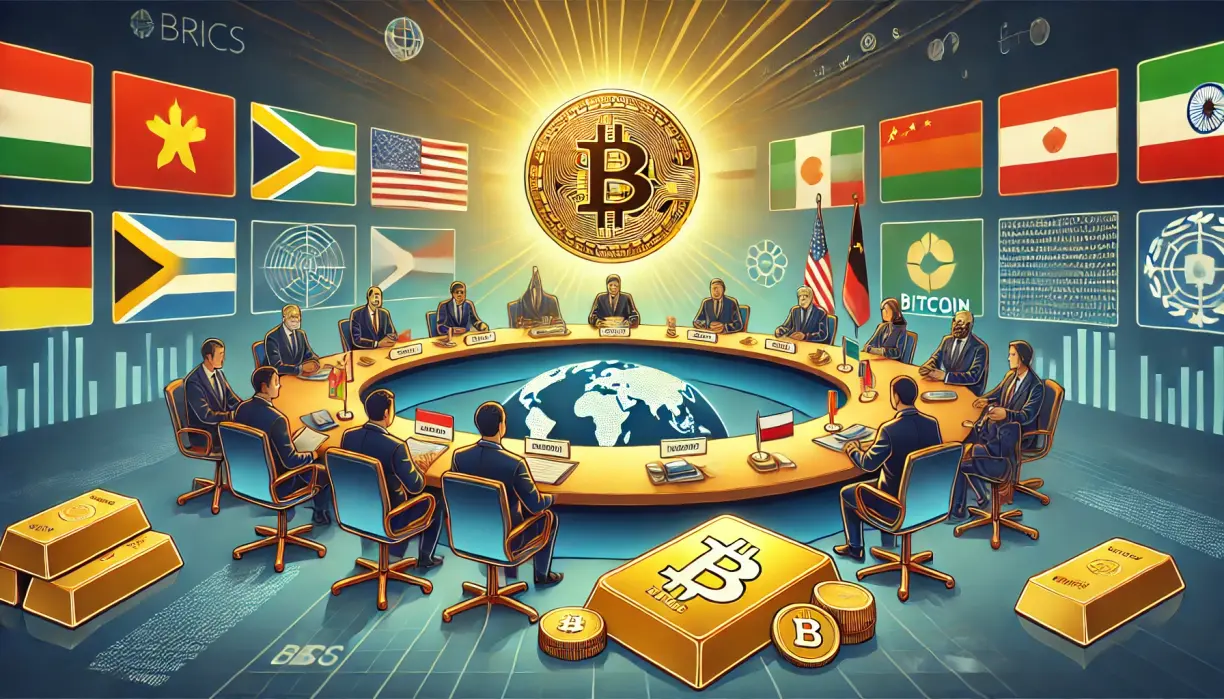
(Kitco News) – As was widely expected, de-dollarization was a major theme at the BRICS summit in Kazan, and as a hint at what is to come, Russian President Vladimir Putin was given a mock-up of a “BRICS bill.”
JUST IN: Russian President Putin has been gifted a mock-up of a "BRICS bill" at BRICS summit in Kazan. pic.twitter.com/gP08KKkRUy
— BRICS News (@BRICSinfo) October 23, 2024
Among the various topics relating to de-dollarization included the potential creation of a new multi-currency system or “basket system,” which would be comprised of the currencies of member states and monetary metals, such as gold.
“It is now necessary to create an alternative monetary relationship between our countries,” said Lula da Silva, the President of Brazil. “We are not talking about replacing our domestic currency. But when we talk about a multipolar world, we must create a financial system; we must seriously discuss this topic.”
The potential inclusion of precious metals was further supported by Russia’s proposal for BRICS to create their own precious metals exchange in a move that could upend the long-established international pricing mechanisms for gold, silver, platinum, and other precious metals.
Another central theme was developing an alternative to the SWIFT payment system controlled by the U.S. and Europe. With Russia banned from using SWIFT after they invaded Ukraine, conducting trade and settlement between BRICS members has become a challenge, leading to a push for an alternative messaging system.
The bloc is focusing on blockchain technology, cryptocurrencies, and central bank digital currencies (CBDCs) as a means to achieve their goal of circumventing the dollar's reserve advantage while also defeating the monopoly of the SWIFT network.
One avenue includes the use of Bitcoin (BTC). BRICS lawmakers introduced the idea of selling Russian-mined Bitcoin to international buyers, positioning King Crypto as a viable alternative to traditional financial systems dominated by the U.S. dollar (USD).
As part of this effort, BitRiver, the top mining firm in Russia, and the Russian Direct Investment Fund (RDIF) have partnered to establish a parallel BRICS-wide mining initiative to construct crypto and AI data centers across member nations and reduce reliance on Western technology.
While no official timeline has been confirmed regarding the creation of a new digital currency, discussions are gaining momentum, with Russia and Iran leading the way in advocating for the creation of such a currency.
According to one researcher, by anchoring the new digital currency to gold, the BRICS nations can provide security and trust, appealing to countries seeking financial sovereignty. A gold-backed digital currency could also provide a hedge against the inflationary pressures affecting fiat currencies worldwide.
“Gold has long been recognized as a reliable store of value, protecting against economic uncertainty and inflation,” Douglas C Youvan, the author of The BRICS Currency: A New Era of Global Finance Backed by Gold, wrote. “This enduring reputation has persisted even after abandoning the gold standard in the 1970s. This decision made gold a logical choice for the BRICS initiative.”
He argued that by leveraging its gold holdings, the BRICS bloc could create a stable and credible alternative to the USD, bolstering its economic influence on the global stage.
Moreover, BRICS is not alone in its efforts to develop a digital alternative to the dollar system, as both the IMF and the BIS have been developing blockchain-based systems. The BIS is already testing CBDCs in multiple countries, including Australia, Saudi Arabia, and China, through Project mBridge.
“MBridge is about connecting central banks to provide a settlement layer for their digital currencies while supporting interoperability between participants’ existing financial infrastructures,” explained Jan Nieuwenhuijs, gold analyst at Money Metals. “Utilizing mBridge is a stepping stone for more use of local currencies and, eventually, an improvement of liquidity.”
While cross-border payments usually rely on an inefficient network of correspondent banking, mBridge enables participants to “do away with correspondent banking and let banks link up efficiently through the new settlement rails,” he said. “According to the BIS, mBridge payments are faster, safer, cheaper, and more accessible, and settlement is final.”
“Since geopolitical tensions aren’t subsiding and the mBridge group has a motive to de-dollarize, we can assume this trend will continue,” Nieuwenhuijs said. “And we shouldn’t rule out Western investors will join in driving up the price of gold.”
According to analysts at ING, if BRICS countries adopt CBDCs and utilize mBridge to aid in their de-dollarization efforts, it could materially impact the sanding of the USD on the global stage.
“Over the last four years, the share of BRICS foreign exchange in cross-border bank claims has increased to 15%, while other emerging market currencies have risen to 19%,” ING analysts wrote. “If core BRICS Nations fully transitioned to non-dollar transactions, it could significantly affect around $2 trillion of the global $18.4 trillion in dollar-denominated cross-border bank claims and about $0.6 trillion of the $13.6 trillion in dollar-denominated international debt securities.”
According to ‘BRICS Sherpa’ Sergey Ryabkov, Russia’s Deputy Foreign Minister, digitization is key to moving beyond SWIFT and establishing a BRICS currency, and the bloc stands ready to be at the forefront of development in this regard.
“What is the new strategy of economic cooperation? It’s digitalization, modernization of infrastructure development, artificial intelligence, start-ups, everything that today constitutes the most advanced edge of both economic and civilizational-intellectual development,” he said. “BRICS should be at the forefront of all these processes, and it will be at the forefront. It is BRICS that will set the tone in this area, not the G7 or any other Western associations.”
Ryabkov also suggested that Western countries may join in the process of de-dollarization using the system being developed by BRICS but warned that they might do so for destructive purposes.
“I will not judge whether Western countries want to join one of the models of future interaction in this area, or will try to destroy it from within, if they set themselves such goal,” he said. For that reason, he urged BRICS members to “not get ahead of ourselves.”
“Let's first make progress in the practical implementation of our plans,” he stressed.
That said, Ryabkov also noted that Russia’s tenure as president of BRICS has successfully achieved results in developing models for decreasing the use of the USD and formalizing them in agreements.
These include BRICS Bridge, BRICS Clear, and BRICS Reinsurance, which he said “have matured during Russia's presidency and have now become elements of agreements between leaders and specialists.”
Ryabkov said Russia is now prepared to let Brazil – which is next in line for the role of President of BRICS – take charge of implementing these ideas.
“The next step, of course, should be the implementation of these ideas [on ditching the dollar] into practical steps and patterns. It is clear that this area is extremely sensitive and carries risks associated with illegitimate sanctions, including secondary ones,” he said. “However, there are also solutions to protect ourselves from such measures. We are handing this topic over to the Brazilians, fully convinced that the initiative has been made; these are not just words, but the result of work formalized in agreements.”
According to former UK lawmaker George Galloway, the BRICS Summit in Kazan marks the beginning of the end of the US hegemony and dollar dominance of the dollar.
“The Kazan Summit has been an enormous success… I have every confidence that BRICS 2024 will be a seminal moment in human history because it is the beginning of the end of the United States hegemony and the tyranny of the dollar,” Galloway told TAAS on the sidelines of the event. “The progress that has been made will begin to change the world that has been scared by unipolar power, by arbitrary violence, by double standards. And BRICS is the antidote to that poison. It took several important steps forward this week.”
