

(Kitco News) – The five countries using the mBridge international payments system are also the ones who’ve been driving gold’s price appreciation over the last few years, and this could have major implications for the U.S. dollar going forward, according to Jan Nieuwenhuijs, gold analyst at Money Metals.
“Countries that participate in the novel cross-border payments system mBridge are each hoarding gold and are largely responsible for the bull market of the past two years,” he wrote. “How and when the global dollar standard will disintegrate is hard to predict, but setting up a non-dollar payments system (mBridge) and aggressively accumulating gold to replace U.S. Treasuries as the prime international reserve asset is a potent strategy to de-dollarize.”
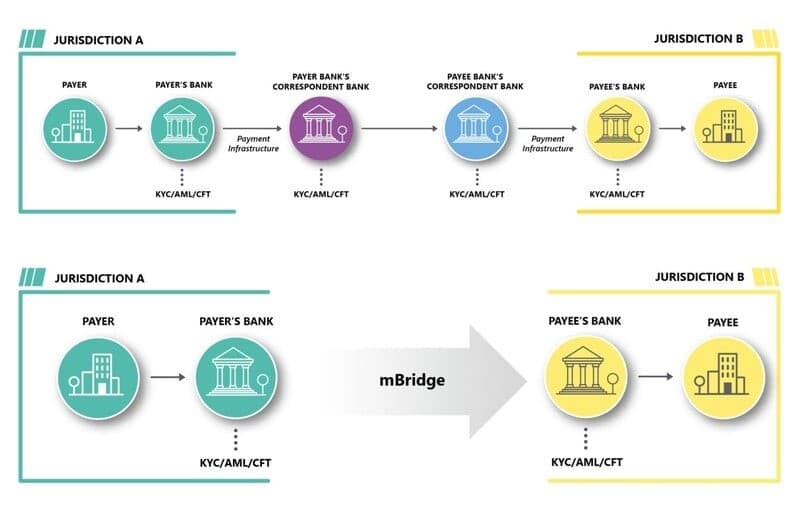
The mBridge international payment system was launched in 2021 by the Hong Kong Innovation Hub of the Bank for International Settlements (BIS). Thailand, China, Hong Kong, Saudi Arabia, and the United Arab Emirates are the five full members, at this stage, but mBridge also has over 30 observing members.
“The project aims to create a multi-central bank digital currency platform for participating central banks and commercial banks, built on distributed ledger technology (DLT) to enable instant cross-border payments and settlement,” Nieuwenhuijs said. “MBridge uses an Ethereum-compatible DLT network, the mBridge Ledger, developed by China’s Digital Currency Research Institute. Because China oversees the backbone of the technology, it’s immune to Western sanctions.”
He wrote that while gold import and export statistics represent private flows, they can also reflect central bank activity.
“Aside from elevated peaks in private demand from China and Thailand, the Chinese and Saudi central banks (PBoC and SAMA) are largely responsible for the rally that commenced in 2022, both having vigorously stepped up gold purchases after the West froze part of Russia’s foreign exchange reserves,” he said. “Strikingly, according to available trade data, the countries in the driver’s seat of the gold market are all full members of mBridge: China, Saudi Arabia, Thailand, and Hong Kong… Statistics by the U.A.E. lag several years and are misleading due to smuggling to India.”
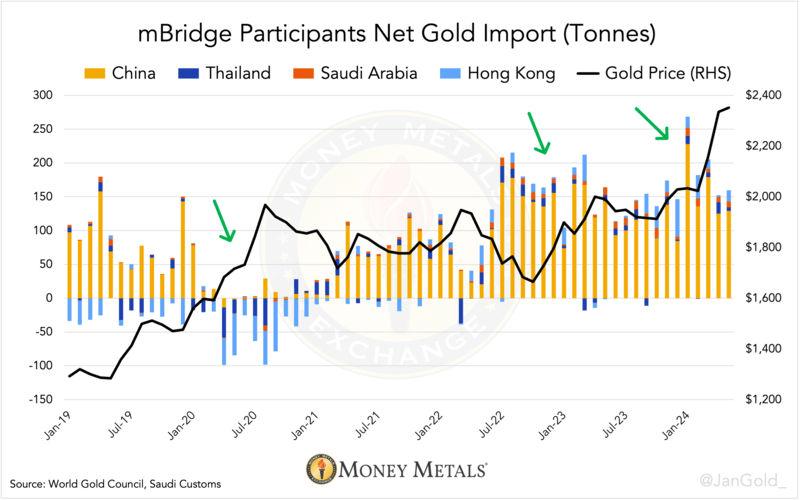
Nieuwenhuijs said that surging gold purchases by the East have broken the correlation between Treasury Inflation Protected Security (TIPS) and gold and “rendered TIPS impotent.”
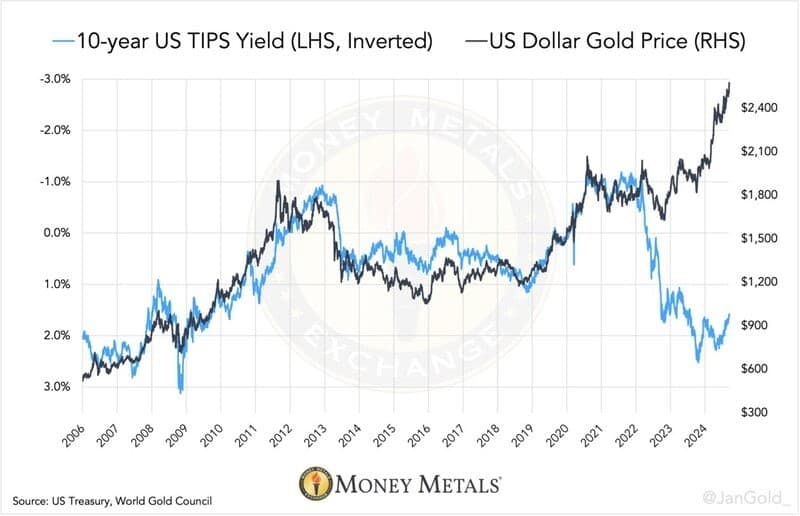
“Between China, Thailand, Saudi Arabia, and Hong Kong, it’s clear their gold stance has changed since early 2022: they’ve jettisoned their sensitivity to the price,” he said. “Instead of selling into rallies, they are themselves causing those rallies as a result of strong demand.”
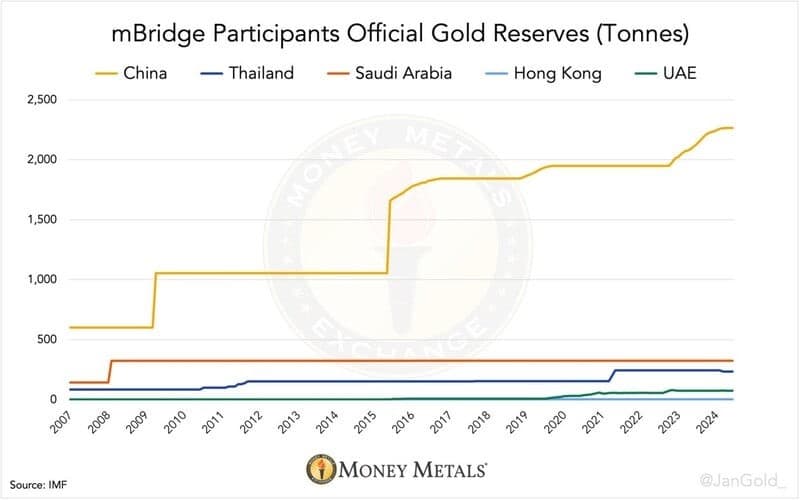
Beyond visible global gold flows, Nieuwenhuijs said that the official gold reserves of Thailand, the UAE, China, and Saudia Arabia have also risen sharply in recent years. “Only Hong Kong’s monetary gold has been flat; however, it can be lumped in with Beijing since it’s a special province of China.”
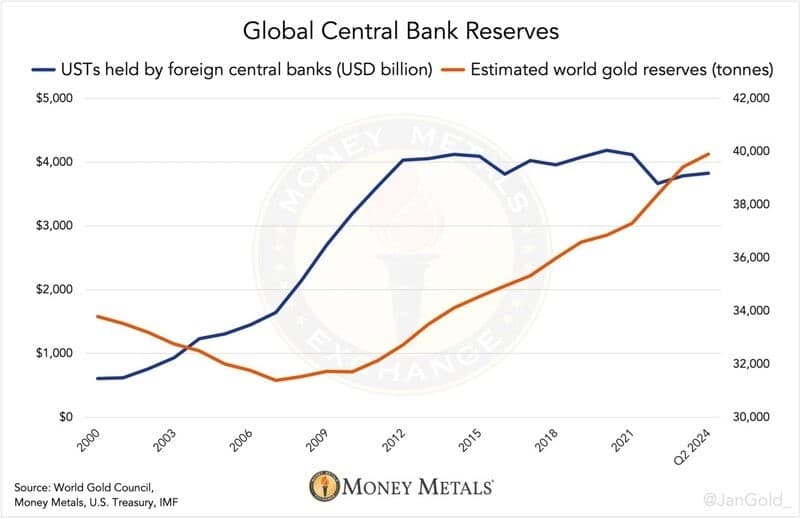
As the world’s reserve currency, the U.S. dollar is the most used currency in global trade. “The lion’s share of global international reserves (owned by central banks) are held in dollar-denominated assets such as U.S. government bonds (USTs),” he said. “Nations wanting to break free from the dollar need an alternative for trade and reserves.”
Nieuwenhuijs said that the members of the “mBridge fellowship” are all running current account surpluses and have all been increasing their gold reserves in recent years. “This is referred to as Gold Recycling: storing trade surpluses in gold rather than USTs.”
“MBridge is about connecting central banks to provide a settlement layer for their digital currencies while supporting interoperability between participants’ existing financial infrastructures,” he wrote. “Utilizing mBridge is a stepping stone for more use of local currencies and, eventually, an improvement of liquidity.”
While cross-border payments usually rely on an inefficient network of correspondent banking, mBridge enables participants to “do away with correspondent banking and let banks link up efficiently through the new settlement rails,” he said. “According to the BIS, mBridge payments are faster, safer, cheaper, and more accessible, and settlement is final.”
Saudi Arabia is the world’s largest exporter of oil, and China is the largest importer. “For a long time, the House of Saud preferred to receive dollars in return for oil, based on an agreement with the United States to invest its trade surplusses in USTs,” Nieuwenhuijs said. “Despite their long-standing ties with the U.S., the Saudis are becoming eager to trade oil in other currencies. In November 2023, the PBoC and SAMA signed a currency swap agreement worth ¥50 billion yuan ($7 billion dollars) to ‘expand the use of local currencies between China and Saudi Arabia and facilitate trade and investment between the two sides.’”
“This September, the Saudi Minister of Mineral Resources, Bandar Alkhorayef, said in an interview with SCMP that he’s open to new ideas, including the use of renminbi in crude oil settlements,” he noted. “No wonder the Saudis joined mBridge in June.”
Nieuwenhuijs believes that the combination of increased gold reserves and the mBridge system has the potential to tank the dollar.
“What are the odds that the countries that have taken over the gold market in the past two years are also in a non-dollar trade alliance? Surely, these countries have a thought-out plan to de-dollarize,” he said.
“Noteworthy, China, Hong Kong, and the U.A.E. have sophisticated precious metals markets where gold is traded in local currency, allowing mBridge associates to convert any surpluses from bilateral trade directly into gold while bypassing the dollar,” he added. “Saudi Arabia doesn’t have a developed gold market, but not long ago, a new refinery was opened in Riyadh under the patronage of the Saudi Minister of Mineral Resources, Bandar Alkhorayef. On the refinery’s website, it reads gold bars will ‘comply with globally approved standards and should be accepted globally by all customers, including all national banks.’ That should tell us enough.”
In order for mBridge to become fully operational at scale, each participating country must complete and roll out their own CBDC, and most of these are still in the pilot phase. “It should be clear, though, that mBridge constituents are being finalized and coming together,” Nieuwenhuijs wrote. “MBridge is likely to become a success because there is a political motive to escape from the clutches of the weaponized dollar if the mBridge group is able to take over the gold market, who knows what they can do on the cross-border payments front?”
“As we keep track of developments in cross-border payments through local currencies, the rise of gold to the detriment of the dollar in global reserves is inescapable,” he added.
Nieuwenhuijs said that according to his calculations, gold now represents 19% of international reserves, up from 10% in 2014. “Meanwhile, the dollar’s share has fallen from 62% in 2001 to 48% in March of this year as a result of the Gold Recycling trend,” he said.
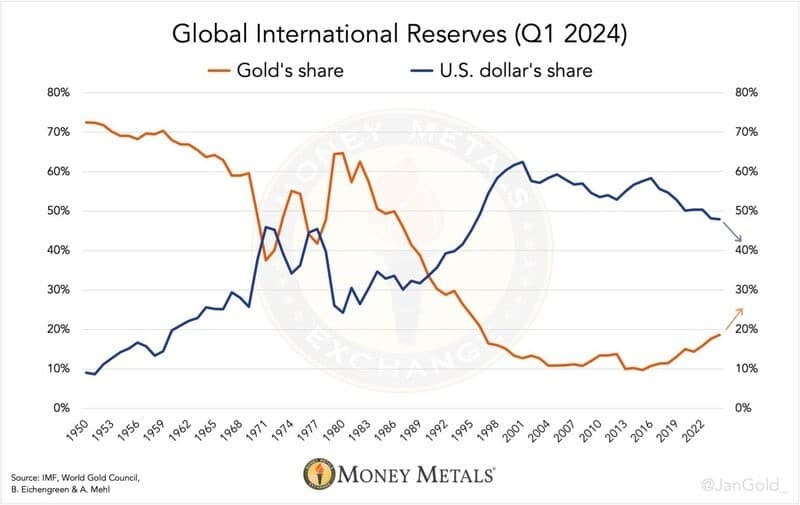
“Since geopolitical tensions aren’t subsiding and the mBridge group has a motive to de-dollarize, we can assume this trend will continue,” he said. “And we shouldn’t rule out Western investors will join in driving up the price of gold.”
