
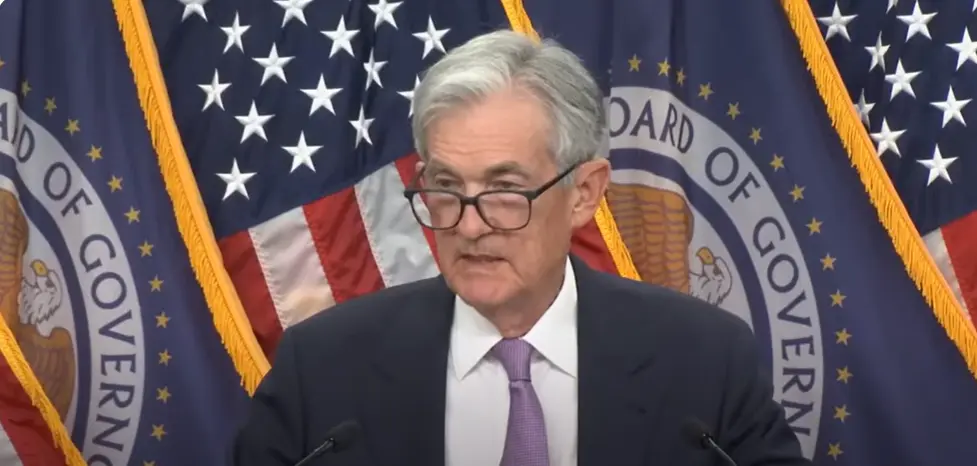
(Kitco News) – After Powell’s strong statements at the last monetary policy meeting in December, reporters were braced for more bracing statements on political independence at the first Federal Reserve meeting under the second Trump administration.
But the Fed Chair’s press conference ended up being a fairly run-of-the-mill affair, with policy issues such as tariffs, mass deportations, DEI, and climate change raised but never directly addressed.
The first question picked up where the previous meeting’s testy exchanges left off, with CNBC referring to the President’s statement that he would demand that interest rates drop immediately.
“I am not going to have any response or comment whatsoever on what the President said,” Powell replied. “It is not appropriate for me to do so.”
“The public should be confident that we will continue to do our work as we always have, focusing on using our tools to achieve our goals, and, really, keeping our heads down and doing our work,” he added. “That is how we best serve the public.”
Asked whether he has had any direct communication with President Trump, Powell said “I have had no contact.”
The Fed Chair was then asked if he still sees interest rates as meaningfully restrictive given financial and economic market developments since the last meeting.
“I don't think my assessment really has changed,” Powell said. “A couple of things have happened. We have gotten more strong data, but we have seen rates move up at the long end which could represent a tightening of financial conditions. We are seeing the economy move toward 2% inflation, and it has moved largely to maximum employment, so we really are looking at the movement toward the goal.
“Now, policy is meaningfully less restrictive than it was before we began to cut, 100 basis points less restrictive,” he added. “For that reason, we will be focusing on seeing real progress on inflation, or some weakness in the labor market before we consider making adjustments.”
Asked about rising inflation expectations linked to President Trump’s proposed tariffs, the Fed chair said expectations appear to be well-anchored where it counts.
“You see expectations moving up a little bit at the short end, but not at the longer end, which is where it really matters,” Powell said. “Those could be related to some of the new policies. I think the Committee is very much in the mode of waiting to see what policies are enacted. We don't know what will happen with tariffs, with immigration, with fiscal policy, and with regulatory policy. I think we need to let those policies be articulated before we can even begin to make a plausible assessment of what their implications for the economy will be.”
Powell was also asked to provide reassurance that the Fed will continue to operate independent of politics under the new administration.
“As I said, countless times over the years, this is who we are, this is what we do,” he replied. “We study the data, we analyze how it will affect the outlook and the balance of risks, and we use our tools to try to give it our best understanding, our best thinking to try to achieve our goals. That is what we do. That is what we always do. Don't look for us to do anything else.”
“Lots of research shows that is the best way for a central bank to operate,” he added. “That will give us the best possible chance to achieve these goals for the benefit of the American people. That is always what we are going to do, and people should have confidence in that.”
Powell was asked whether a future rate cut requires even more progress on inflation than it did previously given recent developments.
“I would say it is the same,” he said. “We want to see further progress on inflation. The story is there, we are just going to have to see the data. At the end of the day, it comes down to 12-month inflation, because it takes out the seasonality issues that may exist, and we need to see that.”
“Our goal is 2%, and we do mean to get back sustainably to 2%,” he added.
On how far the current Fed funds rate is from the neutral rate, Powell said it’s difficult to know with any precision. “You know the neutral rate by its works,” he said. “I think our eyes are telling us that our policy is having the effects on the economy. That is really the question we ask. I think we see it is having meaningful effects in bringing inflation under control. It has helped bring the labor market into balance as well.”
“I would say we are meaningfully above it,” he added. “I have no illusion anyone knows precisely what that is. But having known that, and cutting 100 basis points, means it is appropriate we not be in a hurry to make further adjustments.”
The Fed Chair was also asked about the AI-led stock market selloff earlier this week. “It is a big event in the stock market, and in particular parts of the stock market,” he said. “What really matters for us is macro developments, and that means substantial changes in financial conditions that are persistent for a period of time. I would not put that label on these events, although, of course, we are all watching it with interest.”
Chair Powell was asked if a March cut was still on the table. “The economy is strong, the labor market is solid, and the downside risk to the labor market we think has abated and continues on a sometimes slow and bumpy path,” he replied. “That tells me and other members of the Committee, the broad sense of the Committee is we don't need to be in a hurry to adjust the policy stance.”
The final question related to the risks posed by cryptocurrencies, and the Fed’s level of concern.
“Our role with Bitcoin, with Crypto, is really to look at the banks,” Powell said. “We think banks are perfectly able to serve Crypto customers as long as they can understand and manage the risks, and it is safe to say a number of our banks we regulate and supervise do that.”
“We are not against innovation, and we certainly don't want to take actions that would cause banks to terminate customers that are perfectly legal, just because of excess risk aversion that may be related to relation and supervision,” he added. “I do think it would be helpful if there were a greater regulatory apparatus around Crypto. I think that is something Congress was working on quite a lot. We actually spent a lot of time with members of Congress working together with them on various things. I think that would be a very constructive thing for Congress to do.”
