
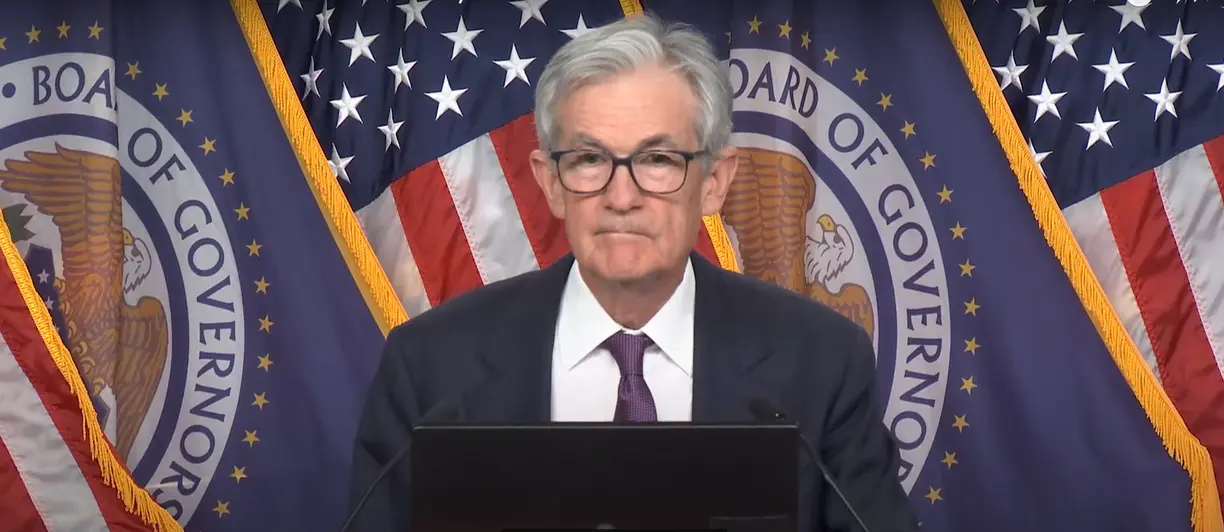
(Kitco News) –Federal Reserve chair Jerome Powell used the final FOMC rate decision of 2024 – and the last Fed meeting under Biden’s presidency – to carefully sidestep the implications of the inflationary policies proposed by the incoming Trump administration, while focusing on the positive gains the central bank has in fighting inflation and supporting employment.
Powell began by emphasizing that the Federal Open Market Committee’s vote in favor of a 25-basis-point rate cut was a close one, but he and other members believed it was the right decision.
“I would say today was a closer call, but we decided it was the right call because we thought it was the best decision to foster achievement of both of our goals, maximum employment and price stability,” he said. “We see the risks as two-sided: move too slowly and needlessly undermine activity in the labor market, or move too quickly and needlessly undermine our progression on inflation. On balance, we decided to go ahead with the further cut.”
The Fed chair was asked at the outset whether markets should expect another cut or a pause in January, and whether it would be appropriate to cut rates at all in 2025.
“About 2025, I think that the slower pace of cuts for next year really reflects both the higher inflation readings we've had this year and the expectation inflation will be higher [in 2025]” he said. “You saw in the SEP that risks and uncertainty around inflation, we see as higher. Nonetheless, we see ourselves as still on track to continue to cut.”
“I think the actual cuts that we make next year will not be because of anything we wrote down today. We're going to react to data,” he added. “That's just the general sense of what the committee thinks is likely to be appropriate.”
Asked what type of data would trigger an additional rate cut in the new year, Powell said the central bank would be looking for further progress on inflation as well as continued strength in the labor market. “As long as the economy and labor market are solid, we can be cautious as we consider further cuts,” he said.
Gold prices sold off sharply in the wake of the Fed’s slower rate cut projections, and the yellow metal made new lows as Powell’s press conference continued.
Spot gold fell from $2,636 per ounce just before the 2 p.m. EST rate announcement and statement to $2,616 in the moments afterward. Then, it declined again at the outset of the 2:30 p.m. EST press conference from $2,624 to a session low of $2,588 per ounce.
The Fed chair was asked if the uptick in the Fed’s medium-term inflation expectations was driven by Trump winning the presidency, and he was careful not to ascribe this to the election outcome.
“That's not the only thing that's happened,” Powell said of the Nov. 5 election. “Our forecasts for inflation for this year are five-tenths higher than they were in September. You had two months of higher inflation in September and October. November is back on track, but once again, we've had a year-end projection for inflation and it's kind of fallen apart as we've approached the end of the year.”
Powell was also prodded on the potential impacts of Trump’s proposed tariffs on the inflation outlook, and whether the Fed’s 2018 Teal Book simulations were a useful baseline for this calculation.
“I do think the September 2018 Teal Book alternative simulations are a good place to start,” he answered. “It's six-year-old analysis, but nonetheless, this is still, I think, the right questions to ask. In any case, this is not a question that's in front of us right now. We won't face that question, and we don't know when we'll face that question. What the committee is doing now is discussing pathways and understanding the ways in which tariffs can affect inflation in the economy and how to think about that.”
“There are many, factors that go into that; how much tariffs will even go into consumer inflation, how persistent will that be,” Powell continued. “We just don't know very much at all about the actual policies, so it's very premature to try to make any kind of conclusion. We don't know what will be tariffed, from what countries, for how long, in what size. We don't know whether there will be retaliatory tariffs. We don't know the transmission of any of that into consumer prices.”
Powell was also asked about another hot-button issue that has dominated the financial news cycle since the election – Bitcoin, and the possibility of the number-one cryptocurrency becoming a reserve asset.
“We're not allowed to own Bitcoin,” he replied. “The Federal Reserve Act says what we can own, and we're not looking for a law change. That's the kind of thing for Congress to look at, but we are not looking for a law change at the Fed.”
The Fed chair also addressed the potential impacts of geopolitical instability and whether it was affecting the American economy.
“We monitor [geopolitical risks] really carefully, but so far, nothing has come out of those risks that's really been important for the United States economy,” he said. “The U.S. is not feeling the effects of geopolitical turmoil, but certainly we are at a time of elevated geopolitical turmoil, and it remains a risk.”
On the possibility of a rate hike in 2025, Powell stopped short of ruling it out but insisted that it was not something the FOMC foresaw happening. “You don't rule things completely in or out in this world, but that doesn't appear to be a likely outcome,” he said.
Powell took time to address the tendency to conflate inflation rates with consumer prices while acknowledging the strain that high prices place on ordinary people. “What I think people are feeling right now is the effect of high prices, not high inflation,” he said.
The Fed chair also pointed out that despite persistent inflation in some areas – housing services and home insurance in particular – the U.S. economy was in far better shape than most experts were predicting two years ago.
“I think it's pretty clear we have avoided a recession,” he said. “Most forecasters have been calling for a slowdown in growth for a very long time, and it keeps not happening. The U.S. economy is performing very, very well, substantially better than our global peer group. And there's no reason to think a downturn is any more likely than it usually is. So the outlook is pretty bright for our economy.”
Spot gold last traded at $2,592.31 per ounce for a loss of 2.05% on the daily chart.

