
Strengths
- Uniswap, the largest decentralized exchange, and Spark, a DeFi protocol focused on stablecoin liquidity, are developing a shared liquidity network to enable seamless transfers between stablecoins. As an initial step, Spark will migrate $150 million in liquidity to Uniswap v4, supporting USDS, USDT, and PYUSD. With the stablecoin market projected by Citi to grow from $300 billion to $4 trillion by 2030, the initiative aims to build the infrastructure needed for a multi-stablecoin financial ecosystem.
- Circle, issuer of the USDC stablecoin, has partnered with Nomura Holdings, one of Japan’s largest financial institutions, to launch a digital asset settlement business by 2027. The platform will enable Japanese companies to use USDC, which has a $73.8 billion market capitalization, for cross-border payments and foreign exchange settlements, targeting a market that processes approximately $440 billion in daily FX transactions.
- Crypto-backed super PAC Fairshake spent more than $5 million supporting Adrian Boafo’s successful congressional campaign, contributing to nearly $40 million invested by crypto and AI groups in this week’s races. Analysts now expect a potential bloc of 70+ pro-crypto Democrats in the next Congress, reinforcing the industry's growing influence over future digital asset legislation.
Weaknesses
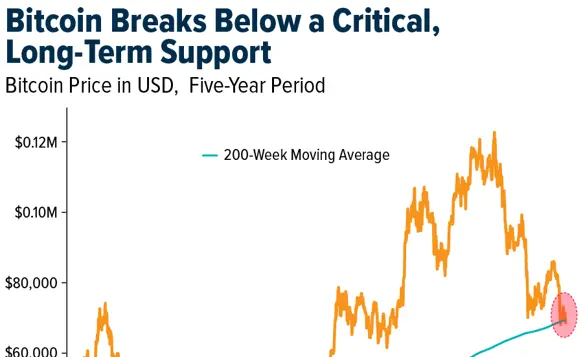
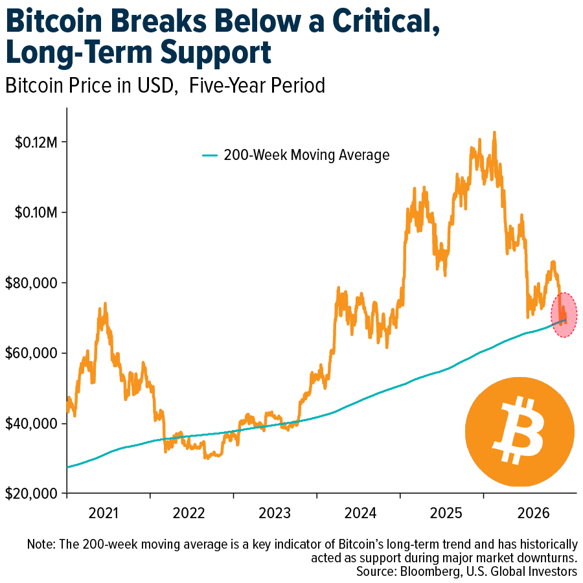
Bitcoin has fallen below its 200-week moving average, a technical level historically associated with prolonged bear markets, as investors prepare for a $10.6 billion quarterly options expiry. The weakness comes alongside $469 million in daily spot Bitcoin ETF outflows and nearly $300 million in average daily redemptions over the past week, increasing the risk of heightened volatility if the $60,000 support fails.
- Strategy, the largest corporate holder of Bitcoin, is facing growing scrutiny as the prolonged decline in Bitcoin has pushed its holdings to an $11 billion unrealized loss. The company’s cash reserves have fallen 36% in 2026 to $1.4 billion, while it continues paying an 11.5% annual yield on preferred shares used to finance Bitcoin purchases, raising concerns about the long-term sustainability of its funding strategy.
- CoinShares, one of Europe's largest digital asset investment firms, surveyed 261 wealth advisors and found that 61% work at firms that restrict or provide no guidance on digital assets, leaving much of clients’ crypto holdings unmanaged. In the UK, 52% of advisors said more than half of their clients’ crypto assets sit outside their oversight, highlighting how institutional policies continue to slow the integration of digital assets into traditional wealth management.
Opportunities
- Ripple, a blockchain payments company that develops digital payment infrastructure for financial institutions, has received approval for its RLUSD stablecoin from Japan’s Financial Services Agency. SBI VC Trade, the cryptocurrency exchange subsidiary of Japanese financial conglomerate SBI Holdings, will offer RLUSD to both institutional and retail investors. Since launching in late 2024, RLUSD has grown to a $1.7 billion market capitalization, strengthening Ripple’s position in cross-border payments, tokenization, and trade finance.
- Hyperion Decimus, a digital asset hedge fund, says four proprietary onchain indicators have aligned for only the sixth time in Bitcoin’s 15-year history, with each previous occurrence marking a major market bottom. While the firm expects confirmation within the next 90 days, it also highlights improving fundamentals, including rising wallet activity and continued Bitcoin withdrawals from exchanges, suggesting an increasingly attractive long-term risk-reward profile.
- USDT0, Tether’s omnichain stablecoin infrastructure backed 1:1 by USDT, has surpassed $100 billion in transaction volume in less than 530 days since launching in 2025. Now live across 23 blockchain networks, USDT0 enables seamless cross-chain transfers without wrapped tokens, highlighting growing demand for interoperable stablecoin infrastructure as institutions and AI-powered applications increasingly adopt blockchain-based payments.
Threats
- Binance has withdrawn its MiCA license application in Greece after regulators indicated approval was unlikely, forcing the exchange to restart the process in another EU country. With the July 1 compliance deadline approaching, crypto firms without a MiCA license risk suspending operations across the bloc. The setback underlines the growing regulatory challenges facing even the industry's largest exchange.
- TRM Labs, a blockchain intelligence firm, alleges that CoinEx, a Seychelles-based cryptocurrency exchange, facilitated more than $3.84 billion in blockchain-traced flows involving sanctioned Iranian crypto entities over the past seven years, including $2.7 billion linked to Nobitex. CoinEx disputes the findings, but the report stresses the growing compliance, sanctions, and anti-money laundering risks facing global crypto exchanges.
- Bithumb, one of South Korea’s largest cryptocurrency exchanges, was fined 210 million won (approximately $136,000) after regulators found it shared users’ personal information with overseas platforms without proper consent. The case emphasizes growing regulatory scrutiny over cross-border data transfers and highlights the increasing compliance requirements crypto exchanges face as global privacy standards tighten.
