
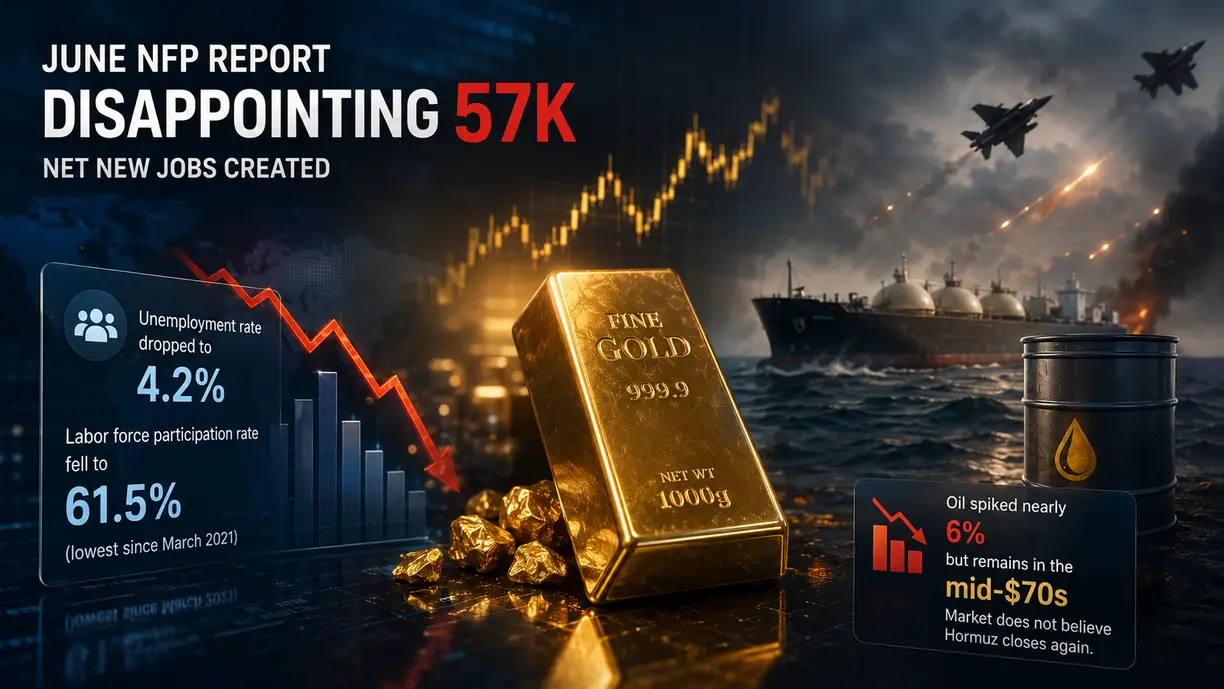
The NFP report for June came in at a disappointing 57k net new jobs created. That was less than the downwardly revised 129,000 jobs added in May and worse than the 115,000 Dow Jones consensus forecast. Revisions slashed 74k jobs from the original May and April reports. The unemployment rate did drop to 4.2%, but that was due to a slump in the labor force participation rate, which fell 0.3 percentage point to 61.5%, the lowest since March 2021. The Household employment survey was much worse than the establishment survey, showing an actual loss of 507,000 jobs. In fact, the household survey shows a whopping 1,700,000 people have lost their job so far in 2026.
The macroeconomic conditions of slowing growth and disinflation remain intact, even as the ceasefire with Iran unravels in real time. On Tuesday, Iran attacked three commercial vessels transiting the Strait of Hormuz, including a Qatari LNG tanker. Washington yanked Iran's license to sell its oil, struck multiple Iranian targets overnight, and by Wednesday Trump was declaring the ceasefire over and promising to hit Iran again. Crude jumped nearly 6% on the news. But pay close attention to the price itself: even with tankers burning and bombs falling, Brent is trading in the mid-$70s—nowhere near the $120 print of late April, when the strait was actually blockaded. The market is telling you it does not believe Hormuz closes again, and neither do I. Trump knows another closure means $4-plus gasoline into the November midterms, a landslide loss, and disaster for the rest of his administration. And Iran, whose only economic lifeline is oil revenue, has every incentive to sell crude, not to strangle its own customers. Hence, I expect continued flare-ups and retaliatory strikes that keep a volatility premium in oil, but not a protracted battle that sends crude sustainably back above $100 per barrel and drops us straight into stagflation. If the data begins to point that way, the IDEC Model will reposition without hesitation. For now, we are prepared for a slowing economy with less inflation, which is why the Model has us long dividend and low volatility stocks, along with gold and the miners.
Meanwhile, most other sectors will not leap for joy as the slowing economic data gets reported. I expect more of the same reaction as we saw last Thursday's NFP report—stocks fell, while gold and the dividend payers soared. Normally, the weaker data would send day traders rushing into stocks across the board at the mere thought of a more dovish Fed. Then again, sometimes the data is so weak that the growth scare offsets any potential rate cutting hopes. In fact, what could be happening is that economic growth stalls while the new Fed Chair Warsh sits on his hands and waits for inflation to fall back to 2%, as he so clearly threatened at his first FOMC meeting and press conference. This leaves the Wall Street gamblers without a Fed PUT for the foreseeable future. But gold should like the fact that rate hikes are off the table for at least the late July Fed meeting and decision. The Atlanta Fed's GDP model for Q2 had predicted growth for the quarter at well over 4% just a few weeks ago. However, the current estimate for Q2 growth has now crashed down to just 1.3%. That is not a scenario where rate hikes occur.
PPS created and owns the IDEC strategy that models the business cycle. If you don't think modeling the business cycle is absolutely crucial, please listen up closely to the data compiled by the NYU Stern School of Business. The following are the average annual returns for the S&P 500 over the given periods of time: 1928-1948 following the stock market crash and during the Great Depression investors saw just an average of 0.6% return per annum over those 20 years, the boom from the end of WWII 1949-1968 saw a healthy 12.7% average annual return, the stagflation era of 1969-1984 caused a pitiful 0.5% return, the strong GDP growth from 1985-1999 lead to a robust 15.1% return, the bursting of the NASDAQ and Housing bubbles from 2000-2012 led to an awful -0.8% average annual return, but this latest bull run of 13 years from 2013-2025 has provided an 11.8% annual return. These returns are not linear; there were significant bull and bear markets within each era.
Amazingly, this time around investors are convinced that bear markets have gone extinct. In sharp contrast, this data proves beyond a doubt that it is absolutely essential to eschew the buy and hold philosophy of investing. It is not time in the market that matters the most. Rather, it is accurately timing the market to avoid the huge drawdowns caused by recession and credit crises. Now, most advisors will say they cannot time the market and they are correct because they are either incapable of doing so or not even allowed to try. Maybe both are true. They simply cannot raise cash levels significantly or short the market, so they must pretend bear markets can't be identified or are inconsequential in the long term.
Please understand, it has never been more crucial to have an active management style of investing. This is true because asset prices have never been more deformed. The triumvirate of real estate, equities, and credit bubbles are at all-time record levels. Hence, for the buy and bag holders there is another decade—or even much longer--of zero or negative returns just in front of them. But for those that have the aptitude and latitude to short the market at the appropriate time, the ability to provide Alpha has never been greater.
