
Why The Promise Feels So Tempting
If you have been investing for more than a few years, chances are you have seen headlines designed to make your heart race.
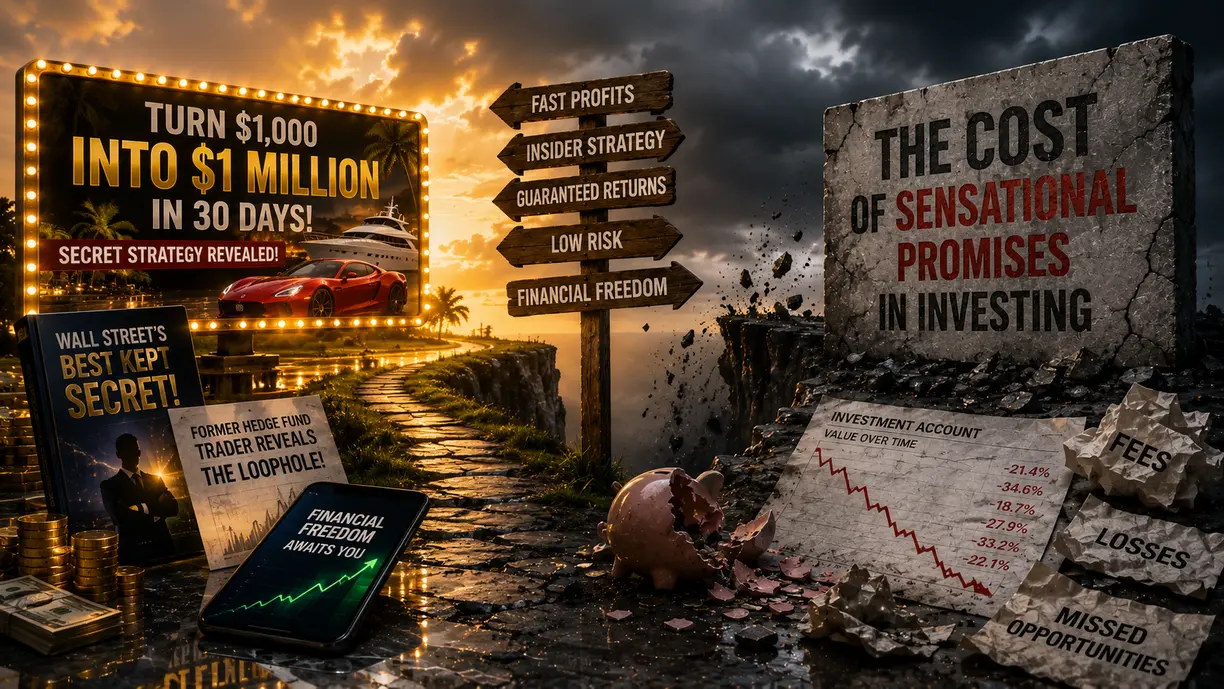
Turn a small account into a fortune in weeks! Discover the secret strategy Wall Street does not want you to know! Follow a former hedge fund trader who claims to have found a loophole no one else understands!
The wording changes, but the message is usually the same.
You are missing out! You are behind! Someone else has found the shortcut, and if you act quickly enough, maybe you can catch up!
I understand why that message pulls people in. Most investors are not looking for hype because they are careless. Many are looking because they are frustrated, tired, anxious, or still trying to recover from decisions that did not work out the way they hoped.
That is what makes sensational promises so dangerous. They do not usually appeal to logic first. They appeal to emotion. They offer relief from uncertainty. Relief from feeling behind. Relief from the slow work of rebuilding. Relief from the fear that time is running out.
For investors nearing or living through retirement, that emotional pull can be especially strong. When the years ahead feel more important, the idea of a shortcut can become very tempting.
But shortcuts in the market often come with a hidden cost.
Sometimes that cost is money. Sometimes it is confidence. And sometimes, the most expensive cost is time.
The Emotional Hooks Behind The Hype
The reason sensational investment promises work is not because they are always convincing on the surface. Many of them sound exaggerated the moment you slow down and think about them.
But they are not designed for slow thinking. They are designed to trigger emotional responses before logic has time to step in.
Fear of missing out says, “Everyone else is already doing this, and I am falling behind.”
Greed says, “Maybe this is finally the opportunity that changes everything.”
Fear of loss says, “If I do not act now, the next crash could destroy what I have left.”
Hope says, “Maybe this system will finally fix the problem.”
Those emotions are powerful because they touch real concerns. Investors do worry about falling behind. They do worry about losing what they have built. They do want a way to recover from past mistakes. They do want to feel more in control.
The problem is that hype takes those legitimate concerns and turns them into urgency.
It pushes people to act before they understand the risk. It makes speed feel more important than process. It makes a bold promise feel more attractive than a boring question like, “What happens if this goes wrong?”
That is usually where the damage begins.
The Most Common Traps
The first trap is the sensational headline. These are the claims that promise extraordinary gains in very little time, often with just enough detail to sound specific and just enough mystery to make the reader curious.
The danger is not only the headline itself. The danger is what it does emotionally. It makes investors feel like they are standing in front of a rare opportunity, and that if they pause too long, they will miss it forever.
Once that emotion takes over, the important questions often get skipped. What is the risk? Has this worked through different market cycles? What happens during a bear market? Is there a clear exit process, or only a story about upside?
The second trap is the free webinar funnel. It often begins with education, a few charts, a warning about what may happen next, or a promise to reveal a method that has helped others. But gradually, the tone shifts. The urgency builds. The deadline appears. The offer becomes limited. The viewer is made to feel that delaying the decision means losing access to something important.
That is not the same as education. Education helps people think more clearly. Emotional pressure tries to make them act more quickly.
The third trap is the fake community. These can appear as trading rooms, chat groups, social media communities, or private channels where the excitement of the group creates the illusion of trust. People see others posting gains, celebrating trades, and acting with confidence. That social proof can make a weak idea feel safer than it is.
But if there is no transparency, no clear process, no risk management, and no accountability, the community can become another emotional trigger. Investors may follow the crowd simply because they do not want to be left behind.
The fourth trap is the pseudo-advisor. This one can be harder to spot because it often looks more professional. There may be charts, commentary, market language, and trade alerts. But beneath the surface, there may be no consistent process, no clear risk framework, and no way to know whether decisions are being made from evidence or opinion.
By the time an investor realizes the process is not really there, the cost may already be paid in losses, stress, and lost trust.
When The Scam Uses A Trusted Name
This is the part that hits closest to home for me.
There are scammers who steal my name, photo, and even video clips from my real work and use them to promote completely fake crypto investments, penny stock promotions, or fraudulent trading groups.
They create fake social media profiles. They send private messages. Some create fake “Chris Vermeulen” trading groups and pretend they are connected to The Technical Traders or me.
Let me be very clear.
I will never direct message you on social media to pitch an investment. I do not promote cryptocurrency investments inside trading rooms. I do not use WhatsApp, Telegram, or Discord for trade signals. I do not ask for money so I can invest it on your behalf.
If it does not come from TheTechnicalTraders.com, it is not me.
Please be careful. If you see one of these impersonators, report it and let our team know. It is deeply frustrating to see good people misled under my name, and I want investors to understand that these scams are designed to use trust against them.
That is why slowing down matters.
The more urgent the message feels, the more important it becomes to verify the source.
Why Investors Often Retreat To Buy-And-Hold
After being burned by hype, many investors move in the opposite direction.
They decide they are done with newsletters, trade alerts, gurus, systems, and promises. They retreat into what feels familiar and safe: buy-and-hold.
I understand that reaction. After a bad experience, the desire for simplicity can feel like protection. Holding through everything sounds calmer than chasing every new idea. It feels more mature, more patient, and less emotional.
But even familiar approaches can carry hidden risks.
Buy-and-hold can work well when time is abundant, and the investor can emotionally and financially withstand large declines. But for investors approaching or living through retirement, the issue is not only whether the market eventually recovers. The issue is how long recovery takes and what happens to life during that period.
A major decline can take years to repair. During those years, confidence may change. Spending decisions may change. Income plans may change. The investor may technically still be following the plan, but the time spent waiting to get back to even is still time that cannot be recovered.
That is why the answer to hype is not simply to accept every downturn and hope time fixes it. The answer is to stop looking for emotional shortcuts and start asking better questions about process, risk, and recovery time.
The Real Alternative Is Not Another Promise
For me, the alternative to hype is not another prediction.
It is a process.
A sensational promise says, “Here is what you can make if everything goes right.”
A process asks, “What happens if conditions change?”
Hype focuses attention on the upside. Process respects both upside and downside. Hype pushes urgency. Process creates patience. Hype often depends on the investor believing a story. Process depends on rules, evidence, and risk management.
One member described the difference in a way that stood out to me. After seeing other services send daily sales pitches and urgent messages like “Sell now or regret it” or “Buy before the boom,” he said, “Never get those with Chris.” That matters to me because urgency is often what causes investors to abandon logic. A process should calm decision-making, not inflame it.
That is why the alternative to hype cannot simply be another exciting promise. It has to be a process built around rules, risk awareness, and respect for the time that can be lost when a bad decision becomes a long recovery. This is where the philosophy behind Asset Revesting connects for me, because it grew out of the belief that capital should be managed through structure, not emotion or urgency.
In our work, that philosophy is applied through a rules-based process rather than emotional promises or headline-driven decisions.
The goal is not to create excitement. It is not to offer a magic formula. It is not to predict every market turn or catch every move.
The goal is to make decisions from structure instead of impulse.
That may sound less exciting than a headline promising fast gains, but over time, less excitement can be exactly what many investors need.
What Breaks The Cycle
The cycle usually begins with discomfort.
An investor feels behind, anxious, frustrated, or tired of uncertainty. A bold promise appears. It offers relief. The investor follows it, hoping this time will be different. If it fails, the damage is not only financial. Confidence takes another hit, trust becomes harder, and more time is lost trying to recover.
Breaking that cycle requires a different relationship with investing.
It means slowing down when a claim makes you feel urgent. It means asking what the process is, not just what the promise is. It means looking for risk management before upside. It means recognizing that real investing discipline is rarely built around excitement.
It is built around consistency.
For retiring or retired investors, this matters even more. The goal is not to find the next sensational opportunity. The goal is to protect the capital, confidence, and time that support the years ahead.
That does not mean avoiding all risk. No investment approach can do that. It means avoiding the kind of emotional decision-making that can turn one bad promise into years of repair.
I have seen many investors come to this realization after trying too many shortcuts. They no longer want the loudest claim. They want something calmer. They want structure. They want rules. They want to know that risk is being respected before damage becomes too large.
That shift is important.
Because the real cost of sensational promises is not only what they can take from an account.
It is what they can take from the years the account was built to support.
Final Thoughts
The market will always attract bold promises.
There will always be someone claiming to have found the shortcut. There will always be headlines designed to trigger fear or greed. There will always be stories that make disciplined investing feel too slow.
But most investors do not need more excitement.
They need clarity.
They need a process that helps reduce emotional decisions. They need a way to evaluate risk before it becomes damage. They need to protect not only what they have built, but also the time they do not want to spend rebuilding it.
That is the difference between hype and process.
Hype asks you to believe. Process asks you to follow evidence.
And for investors who have worked for decades to build wealth, that distinction can make all the difference.
