

Strength
- Goldman Sachs agreed to acquire NEOS Investments, an asset manager specializing in options-based income ETFs, in a deal valued at up to $2.25 billion. NEOS manages BTCI, a bitcoin income ETF with approximately $1.1 billion in assets, which surpassed the $1 billion mark less than two years after launch. The acquisition brings Goldman a $30 billion platform spanning 19 ETFs, highlighting growing institutional integration of bitcoin into traditional investment products.
- OranjeBTC, Brazil’s largest bitcoin treasury company with 3,950 BTC worth roughly $250 million, plans to launch the DIGY11 ETF in September. The fund will initially allocate 95% to Strategy’s STRC and 5% to Strive’s SATA, targeting monthly distributions equivalent to Brazil’s 14.15% CDI rate plus 3–5 percentage points. The launch builds on a Brazilian crypto fund and ETF market already holding R$13.7 billion ($2.6 billion) across approximately 576,000 investors.
- Fidelity plans to allow its Fidelity Ethereum Fund (FETH), which holds about $898 million in assets, to stake up to 100% of its ETH under normal conditions. FETH would retain 85% of gross-staking rewards, with net proceeds potentially distributed to investors quarterly in cash. The move, alongside staking initiatives from BlackRock, Grayscale and 21Shares, highlights growing institutional adoption and innovation in regulated crypto investment products.
Weaknesses
- The OCC returned Zerohash’s application to become a U.S. national trust bank after identifying material deficiencies in the filing. Zerohash is a crypto infrastructure company that provides trading, custody and settlement technology to financial institutions, supporting firms including Morgan Stanley’s E*Trade, BlackRock and Franklin Templeton. The company has also faced allegations from a former compliance executive involving more than 200 significant compliance gaps, underscoring the regulatory and compliance hurdles facing crypto firms seeking deeper integration with the U.S. banking system.
- Metaplanet reported a $1.5 billion unrealized loss on its holdings of roughly 43,000 BTC, while Strategy recently recorded an $8.2 billion paper loss. Combined, the two largest publicly traded bitcoin treasury companies are sitting on nearly $10 billion in unrealized losses. The declines highlight the financial risks of concentrating corporate balance sheets in a single volatile digital asset, particularly when debt is used to finance additional bitcoin purchases.
- About 34% of all ETH is now staked, up from 29% at the start of 2026, leading Ethereum researchers to propose changes that would reduce rewards as more ETH enters staking. Under the proposal, staking yields could fall from roughly 2.6% to 1.2% over 18 months. That could cut staking income by about half for major ETH treasury companies such as BitMine and SharpLink, making the economics of holding large ETH positions less attractive.
Opportunities
- Japan’s largest banking group plans a proof-of-concept using Canton Network to settle JGB transactions onchain, potentially reducing the current 1–3-day settlement process to real-time, 24/7 settlement. The initiative could improve capital efficiency and reduce operational friction in the repo market. The project highlights growing opportunities for blockchain technology to become part of the infrastructure underlying traditional global capital markets.
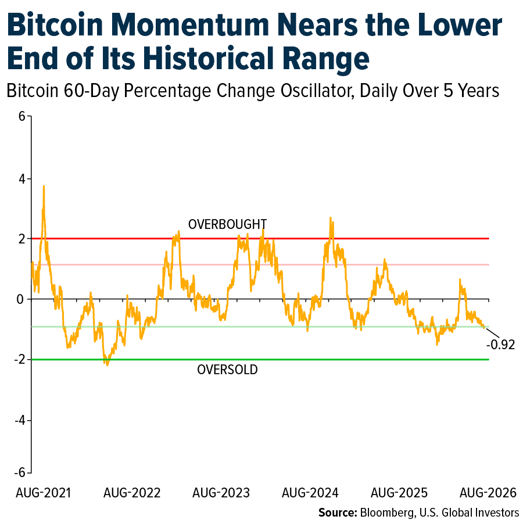
- Bitcoin’s 60-day percentage-change oscillator has fallen to -0.92, near the -1 standard deviation level and well below the positive readings seen during stronger momentum periods over the past five years. Historically, readings around or below -1 sigma have coincided with periods of significant price weakness, providing context for the current momentum environment. While not a signal of an imminent rebound, the current reading highlights historically weak momentum that investors may continue to monitor for signs of stabilization.
- Robinhood Chain reached a record 11.6 million daily transactions, up from roughly 2 million per day at the end of June, while total value locked surpassed $500 million, supported by growing use of Ethena’s USDe. Robinhood is building its Ethereum Layer 2 to support products including tokenized stocks and other onchain financial services. The surge in transactions and assets highlights the opportunity for established financial platforms to bring more users and traditional assets onto blockchain infrastructure.
Threats
- The CEO of South Korean crypto lender Delio was sentenced to 15 years in prison for a roughly $50 million fraud that affected more than 1,100 investors. The platform, which accepted bitcoin and ether deposits while promising high yields, suspended withdrawals in 2023 before entering bankruptcy in 2024. The case highlights how fraud and weak platform controls remain a reputational and financial risk for the broader digital asset ecosystem.
- More than three dozen crypto firms, including Coinbase, Block, BitGo, Blockstream, Anchorage Digital, ARK Invest and Bitwise, urged major AI labs to give security researchers access to their most advanced models. The warning follows a critical BTCPay Server vulnerability that attackers exploited to drain merchants’ Lightning nodes, while AI is making it faster and cheaper to identify weaknesses across large codebases. The firms warn that current AI safety restrictions could leave Bitcoin developers using weaker tools than malicious actors.
- The New York City Council opened an investigation into major platforms including crypto-based Polymarket and federally regulated Kalshi, seeking information about their operations, consumer protections and contracts tied to sensitive events. The probe adds to regulatory scrutiny surrounding the rapidly growing prediction-market industry. Greater oversight could restrict the types of contracts platforms can offer and create additional compliance hurdles for this emerging segment of the digital asset ecosystem.
