

Gold prices fell sharply Tuesday as mounting inflation pressure and firming odds of a Federal Reserve rate hike overwhelmed a weaker dollar, leaving the metal well below a key resistance level with just over a week to go before the Fed's policy decision.
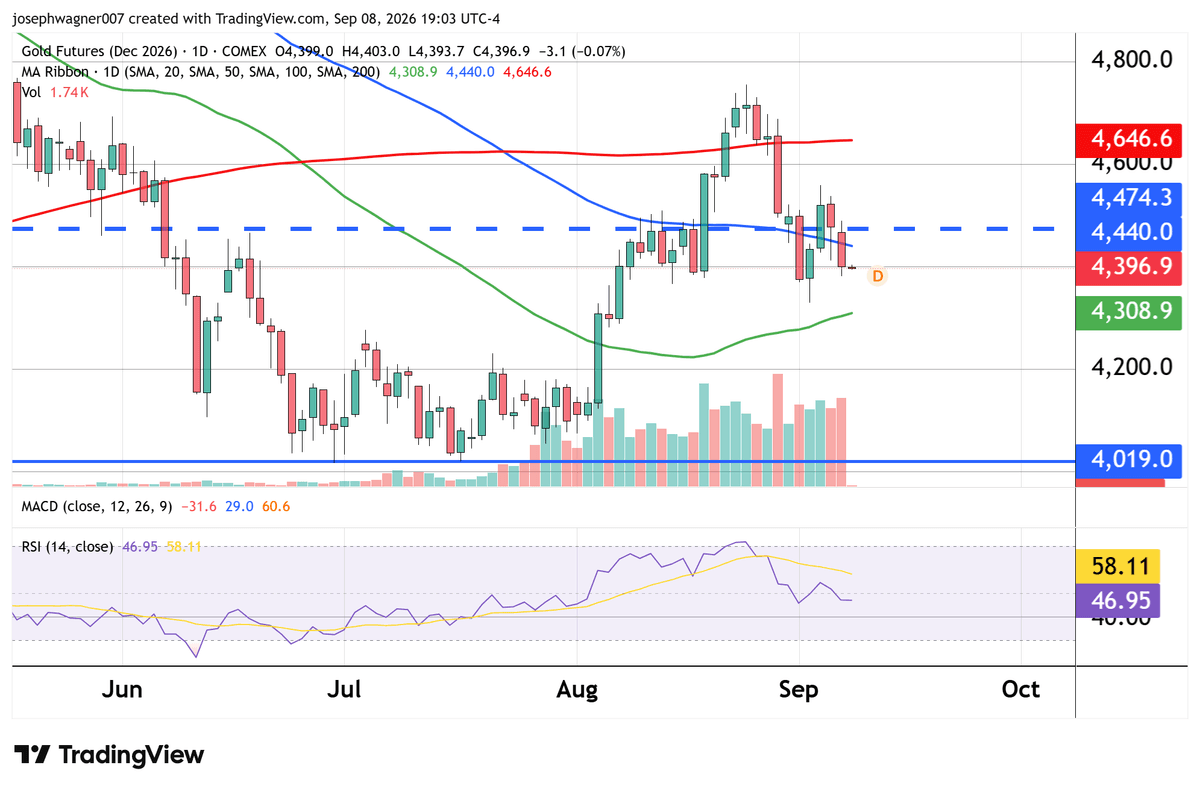
December gold futures dropped $77.20, or 1.72%, to settle at $4,400 an ounce, extending bullion's retreat from a key level at $4,474 level. Gold is now range-bound with a downward bias tied almost entirely to the outlook for the Fed funds rate: markets are largely pricing in a hike next week, so any data this week that hints at a continued hold instead could spark a sharp bounce.
The rate outlook has shifted quickly. A month ago, the CME's FedWatch tool put the odds of a September hike at just 45%, with markets leaning toward a hold after a soft July jobs report. Hawkish commentary from Fed Chair Kevin Warsh at the Jackson Hole symposium and a run of firmer data since pushed those odds as high as two-to-one in favor of a hike within the past week. They now sit at 60/40 in favor of a hike — a quarter-point move that would lift the federal funds rate to a range of 3.75% to 4.00% — after Friday's stronger-than-expected August jobs report showed nonfarm payrolls up 162,000, nearly triple the 56,000 economists had forecast, while the unemployment rate held steady at 4.1%.
Oil has reinforced the inflation narrative. WTI crude climbed another 1.69% Tuesday to trade above $93 a barrel, extending a rally that has added $13.14, or 16.20%, cementing another win now for seven of the past nine sessions. The catalyst is a fresh escalation in the Middle East, where Iran-aligned Houthi militants struck Saudi energy facilities over the weekend and the U.S. and Iran exchanged strikes on vessels, reviving fears of a broader supply disruption. Brent crude, the international benchmark, has pushed to within striking distance of $100 a barrel on the news. Higher energy costs feed directly into headline inflation, reinforcing the case for a more hawkish Fed, even though the same headlines would, in calmer circumstances, typically support gold as a safe-haven trade.
That tension helps explain gold's otherwise unusual behavior this week. Even with the dollar softening roughly 0.30%, a move that would ordinarily lift gold, the metal has fallen right alongside it — underscoring just how dominant the rate-path narrative has become in pricing bullion for the moment.
The next test comes fast. The Producer Price Index is due Thursday and the Consumer Price Index follows Friday, with traders treating both as the final inflation inputs before the Fed's two-day meeting concludes on September 16. A hotter-than-expected print would likely cement hike expectations and keep gold on the defensive; a softer one could quickly flip the narrative and fuel a bounce back toward $4,474 and beyond.
Technical Outlook
On a technical basis, gold has broken beneath its 100-day simple moving average, though it still sits roughly $90 above the 50-day SMA at $4,308, a level that should offer nearby support if selling continues. The correction has cooled the daily Relative Strength Index out of overbought territory without pushing it into oversold conditions; the indicator sits at a neutral 47.03, suggesting the pullback has been orderly rather than panicked.
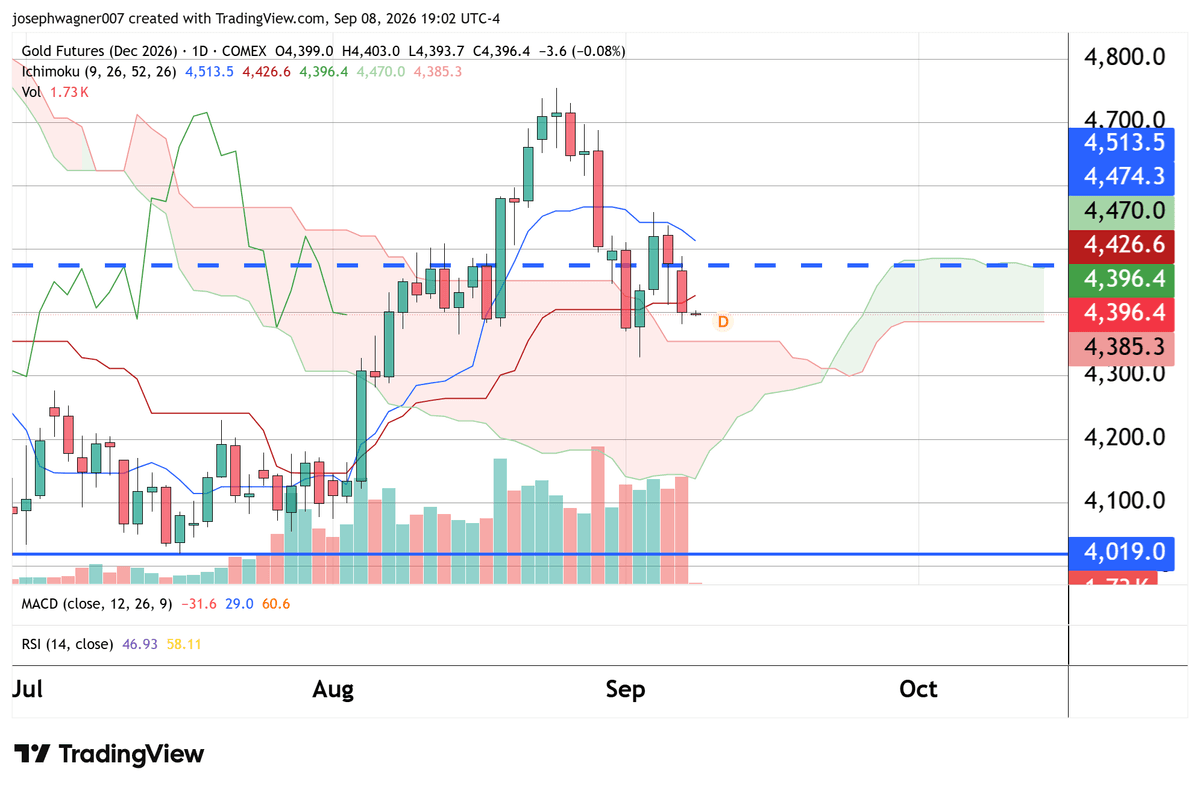
The Ichimoku Cloud still points to an underlying bullish structure, with price holding above the cloud even as the cloud itself has turned red and thickened in recent sessions. The cloud is projected to flip back to green and rise higher in the coming weeks — a setup that would typically support higher prices if gold can hold its ground. The key task for bulls is defending that structure: gold needs to reclaim the $4,474 level in the weeks ahead to keep both its broader uptrend and its position above the cloud intact.
With the Fed decision, PPI, and CPI all landing within the next eight days, gold traders are bracing for one of the more consequential stretches of the year for bullion — one that will likely determine whether the metal's next major move is a breakout above $4,474 or a deeper slide toward the 50-day average.
