
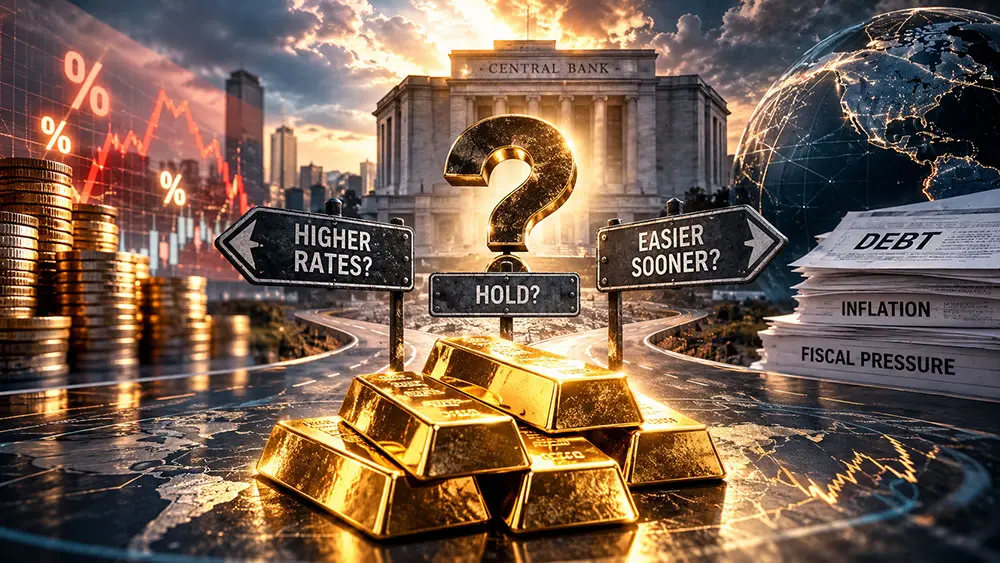
Central banks can set the price of money, but they cannot guarantee the economy can afford it.
That is the uncomfortable question behind the latest debate over inflation and interest rates.
If price pressures persist, policymakers may need to keep borrowing costs elevated or raise them further. But households, businesses and governments must then absorb the consequences.
Ease too soon, and inflation could regain momentum. Tighten too far, and the damage may extend well beyond the borrowers who took the greatest risks.
For gold investors, the next important catalyst may be a growing suspicion that policymakers are running out of comfortable choices.
The cost of fighting inflation
Higher interest rates work partly by making people and businesses spend less.
Mortgages become more expensive when they reset. Investment projects become harder to justify. Refinancing exposes borrowers to costs they could previously avoid.
That pressure is part of the mechanism through which monetary policy restrains demand.
But the same mechanism operates on governments.
In an analysis published on October 15, IMF economists[i] highlighted how high debt magnifies the deterioration in public finances caused by rising policy rates. They also reported that average G7 ten-year government bond yields rose by more than one percentage point between February and September.
Governments do not refinance every bond overnight. The adjustment arrives progressively, depending on debt maturities and financing arrangements. But as old borrowing is replaced, a more expensive interest-rate environment works its way into the budget.
More revenue goes towards servicing yesterday’s spending and less remains for today’s priorities.
Borrowing to cover the gap adds another claim on tomorrow’s taxpayers.
A government can promise better services, lower taxes and fiscal discipline. An expanding interest bill makes delivering all three considerably harder.
You cannot raise interest rates into an oil well
The dilemma becomes more difficult when inflation includes a supply shock.
Higher rates can restrain demand for fuel. They cannot reopen a shipping route, repair a refinery or deliver a cargo.
If energy becomes more expensive, businesses face higher transport, production and operating costs. Households have less money left after paying for essentials.
The economy can therefore weaken while prices continue rising.
A central bank may still need to act. An initial energy shock can spread into wages, services and inflation expectations. Allowing that process to become entrenched could make the eventual adjustment worse.
But the treatment has limits. Suppressing demand enough to offset scarce supply may impose a substantial economic cost.
That creates a political temptation: cushion the shock with government support.
Targeted help may be necessary. Broad subsidies, however, can move part of the energy bill from the consumer to the public balance sheet without removing the underlying shortage.
The cost still has to be borne.
Three choices, each with a bill attached
Policymakers can tighten further, ease earlier or wait.
Further tightening may defend monetary credibility, but intensify pressure on employment, credit and public finances.
Earlier easing may relieve borrowers, but risk convincing households and investors that inflation will be tolerated whenever controlling it becomes sufficiently painful.
Waiting preserves flexibility. It also gives persistent price pressures more time to spread if the diagnosis proves wrong.
There is a successful route through this: supply conditions improve, inflation expectations remain anchored, fiscal policy becomes more credible and growth proves resilient.
That outcome deserves a place in any serious analysis.
My concern is how much must now cooperate to achieve it—and how little room heavily indebted economies have for an error.
Central banks retain powerful tools. Their freedom to use those tools without causing damage elsewhere is more constrained.
Why gold can fall before the argument strengthens
None of this means an inflation surprise must immediately send gold higher.
Gold pays no interest. When inflation news leads investors to expect tighter policy and higher real yields, interest-bearing assets can become more attractive. A stronger dollar can add further pressure.
September offered a useful reminder. The World Gold Council’s market commentary reported an 8.5% monthly decline in the dollar gold price, identifying higher Treasury yields and a stronger dollar as major contributors.[ii]
Gold can fall while concerns about inflation remain entirely justified.
But a higher government bond yield deserves a second question: what is the investor being compensated for?
Sometimes the answer is stronger growth and an attractive real return. Sometimes it includes greater uncertainty about inflation, fiscal policy or the future supply of debt.
Those explanations carry different implications for gold.
If investors believe higher rates will restore stability, gold faces a persuasive competitor.
If they begin to doubt whether those rates can be sustained, the calculation changes.
Investors are already making a distinction
Price action alone can obscure what is happening beneath the surface.
According to the World Gold Council’s September ETF report,[iii] global physically backed gold ETFs attracted $10 billion during the month, taking third-quarter inflows to a record $31 billion. UK-listed funds recorded their strongest quarter on record.
These figures cannot tell us every investor’s motivation, however, they do show that substantial investment demand persisted through a falling market.
My interpretation is that some investors are making a distinction between gold’s immediate sensitivity to interest rates and its longer-term role in a portfolio.
They can recognise the short-term headwind while still wanting an asset whose existence does not depend on a government meeting its obligations.
That is a more durable foundation for demand than assuming every uncomfortable economic release must produce a rally.
What does the policy promise depend on?
A bond promises payment under specified terms. The purchasing power of that payment depends on what happens to money.
Cash provides liquidity and a stable nominal balance. What that balance will buy in future remains uncertain.
Physical gold has a different set of characteristics. It produces no income, its price fluctuates and ownership brings costs and practical considerations. Direct ownership of the metal, however, does not require an issuer to repay it.
That distinction becomes more valuable when confidence in policy weakens.
Investors do not need to anticipate default or monetary collapse. They may simply want less of their wealth dependent on governments and central banks delivering a difficult combination: lower inflation, sustainable debt and tolerable borrowing costs.
For a sterling investor, the dollar gold headline is also only part of the picture. Currency movements affect the return measured in pounds. Wealth preservation ultimately has to be assessed against the currency in which future spending will occur.
The mistake may be waiting for certainty
I do not believe gold needs a spectacular policy failure to justify a place in a portfolio.
Repeated compromises may be enough: inflation taking longer to contain, fiscal repair being postponed and borrowing costs becoming harder to absorb.
A decisive restoration of price stability and fiscal credibility would weaken this argument. Gold could also remain under pressure while real yields stay attractive.
But investors must make decisions before the outcome becomes certain.
That is why the next catalyst for gold may emerge before any central bank admits a mistake. It may arrive when enough investors decide that the margin for error has become too narrow to ignore.
Central banks can promise to restore confidence.
Gold allows investors to hold something that does not require that promise.
