

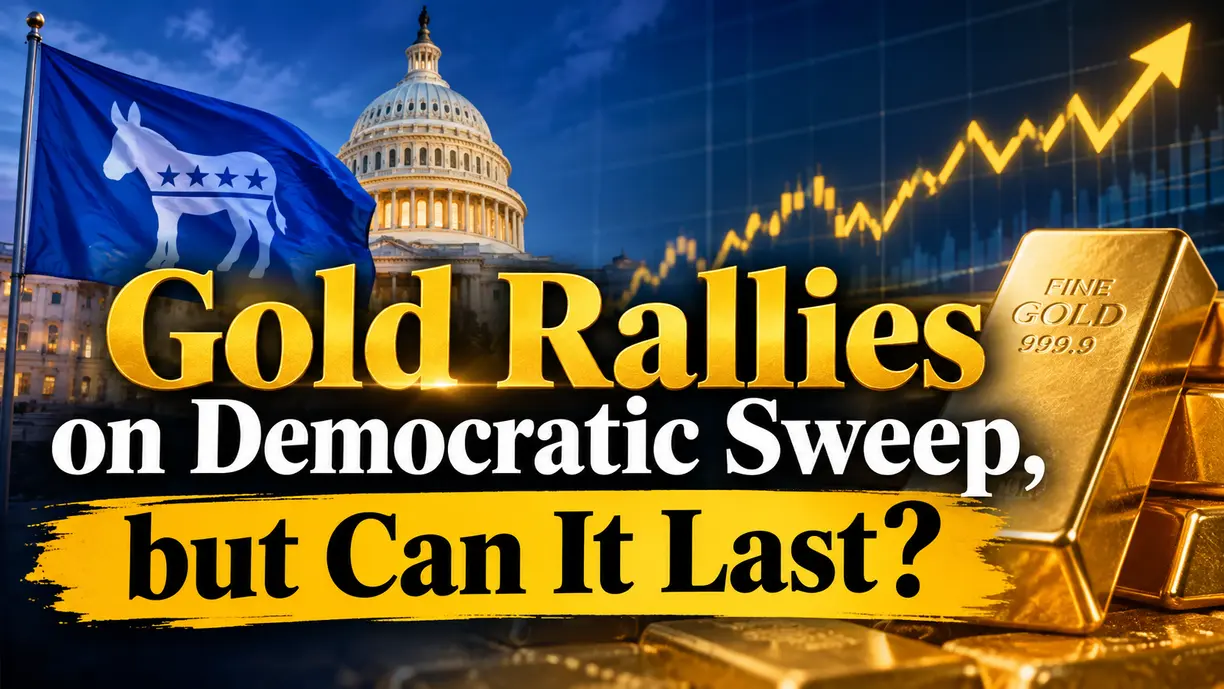
On November 4th, the US midterm elections gave Democrats a majority in both the House and the Senate. That same day, gold futures rallied $135, or 3.35%. It was the largest single-day advance since gold fell to 13-month lows and broke below $4,000 for the first time since it closed above that level in late September 2025. With the Fed still expected to raise rates next month, can this political shift pull gold out of a multi-month correction and convince traders to pivot from bearish to bullish sentiment? That is the question we will try to answer today.
First, we have to ask ourselves: what forces took gold from its euphoric all-time highs at the beginning of the year to a depressing decline of $1,600, or 40%, over the seven months from March to October?
On shorter time frames, a simple candlestick chart muddies the answer. A market technician knows that a parabolic rise precedes a parabolic fall, and traders have the 1979 and 2011 rallies in precious metals as a reference for how gold should react after a parabolic advance. We will dive deeper into that topic later this week. Put simply, every parabolic rally in gold and silver has been followed by a parabolic correction. From a technical standpoint then, gold and silver were both late for their appointment with a steep and sudden correction at the start of this year.
However, when we look through the lens of a monthly or even weekly time frame, gold was not behaving like a market that had exhausted its upside momentum. On the monthly candlestick chart, gold futures had not printed a single red candle since December 2024, when gold gave up a meager $34. In January of this year, gold posted its largest monthly dollar gain ever, $575. February followed with the second-greatest monthly advance and the highest monthly close on record, near $5,300. Any analyst you asked at the time would have told you gold seemed poised to climb even higher. Then, in March, we got the largest monthly dollar decline ever, with no exhaustion pattern and none of the doji candles that typically form at a market top.
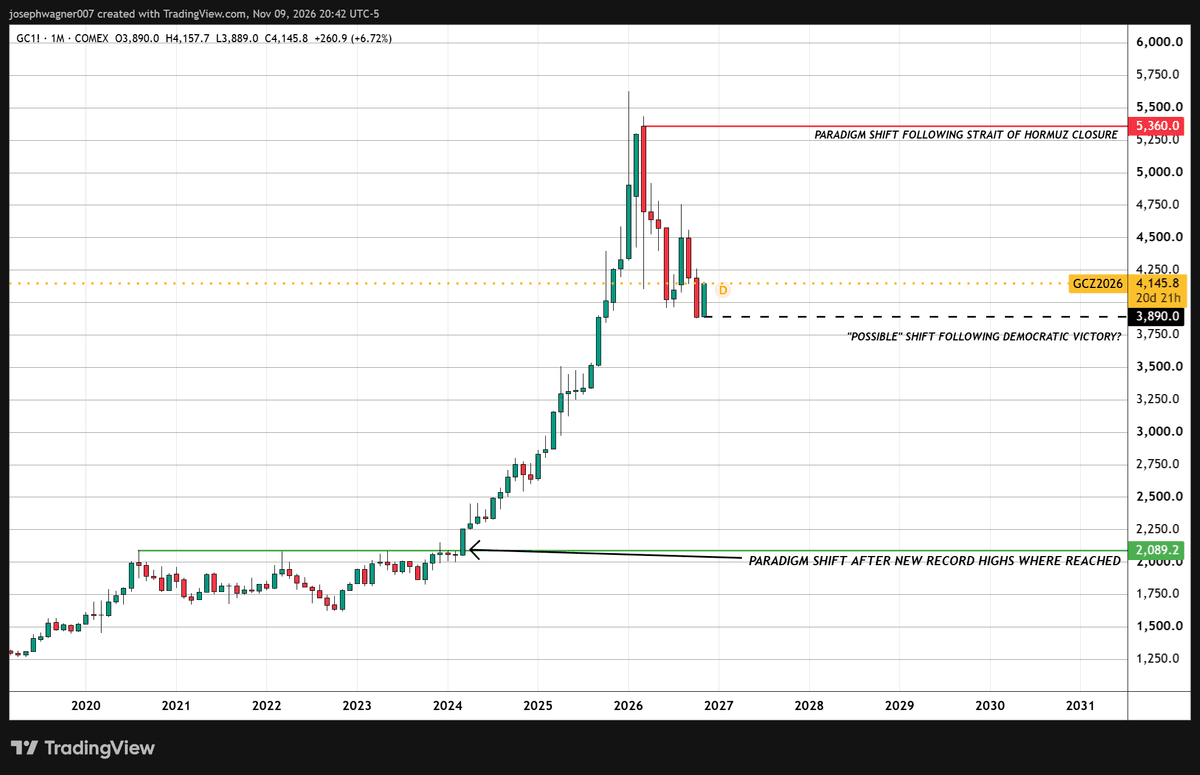
What we got instead, at the tail end of gold's record month of February, was a joint US/Israeli airstrike that killed Iran's Supreme Leader, Ali Khamenei, and his family. The brutal ruler of the Islamic Republic, who had served since 1989, was killed along with the close relatives who were likely next in line for power. The exception was his son Mojtaba Khamenei, who has since become Iran's new Supreme Leader. This will likely go down in history as one of America's greatest military failures. Instead of eliminating a ruthless dictator and his successors, the strike unintentionally put in charge a man whose family was slaughtered by Western forces. Iran had already vowed to bring down Western civilization by funding terrorist organizations and pursuing nuclear ambitions, and the new leader has every reason to stay on that path after a massacre that killed his family and nearly ended his own life. Iran's new leadership was also clever enough to engage the West in economic warfare, effectively shutting down one of the world's most important corridors for transporting oil out of the Middle East and into the Western countries that need it to keep prices and their economies stable.
This was the paradigm shift in gold as it relates to geopolitical uncertainty and inflation. For gold to return to the rally that seemed destined to continue before this shift, the corridor must reopen. Looking at our monthly chart, the market does not see a high chance of that. But the Democrats' victory gives us some hope that it may happen sooner rather than later, now that Congress has turned blue.
So, to answer the question we posed, whether this political shift can bring gold out of a multi-month correction and convince traders to pivot from bearish to bullish sentiment, the answer depends on how much the Democrats in Congress can sway the President to end the war. The markets have not yet delivered a final verdict, but they agree there is now a much better chance that the war will end sooner rather than later.
To get more in-depth daily content, click here.
