
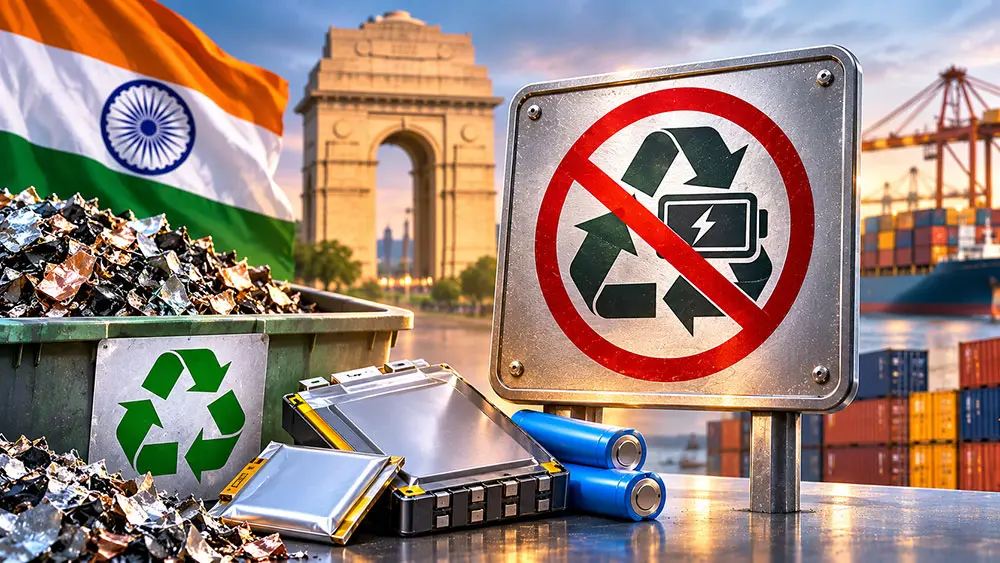
The Indian government on Tuesday banned the export of lithium-ion battery black mass, a recycled battery material containing metals such as lithium, cobalt, nickel and manganese, by changing its export status from “free” to “prohibited” with immediate effect.
The amendment prohibits Indian recyclers from exporting lithium-ion battery black mass, encouraging domestic processing of critical battery materials and supporting India’s electric-vehicle supply-chain ambitions.
According to the notification from the Ministry of Commerce and Industry and the Department of Commerce, the export ban applies to lithium-ion battery black mass and associated battery waste that are unsorted and not containing lead, cadmium or mercury.
The notification comes days after the Indian cabinet approved an incentive policy worth 28.14 billion rupees ($300.2 million) to boost domestic processing of lithium and nickel, aimed at reducing reliance on supply chains dominated by China.
India is one of the world’s fastest-growing EV markets, with the government promoting local battery manufacturing and recycling as it targets EVs to account for 30% of new car sales and 80% of new two- and three-wheeler sales by 2030.
($1 = 93.7475 Indian rupees)
(Reporting by Saikeerthi in Bengaluru; Editing by Mrigank Dhaniwala)
