
What I Have Been Thinking About Since Part 1
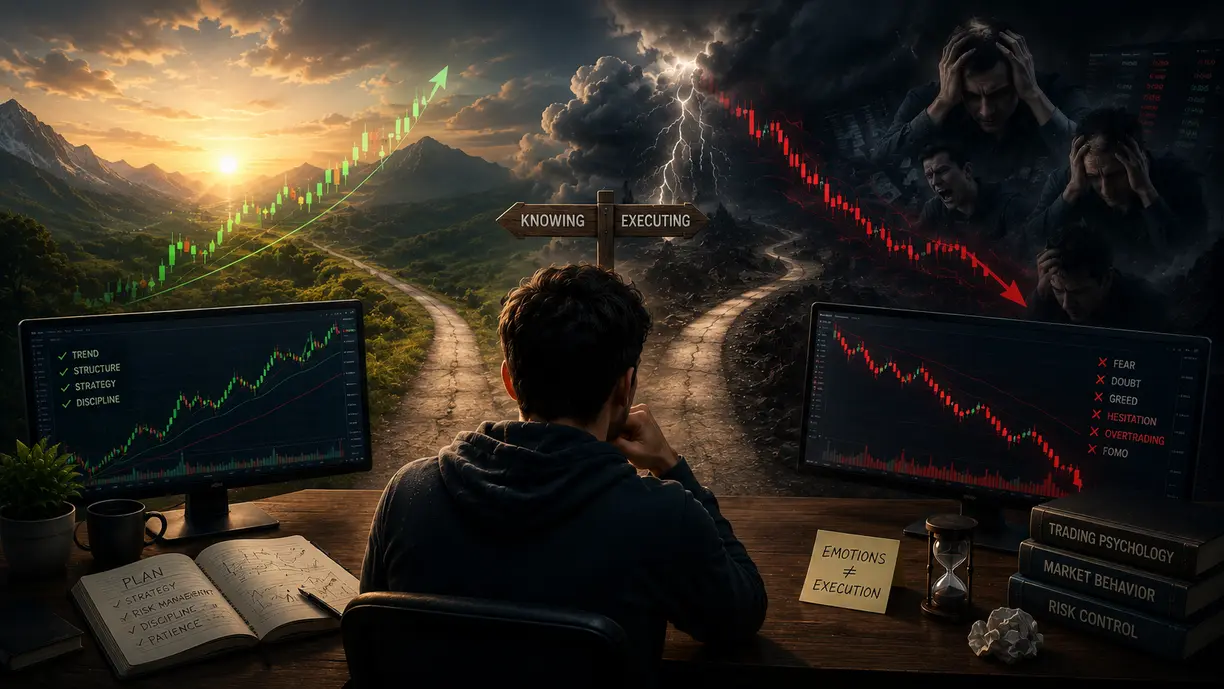
When I wrote about why trading feels harder than it should, I focused on what I call the 80% zone. That is the place where many traders and investors know enough to understand what is happening in the market, but not enough to execute with calm consistency when pressure rises.
They may understand charts, indicators, trends, and strategy. They may be able to explain what should happen. But when real money, real volatility, and real emotion enter the picture, the same old problems often return - second-guessing, hesitation, chasing, overtrading, moving too early, or waiting too long.
That first article was about the gap between knowledge and execution. Since then, I have been thinking about another part of that problem, one that becomes even more important as investors move closer to retirement or begin living through it.
Execution problems do not just cost money. They can cost time.
That is the part many investors do not fully see at first. A mistake in the market may look like a bad trade, a missed entry, an early exit, or a decline that went too far. But when those mistakes cause losses that take months or years to recover from, the cost becomes much greater than the amount on the statement. It becomes time spent on repairs rather than on progress.
When The 80% Zone Becomes More Expensive
When someone is younger, trading mistakes can sometimes feel like tuition. They hurt, but there may be more income ahead, more years to recover, and more time for compounding to repair the damage. That does not make the mistakes harmless, but it changes how they are experienced.
Later in life, the same mistakes feel different. A large loss at 35 is not the same as a large loss at 60 or 70. The percentage may be the same, but the meaning changes. At that stage, the money may represent income, travel, family support, healthcare flexibility, independence, or simply the ability to enjoy the years that were supposed to feel more secure.
This is why staying stuck in the 80% zone can become so costly. It is not only that trading feels harder than it should. It is that the repeated cycle of knowing, hesitating, reacting, and recovering can begin consuming years that investors may not want to spend getting back to where they already were.
I have seen this many times. An investor knows enough to see opportunity, but not enough to trust the process. They know enough to recognize risk, but not enough to act with consistency. They know enough to feel responsible for every decision, but not enough to stop the emotional pressure from building.
Over time, that can become exhausting. And when people become exhausted by the market, mistakes often become easier to make.
Learning More Is Not Always The Same As Moving Forward
One of the hardest things for capable people to accept is that learning more does not always solve the problem.
I believe in education. I have spent my career studying markets, building strategies, teaching technical analysis, and helping investors understand price action, risk, momentum, and market behavior. Learning matters. But there comes a point where more information can become another form of delay.
Another indicator, another course, another video, another opinion, and another attempt to finally feel certain can all feel productive. The problem is that markets rarely give certainty. They give evidence, probability, risk, and changing conditions. If an investor keeps waiting until everything feels perfectly clear, they may spend years learning without ever building the consistency needed to act.
That is where the 80% zone becomes dangerous. It can feel productive because the investor is still engaged. They are still studying. They are still watching. They are still trying. But if the result is more second-guessing, more emotional decision-making, and more time spent trying to recover from preventable mistakes, then learning has not yet become progress.
Progress begins when knowledge turns into process.
The Shift From Trading Better To Protecting Better
For many investors, the goal eventually changes. Early on, the question may be, “How do I become a better trader?” Later, especially as retirement gets closer, the question often becomes, “How do I protect what I have built?”
That shift matters.
Becoming a better trader can still be a worthy goal, but for investors nearing or living through retirement, the bigger issue may not be mastering every market move. It may be reducing the kind of mistakes that can create large losses, long recoveries, and years of emotional stress.
That is why execution matters so much. Execution is not just about getting into a trade at the right time. It is about knowing when to wait. It is about knowing when conditions no longer support the same level of risk. It is about following a process even when a headline, a rally, a pullback, or a sudden burst of fear tries to pull you away from it.
The real skill is not constant action. The real skill is consistent behavior.
That is where many investors begin to feel the difference between trading activity and capital discipline. One creates movement. The other creates structure. And structure is what helps protect time.
What Time Changes About Risk
Time changes everything about risk. When time feels abundant, losses may feel temporary. The thinking is simple enough: markets fall, markets recover, and eventually everything works itself out.
But as time becomes more valuable, that belief starts to feel incomplete. A portfolio may recover, but the years spent waiting do not come back. A market may eventually return to its previous highs, but the emotional weight of sitting through that process can change how investors make decisions, how they spend money, and how they experience the years ahead.
This is where many investors begin to understand risk differently. Risk is not only volatility. It is recovery time, confidence lost, flexibility reduced, and the feeling that life has been put on hold while the account tries to repair itself.
That is why the 80% zone cannot be treated casually. If an investor keeps repeating the same execution mistakes, the real danger is not one bad decision. The real danger is the accumulated cost of years spent circling the same problem.
What A Process Is Really Supposed To Do
A process is not there to make the market easy. The market will never be easy. There will always be uncertainty, missed moves, frustrating pauses, and periods where discipline feels uncomfortable.
A process is there to keep uncertainty from becoming emotional chaos. It gives decisions a structure. It defines when conditions support participation. It helps identify when risk deserves more respect. It allows patience to have a role instead of making every quiet period feel like failure.
For me, this is where the work we do through ACS becomes important. Not because it removes risk or makes every decision perfect, but because it creates a rules-based structure for execution when conditions become difficult.
That structure matters because the investor no longer has to personally carry every market decision alone. They do not have to react to every headline, guess every top or bottom, or turn every market move into a test of willpower. They can follow a process. And for many investors, that is when trading and investing begin to feel different.
What 'Easier' Means In Part 2
In the original article, I talked about why trading feels harder than it should. In this, Part 2, the point is not that markets become easy once a process is in place. They do not.
What changes is the cost of staying stuck. When execution is inconsistent, the market can take more than money. It can take attention, confidence, emotional energy, and time. It can turn investing into something that follows people into the evening, into the weekend, and into the years they were hoping to enjoy with more freedom.
That is not the goal.
The goal is not to trade more, watch more, or know more than everyone else. The goal is to build enough structure that capital, confidence, and time are no longer being put at risk by the same emotional patterns over and over again.
That is what easier means now. It means fewer emotional decisions, less time spent trying to interpret every move, more respect for risk when conditions weaken, more patience when the evidence is unclear, and more focus on protecting progress before recovery becomes the main job.
For investors who have spent decades building wealth, that may be the most important shift of all. Trading feels harder than it should when knowledge is not supported by process. But it becomes even more costly when that gap starts consuming the years the money was built to protect.
