

(Kitco NewsWire) - Spot gold and silver prices were sharply lower in late U.S. trading Thursday, extending their recent selloff as expectations for further Federal Reserve interest rate increases, a firm U.S. dollar and another sharp decline in North American equity markets pressured precious metals. Gold dropped below $3,650.00 an ounce to fresh 14-month lows, while silver suffered heavier selling amid weakness in industrial commodities and concerns about global economic growth. Softer U.S. labor market and manufacturing figures provided little relief, while continuing U.S.-Iran tensions failed to generate sustained safe-haven demand. At 4:37:58 p.m. EST, spot gold was trading at $3,625.50 an ounce, down $98.60, or 2.65%, while silver was trading at $42.830 an ounce, down approximately $2.120, or 4.71%, on the session. Gold had traded as low as $3,625.30 during the day, while silver touched $42.830.
Thursday's U.S. economic data indicated further deterioration in underlying economic momentum, with labor market indicators weakening, regional manufacturing activity slowing and leading economic indicators declining. Initial claims for unemployment benefits increased to 203,000 during the week ended Nov. 14, exceeding expectations for 197,000 and rising from the previous week's upwardly revised 202,000. Continuing claims increased to 1.763 million, above expectations for 1.710 million. The Philadelphia Fed's November manufacturing index declined sharply to 6.3 from 20.9 in October, substantially below expectations for a reading near 20.0, although the positive figure indicated that regional factory activity continued expanding. The Conference Board's Leading Economic Index declined 0.3% in October to 99.3, following an unchanged reading in September. The reports reinforced evidence of slowing growth following Wednesday's weaker housing figures and Tuesday's decline in industrial production, but persistent inflation and resilient underlying consumer spending continued to complicate the Federal Reserve's monetary policy outlook.
Market positioning remained heavily tilted toward another Federal Reserve interest rate increase at the Dec. 8-9 meeting, following Wednesday's release of the minutes from the central bank's October policy meeting. Nearly all policymakers anticipated that further tightening would likely be appropriate, while a couple of participants raised the possibility of an increase larger than 25 basis points if incoming inflation figures remained unfavorable. The latest published futures assessment indicated approximately a 90% probability of a 25-basis-point increase in December, with markets continuing to assess the possibility of additional tightening in early 2027. Thursday's weaker labor market and manufacturing figures encouraged demand for Treasury securities, with the benchmark 10-year yield easing toward 5.04% from approximately 5.07% Wednesday. However, the dollar remained near its strongest level in 19 months, maintaining pressure on precious metals. Investors now turn to Friday's final November University of Michigan consumer sentiment survey at 10 a.m. EST, along with additional Federal Reserve commentary, for further evidence about inflation expectations and the outlook for monetary policy. Softer economic activity could eventually reduce expectations for restrictive interest rates, although the latest Fed communications continued to emphasize the risks from persistent inflation.
The Strait of Hormuz and U.S.-Iran situation remained unsettled Thursday as attacks on commercial shipping and stalled diplomatic negotiations continued to threaten petroleum exports through the strategic waterway. Maritime traffic slowed sharply following attacks on three vessels operated by the Abu Dhabi National Oil Company, with vessel-tracking figures indicating that just five commodity ships transited the strait Saturday and none were recorded Sunday, compared with 31 during the preceding weekend. Some vessels may have continued operating without active tracking signals, but the decline nevertheless highlighted the risks facing commercial shipping. The United States maintained its naval blockade of Iranian ports, while negotiations over sanctions, maritime security and the broader military confrontation remained stalled. Iranian threats and recent exchanges involving U.S. military installations continued to support an underlying geopolitical premium in energy markets, although recovering petroleum production elsewhere in the region limited the immediate supply impact. For gold, continuing instability maintained the potential for defensive demand, but the stronger dollar, restrictive monetary policy expectations and broad financial-market liquidation continued to outweigh the metal's traditional response to geopolitical uncertainty.
Crude oil futures finished little changed Thursday after a volatile session as continuing Middle Eastern shipping risks offset expectations for a global petroleum surplus. Nymex WTI crude oil futures declined $0.05, or approximately 0.06%, to settle at $83.21 a barrel, while Brent crude advanced $0.03 to $91.98. Earlier gains faded as a stronger dollar and renewed selling across commodity markets limited demand. Wednesday's U.S. petroleum inventory figures continued to weigh on sentiment, with commercial crude stocks rising 3.4 million barrels to 417.8 million barrels during the week ended Nov. 13. Gasoline inventories increased 5.2 million barrels, while distillate stocks rose 1.6 million barrels. The inventory increases reinforced expectations for recovering global supply, even as military activity and shipping disruptions through the Strait of Hormuz maintained the possibility of renewed price volatility. Lower energy costs could eventually moderate inflation expectations, although the latest Federal Reserve communications indicated that policymakers remained concerned about broader price pressures.
North American equity markets finished sharply lower Thursday as renewed selling in artificial intelligence-related companies and technology shares spread across Wall Street. The Dow Jones Industrial Average declined 1,101.11 points, or 2.19%, to close at 49,097.06, while the S&P 500 fell 2.02% to 7,175.83, extending its losing streak to six sessions. The Nasdaq Composite dropped 2.25% to finish at 23,879.20, with more than 90% of S&P 500 constituents declining. Nvidia reversed an early advance and fell 3.3%, while other artificial intelligence infrastructure companies also came under pressure amid concerns about valuations, borrowing costs and the profitability of heavy data-center investment. Anthropic's highly anticipated stock market debut initially supported technology sentiment, with its shares rising sharply above the $83.00 offering price before closing at $97.17, a gain of 17.1%. However, the offering failed to halt the broader market decline. Treasury securities attracted defensive demand, but gold and silver continued falling alongside equities, suggesting that investors were reducing commodity exposure despite the renewed deterioration in risk sentiment.
Canada's S&P/TSX Composite Index finished sharply lower Thursday, extending Wednesday's 2.09% decline as weakness in precious metals, technology and financial shares weighed on the Toronto market. The benchmark fell 549.32 points, or 1.59%, to close at 34,028.73, its lowest finish in more than five months. The materials sector remained under pressure as declining gold and silver prices weighed on mining companies, while the information technology sector lost 3.27% and industrials declined 1.39%. Shopify fell 5.22%, while Franco-Nevada declined 2.51% and Wheaton Precious Metals lost 3.17%. Energy shares also weakened, although telecommunications outperformed as Telus surged 13.72% and Quebecor gained 7.53% following developments involving the two companies. The broad decline reflected deteriorating risk sentiment across North American markets, with 1,981 Toronto-listed securities declining against just 335 advancing.
European equity markets finished lower Thursday, extending their recent declines as concerns about artificial intelligence valuations, restrictive monetary policy and weaker global growth weighed on investor sentiment. The pan-European Stoxx 600 declined approximately 0.6% to close near 638.41, while Germany's DAX fell 1.06% to 25,463.81. France's CAC 40 lost approximately 0.81%, and the U.K.'s FTSE 100 declined 0.93% to 10,452.68, its lowest finish in approximately six weeks. Technology shares initially recovered following strong demand for Anthropic's stock market debut, but gains faded as broader risk sentiment deteriorated. Selected semiconductor companies outperformed, while banks, consumer-related shares and energy companies faced renewed selling pressure. The weakness reflected growing concerns that elevated borrowing costs and substantial investment in artificial intelligence infrastructure could constrain corporate profitability, even as European economic activity remained uneven.
The key outside markets see Nymex WTI crude oil futures little changed after settling at $83.21 a barrel, while Brent crude finished at $91.98. The benchmark 10-year U.S. Treasury yield eased toward 5.04%, reflecting renewed demand for government securities during the equity market selloff. The U.S. dollar remained firm near recent highs, adding to pressure on gold and silver despite weaker economic data and continued geopolitical uncertainty. The combination of restrictive Federal Reserve policy expectations, falling industrial commodity prices and broad liquidation across risk assets maintained the bearish near-term environment for precious metals. (Kitco Global Index shows how much of today's gold move is the dollar versus the gold market itself.)
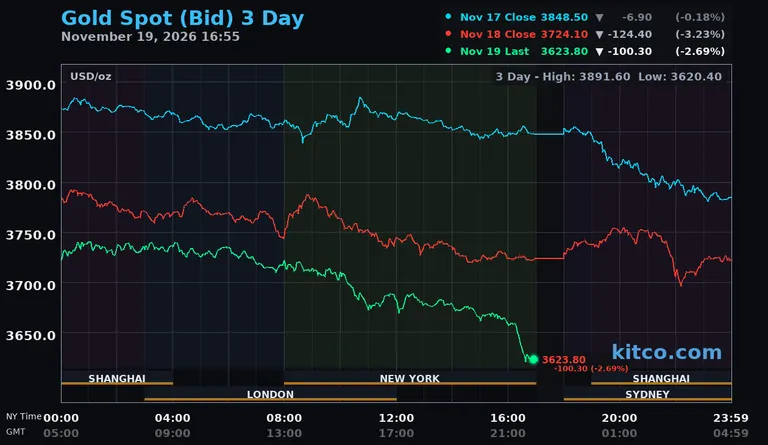
Technically, spot gold bulls' next upside price objective is to push prices back above the $3,678.00 to $3,707.00 resistance zone, with a sustained recovery targeting $3,755.00 and then $3,791.00. Bears' next near-term downside price objective is a break below the session low at $3,625.30, with the longer-term technical outlook identifying $3,500.00 as a deeper potential downside target. First resistance is seen at $3,640.51 and then at $3,678.00. First support is seen at $3,625.30, with deeper support potentially developing near $3,500.00.
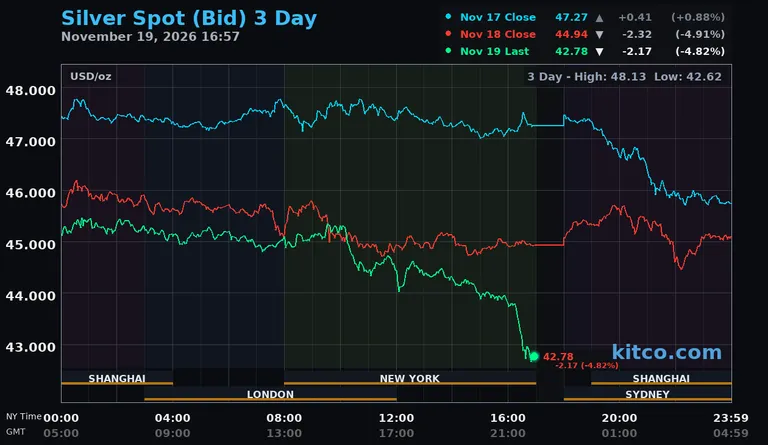
Spot silver bulls' next upside price objective is to drive prices back above the $44.340 to $45.550 resistance zone, with a sustained recovery targeting $45.700 and then $46.060. The next downside price objective for the bears is a sustained break below $42.830, with the next potential downside area near $42.500, based on the corresponding silver futures technical outlook. First resistance is seen at $44.340 and then at $45.550. Next support is seen at $42.830, followed by the $42.500 area.
See live precious metals prices for gold, silver, platinum and palladium — in USD, CAD and 12 more currencies.

