
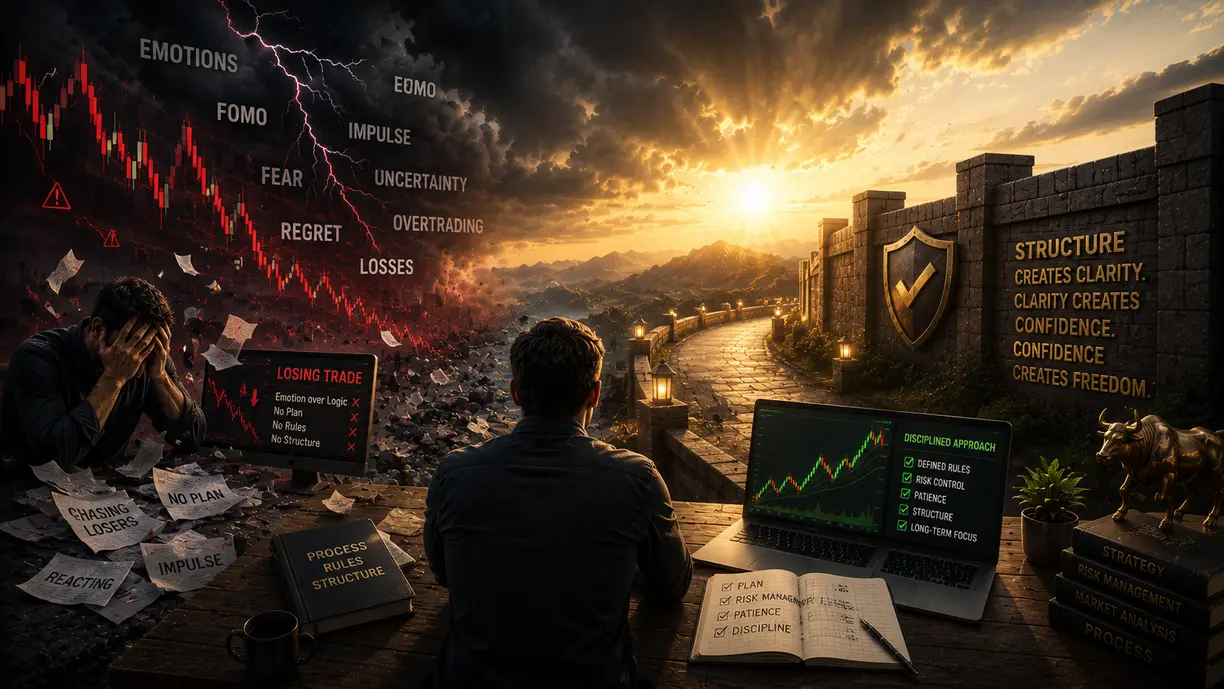
The Moment Willpower Breaks
If you have ever stared at your screen after a bad trade and thought, “Why did I just do that?” I understand the feeling.
I have been there more times than I would like to admit.
Years ago, I found myself reading everything I could about trading psychology, mindset, discipline, and self-control. I thought if I could just become more disciplined, I would stop repeating the same emotional mistakes. I wanted to fix the mental side of trading through willpower.
But no matter how much I learned, I still found myself falling into familiar traps. I would jump into trades too early, hold losers too long, get pulled into FOMO near the top, or sell near the bottom because the pressure became too uncomfortable.
At the time, I thought the problem was me. Eventually, I realized something that changed how I viewed the markets.
It was not only a discipline problem. It was a structure problem.
Why Good Intentions Are Not Enough
Good intentions matter, but they are not enough when real money, real fear, and real uncertainty are involved.
Most investors do not make emotional decisions because they are careless. They make them because the market is designed to create pressure. Prices move quickly. Headlines get loud. Other people seem to be making money. Losses feel personal. And suddenly, the plan that felt so clear when the market was closed becomes much harder to follow when the account balance is moving.
That is why trying harder is often not the answer.
You cannot out-discipline a process that is not clear. You cannot think your way through every emotional moment if the rules are not already defined. And you cannot expect willpower to carry the full weight of every market decision, especially during periods of stress.
I have seen this in my own trading, and I have seen it in many investors over the years.
They know what they want to do. They want to protect capital. They want to stay calm. They want to avoid chasing. They want to stop reacting to headlines. But when the market moves against them or when a rally takes off without them, the emotional pressure builds.
That is when structure matters most.
The Difference Between Discipline And Structure
Discipline is the intention to do the right thing.
Structure is the system that helps make the right thing easier to do when emotions rise.
That difference matters.
Discipline says, “I will not chase this move.”
Structure defines what conditions must be present before action is taken.
Discipline says, “I will protect capital.”
Structure defines when risk has changed and what exposure is appropriate.
Discipline says, “I will stay patient.”
Structure gives patience a role, so it does not feel like hesitation or failure.
Without structure, discipline has to work too hard.
That is where many investors struggle. They are trying to make every decision personally, emotionally, and in real time. They may have a general idea of what they want to do, but they do not have enough process around when to act, when to wait, and when to reduce risk.
The result is often a cycle of good intentions followed by emotional decisions.
A plan is created, then adjusted under pressure. A rule is written down, then bent during volatility. A position is held too long because selling feels uncomfortable. Or a new trade is entered too quickly because missing out feels worse than waiting.
Those moments do not usually happen because someone lacks intelligence. They happen because discipline is being asked to do the job of structure.
Why Guardrails Matter In Difficult Conditions
I think about this like driving on a mountain road.
A careful driver still needs discipline. They still need to pay attention, keep their hands on the wheel, watch their speed, and respect the conditions. But the guardrails matter too.
Guardrails are not there because the driver is weak. They are there because even careful drivers can face fog, ice, fatigue, sharp turns, or an unexpected mistake by someone else on the road. The guardrails do not replace good driving. They help prevent one mistake from becoming life-changing.
Markets are similar.
A disciplined investor still needs awareness, patience, and emotional control. But they also need guardrails. They need a process that defines risk before emotion takes over. They need rules that help prevent one stressful moment from turning into a decision that damages capital, confidence, and time.
This is especially important when the money being managed represents more than a trading account.
For investors approaching retirement or already living through it, a large mistake can affect more than performance. It can affect income decisions, travel plans, family support, peace of mind, and the years ahead. A loss that takes years to recover from is not just a financial setback. It is time redirected toward repair instead of progress.
That is why structure is not about making investing rigid.
It is about creating guardrails before conditions become difficult.
What Structure Protects Besides Capital
A good process protects more than money. It protects decision-making. It protects confidence. It protects emotional energy. It protects time.
That is something I did not fully appreciate early in my career. I was so focused on improving performance that I underestimated the emotional cost of constantly making decisions under pressure. A strategy can look good on paper, but if it forces someone to second-guess every move, react to every headline, or sit through every market swing without a plan, the emotional cost can become too high.
For me, this is where a rules-based process matters.
In our work through ACS, the goal is not to ask investors to rely on willpower at every turn. The goal is to give decisions a structure so that risk, exposure, and patience are guided by evidence instead of emotion.
That does not mean the process removes uncertainty. No strategy can do that. But it can reduce the number of decisions made out of fear, FOMO, or impulse.
One member described the shift very simply: “This is the first time I feel like I have a plan.”
That may sound basic, but to me, it is powerful.
A plan gives discipline something to stand on. It helps investors stop treating every market move as a personal test. It gives them a way to participate when conditions are favorable, become more defensive when conditions weaken, and wait when the evidence does not support action.
That kind of structure can change the entire experience of investing.
The Goal Is Not To Try Harder
I still believe discipline matters. Patience matters. Emotional control matters. The ability to follow rules matters.
But discipline alone is not enough if the structure underneath it is weak.
At some point, the answer is not to try harder, read another mindset book, or blame yourself for every emotional reaction. The better question is whether the process is strong enough to support the behavior you are trying to maintain.
If the process is unclear, every decision becomes harder. If the rules are vague, every market move becomes more emotional. If risk management is not defined in advance, fear often takes over when conditions change.
That is not a personal failure. It is a structure problem.
The goal is to build a process that reduces the need for constant willpower. A process that helps protect capital before damage becomes too large. A process that respects both growth and risk. A process that helps preserve the time, confidence, and flexibility investors have worked so hard to build.
Because in the end, investing should not depend on whether you can muscle your way through every emotional moment.
Discipline is important.
But structure is what helps discipline survive.
Chris Vermeulen
Chief Investment Officer
TheTechnicalTraders.com
P.S. Book your free call with my team now! Pick a day and time here.
Disclaimer:
The content published on this website, including blog posts, videos, research articles, and commentary, is intended solely for informational and educational purposes and should not be construed as investment advice. Technical Traders Ltd. and its affiliates are not registered as investment advisers with the U.S. Securities and Exchange Commission or any state securities authority. The information provided is general in nature and is not tailored to the investment needs of any specific individual. Nothing published on this site constitutes a recommendation to buy, sell, or hold any particular security, commodity, or financial instrument. The views expressed represent the opinions of the authors and are subject to change at any time without notice. Performance results discussed may include live trading outcomes and/or backtested or hypothetical data. Hypothetical results are inherently limited and do not reflect actual trading performance. No representation is made that any account will or is likely to achieve profits or losses similar to those discussed. Past performance is not indicative of future results. All investments involve risk, including the potential loss of principal. Testimonials and user experiences presented may not be representative of others and do not guarantee future success. Some content may contain affiliate links or promotional material, from which we may earn compensation. This does not influence our content or editorial independence. By accessing this website or consuming its content, you acknowledge that you are solely responsible for your own financial decisions and agree to consult a licensed financial professional before acting on any information provided.
