
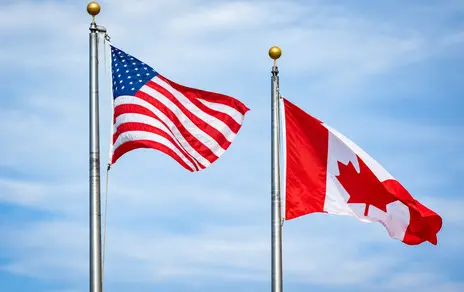
On September 8, Canada hit back with tariffs of 15% to 50% on hundreds of US products, matching the 50% tariffs Donald Trump imposed on $20 billion of Canadian exports at the end of August.
In response to Canada’s response, Trump threatened to block Canadian Bombardier business jets from the US unless the company moves production there, while accusing Ottawa of treating US companies unfairly and urging Americans to buy domestic goods and services.
The real worst-case scenario, though, would be the US scrapping USMCA. For now, Washington has refused to automatically extend the deal with Canada and Mexico for another 16 years, calling instead for a review of disputed provisions.
Beyond hurting profits on all sides, the trade fight could also push inflation higher. According to the Peterson Institute for International Economics, if the US scraps USMCA and imposes 15% tariffs on goods from Canada and Mexico, it could add around 0.27 percentage points to the PCE price index, as the two countries account for 26.9% of US imports, and many goods and components would be hard to replace quickly.
For now, though, the S&P 500, Nasdaq, and Dow Jones are holding up just fine.
But that calm could be tested as soon as this week if inflation comes in above the expected 0.4% month-on-month and 3.4% year-on-year, with core inflation at 2.4%, especially after US payrolls surprised on the upside in August with 162,000 new jobs versus 55,000 expected, which could further raise the odds of a Fed rate hike at next week’s meeting.
Now, even if inflation doesn’t surprise on the upside, oil prices are once again nearing $100 a barrel, so inflation risks aren’t going away.
As for the rest of the world, the ECB meets on September 10, with markets expecting a 25-basis-point hike to 2.5% as inflation has already hit 3.3% on higher energy prices. The question is what comes next, and Lagarde may give us some clues, though the base case is that she will stick to the usual line that the next moves will depend on the data.
In Japan, the BOJ is also expected to hike rates to 1.25% this month, followed by another 25-basis-point increase in December or January as it tries to guard against rising inflation risks.
Hence, global bond yields are still heading higher.