
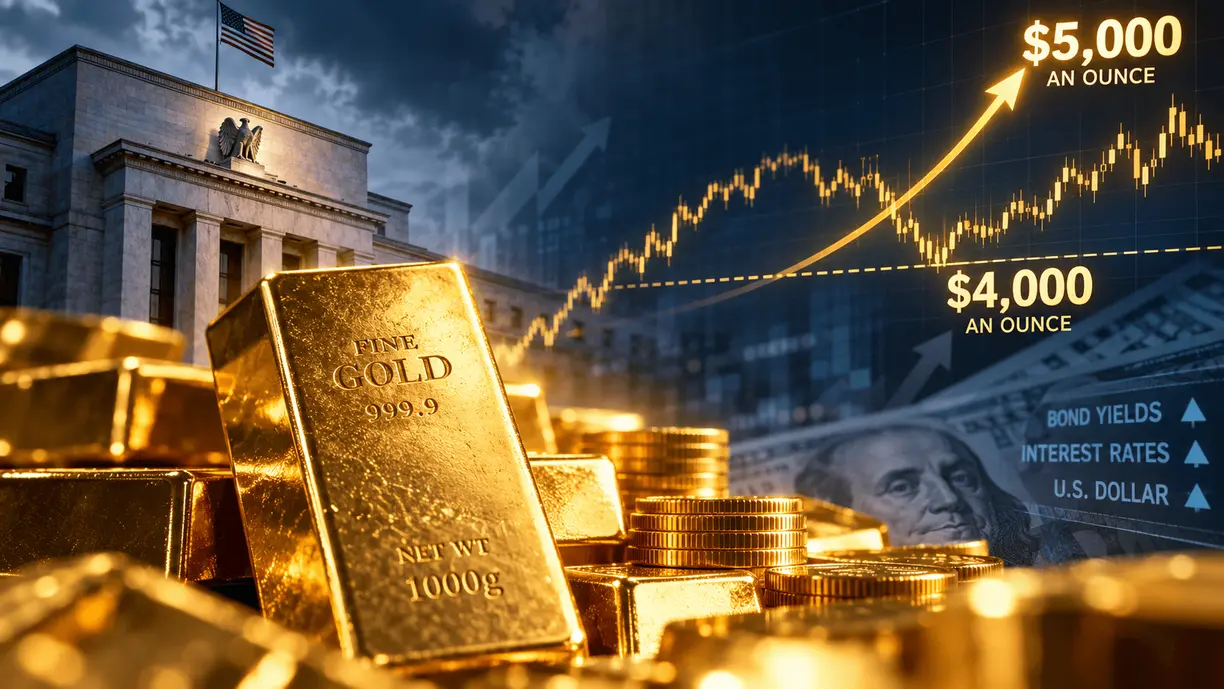
(Kitco News) - Rising interest rate expectations and surging bond yields have the potential to push gold prices back toward $4,000 an ounce within the next week; however, one strategist expects that floor to hold, and while the path higher has become more challenging, prices could still reach $5,000 within the next six months.
In an interview with Kitco News, Aakash Doshi, Head of Gold Strategy at State Street Investment Management, said gold is facing significant tactical headwinds as markets price in a more aggressive Federal Reserve and the U.S. dollar strengthens. However, despite the downside risks, there is still a “structural bid” in the marketplace.
Doshi said the selloff in gold is not surprising given how dramatically interest rate expectations have shifted. He explained that markets have priced in two additional rate hikes since mid-August, while expectations further out on the curve have also shifted significantly. He said gold is effectively reacting to “peak market hawkishness,” with higher nominal and real yields and a stronger U.S. dollar weighing on the precious metal.
However, Doshi said the current correction has not materially altered gold’s longer-term structural outlook.
“The Fed hiking a couple more times, I do think that's a tactical headwind for gold,” he said. “It makes the path to five thousand a little bit more challenging as people look at high real yields.”
He pointed out that higher rates do not solve the longer-term fiscal problems facing the United States and other major economies. In fact, rising borrowing costs exacerbate those challenges by increasing government debt-servicing costs.
That dynamic could explain why gold has remained remarkably resilient despite the dramatic repricing in global bond markets.
Doshi noted that before the COVID-19 pandemic, the U.S. 10-year Treasury yield was around 1.5%. He argued that few investors at the time would have expected that six and a half years later, the 10-year yield could be around 5.3% while gold remained near $4,000 an ounce. He said that divergence illustrates the importance of structural forces beyond gold’s traditional relationship with interest rates.
In its September monthly gold report, State Street said that the reason yields are rising matters. Long-term term premia across the U.S., U.K., France and Germany have climbed to their highest levels since 2011 amid fiscal imbalances, persistent inflation risks and geopolitical uncertainty. U.S. public debt surpassed $40 trillion in August, with the latest trillion dollars accumulated in roughly five months.
Doshi said rising term premia are being driven by three important factors: concerns surrounding institutional credibility, persistent inflation and fiscal imbalances accompanied by increased Treasury supply.
At the same time, Doshi said physical and investment demand, specifically from China, continues to provide underlying support.
State Street noted that Chinese non-monetary gold imports reached a record 1,000 tonnes during the first seven months of 2026, up 78% from the same period last year, even though local gold prices averaged roughly 45% higher year over year.
Doshi also pointed out that Western investors have continued allocating to gold even as prices have declined. He said ETF inflows during September indicate that strategic investors continue to view gold as a hedge against macro-policy uncertainty and risks to fiat currencies.
That follows a major resurgence in Western investment demand during August. Global gold-backed ETFs attracted $17.1 billion during the month, while U.S.-listed funds recorded $7.9 billion in inflows, their strongest month since September 2025.
He also noted that positioning in the gold options market supports the case for higher prices. Doshi pointed out that longer-dated volatility skews remain relatively bullish, with investors continuing to show greater demand for upside exposure. State Street said in its September report that gold derivatives flows had shifted from being put-biased to call-biased, with calls becoming increasingly expensive relative to puts.
