

(Kitco NewsWire) – Spot gold and silver prices were higher in early U.S. trading Monday, supported by a softer dollar, easing crude oil prices and renewed hopes for a diplomatic resolution to the U.S.-Iran conflict. Lower energy prices reduced some inflation concerns ahead of Tuesday's U.S. consumer price index report, although Friday's stronger-than-expected employment figures reinforced expectations that the Federal Reserve could raise interest rates again in December. Spot gold was trading near $4,124.74 an ounce, up $54.15, or 1.33%, while spot silver was trading near $52.759, up $0.815, or 1.57%.
Gold was extending its recovery after gaining approximately 5% last week, when the Democratic sweep of the U.S. midterm elections initially drove Treasury yields and the dollar lower. Precious metals subsequently faced renewed pressure from Friday's stronger employment report, which increased expectations for another Federal Reserve interest rate increase. Monday's rebound reflected a partial reversal of those headwinds as lower crude oil prices helped ease concerns about energy-driven inflation.
Friday's U.S. employment report showed nonfarm payrolls increasing by 165,000 in October, substantially exceeding expectations for approximately 65,000 new jobs. The unemployment rate declined to 4.1% from 4.2%, while average hourly earnings increased 0.4% on the month and 3.1% from a year earlier. August and September payroll figures were revised upward by a combined 84,000 jobs, providing further evidence of stronger labor-market conditions. Professional and business services added 70,000 positions, health care employment increased by 42,000 and transportation and warehousing gained 25,000. The figures reinforced expectations that the Fed has room to maintain restrictive monetary policy while addressing inflation that remains above its 2% target.
The payroll figures followed other economic reports suggesting that business activity remains resilient even as some inflation pressures moderate. Third-quarter nonfarm business productivity increased at a 3.6% annualized rate, while unit labor costs declined 0.7%, suggesting that efficiency gains are helping offset compensation increases. Weekly initial jobless claims fell to 189,000, indicating continued reluctance among employers to reduce staffing. September job openings increased to 7.523 million, while the October Institute for Supply Management manufacturing index rose to 55.5 from 54.5 in September. Together, the reports suggest that labor demand and economic activity remain relatively firm, although higher borrowing costs and recent technology-sector volatility continue to present risks to business investment.
Market positioning remains focused on the Fed's Dec. 8-9 policy meeting and the outlook for inflation following Friday's employment surprise. Interest rate futures indicated approximately a 79% to 81% probability of a 25-basis-point increase in December, compared with roughly 71% before the payroll report. The benchmark 10-year Treasury yield was trading near 4.87% in early Monday dealings, while the more policy-sensitive two-year yield was around 4.54%. The dollar was modestly weaker, providing support for precious metals despite elevated expectations for additional monetary tightening. Lower crude oil prices have helped limit the rise in inflation expectations, but persistent wage growth and resilient hiring remain significant considerations for Fed policymakers.
Tuesday's October consumer price index report, scheduled for release at 8:30 a.m. EST, is the week's principal economic event. Investors will examine both headline and core inflation for evidence that underlying price pressures are moderating, particularly after the substantial rise in energy costs during October. September headline consumer prices increased 0.6% on the month and 3.7% annually. A softer October reading could reduce expectations for December tightening, push Treasury yields and the dollar lower and provide additional support for gold and silver. Conversely, stronger-than-expected inflation would reinforce the implications of Friday's employment surprise, potentially increasing rate hike expectations and placing renewed pressure on non-yielding precious metals.
The October producer price index follows Friday, Nov. 13, at 8:30 a.m. EST, while Thursday's economic calendar includes weekly jobless claims and October existing home sales. Federal Reserve officials are also scheduled to speak during the week, potentially providing additional guidance on the balance between resilient employment and persistent inflation. U.S. bond markets will be closed Wednesday for Veterans Day, although equity markets will remain open. Investors will also monitor corporate earnings, particularly among artificial intelligence-related companies, following last week's sharp technology-sector selloff. Any renewed deterioration in equity sentiment could support defensive demand for gold, although forced liquidation or a further rise in Treasury yields could offset that benefit.
The Strait of Hormuz and U.S.-Iran situation remained a major influence on global energy markets Monday as President Donald Trump indicated that further U.S. military strikes against Iran were highly unlikely while negotiations toward a settlement continued. The comments encouraged traders to reduce some of the geopolitical risk premium embedded in crude oil prices, extending last week's sharp decline. Diplomatic efforts involving Washington, Tehran and regional mediators remain focused on ending the confrontation and restoring more normal commercial shipping conditions. However, no binding settlement has been announced, and the terms of any agreement remain uncertain.
The underlying security situation remains fragile despite the more conciliatory diplomatic signals. Both the United States and Iran have reported attacks affecting commercial shipping in or near the Strait of Hormuz, highlighting the continuing vulnerability of energy transportation through the strategic waterway. Threats to tanker traffic, uncertainty surrounding sanctions and maritime restrictions and the possibility of renewed military escalation mean that normal shipping conditions cannot be assumed to have returned. Further progress in negotiations could reduce freight costs, insurance premiums and crude oil's geopolitical risk premium, while additional attacks or a breakdown in talks could quickly reverse the decline in energy prices.
Crude oil futures moved sharply lower Monday as the prospect of renewed diplomacy encouraged traders to reassess supply-disruption risks. Brent crude fell toward $94.76 a barrel in morning trading, while WTI also declined as investors weighed the possibility of reduced tensions against continuing maritime security concerns. Lower energy prices provide some relief from inflation expectations, potentially limiting the need for additional Federal Reserve tightening and reducing the opportunity cost of holding gold. However, Friday's strong payroll figures mean that a sustained improvement in the precious metals outlook will also depend on evidence that consumer and producer price inflation is moderating. Silver has benefited from improving investment sentiment but remains sensitive to industrial demand, financing conditions and the broader outlook for manufacturing activity.
Global equity markets were firmer before the U.S. open as technology shares recovered from last week's heavy selling and investors responded to the decline in crude oil prices. S&P 500 futures advanced approximately 0.7%, while Dow futures rose around 1% and Nasdaq futures gained about 0.4%. Asian markets rebounded, with the broader MSCI Asia-Pacific index outside Japan rising approximately 2%, Japan's Nikkei gaining about 3.5% and Taiwan's benchmark advancing more than 6%. European equities also moved higher as lower energy prices and improving risk sentiment provided some relief from concerns about corporate costs and restrictive monetary policy. Nevertheless, uncertainty surrounding artificial intelligence investment, technology-sector regulation and the upcoming U.S. inflation data continued to limit confidence in a sustained equity-market recovery.
The key outside markets see Nymex WTI crude oil prices under pressure and Brent crude trading near $94.76 a barrel. The yield on the benchmark 10-year U.S. Treasury note was near 4.87%, while the two-year yield was approximately 4.54%. The U.S. dollar was modestly weaker as lower oil prices tempered some inflation concerns. (Kitco Global Index shows how much of today's gold move is the dollar versus the gold market itself.)
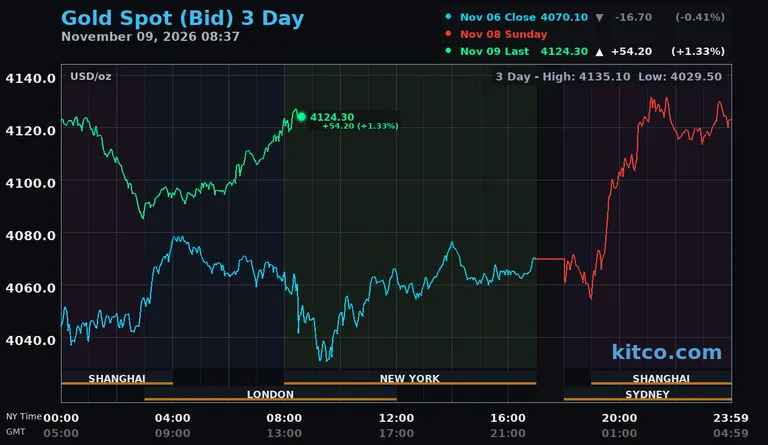
Technically, spot gold bulls' next upside price objective is to push prices through the $4,147.62 resistance level, with a sustained four-hour close above that area and the descending trendline targeting $4,200.09. A further confirmed breakout could bring the broader $4,250.00 resistance area into focus. Bears' next near-term downside price objective is a break below $4,088.51, with deeper downside targets at $4,051.45 and then $4,000.00. First resistance is seen at $4,147.62 and then at $4,200.09. First support is seen at $4,088.51 and then at $4,051.45.
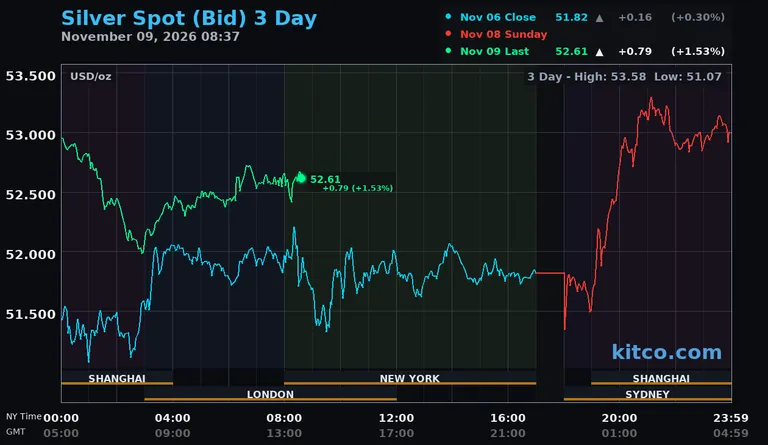
Spot silver bulls' next upside price objective is to drive prices above the $53.107 to $54.617 resistance zone, with a sustained move through the upper boundary targeting the broader $55.000 resistance area. The next downside price objective for the bears is a break below $51.153, with deeper downside targets at $49.989 and then $48.000. First resistance is seen at $53.107 and then at $54.617. Next support is seen at $51.153 and then at $49.989.
See live precious metals prices for gold, silver, platinum and palladium — in USD, CAD and 12 more currencies.

