

(Kitco NewsWire) - Spot gold and silver prices are sharply higher in early U.S. trading Monday, supported by bargain hunting, short covering and reduced expectations of aggressive Federal Reserve tightening following last week's heavy selling across global financial markets. In overnight trading, spot gold climbed 2.4% to $3,616.51 an ounce, while spot silver advanced 5.0% to $43.20 an ounce.
The rebound follows a punishing week for precious metals. Gold declined approximately 9%, its steepest weekly loss since March, and touched a 14-month low. Silver also suffered heavy losses as investors liquidated readily tradable assets amid a sharp correction in technology shares and growing concerns about the sustainability of artificial intelligence investment.
David Morrison, senior market analyst at Trade Nation, said Monday that the correction in gold and silver following their late-January record highs appears increasingly extended. Gold's weekly moving average convergence divergence indicator, or MACD, has fallen below levels recorded during the depths of its 2013 bear market, while silver's weekly MACD has reached exceptionally oversold territory.
These extreme momentum readings suggest the potential for a significant rebound. However, Morrison cautioned that daily momentum indicators have yet to confirm a sustainable reversal, leaving both metals vulnerable to renewed selling despite Monday's recovery.
Morrison also highlighted the role of the recent AI-driven equity selloff, noting that investors were forced to liquidate gold and silver to raise cash and meet margin requirements on leveraged technology positions. He suggested the latest decline could represent a final wave of liquidation, with bearish traders potentially becoming more inclined to take profits.
The broader equity-market correction has complicated gold's traditional safe-haven role. While sustained weakness in AI-related shares could eventually strengthen defensive demand, disorderly selling can initially pressure bullion as investors prioritize liquidity. Monday's recovery suggests some immediate selling pressure may be easing, although further equity-market volatility remains a risk.
The latest U.S. economic data have also provided support. The University of Michigan's final November consumer sentiment index improved to 51.5 from 48.0 in October, while year-ahead inflation expectations declined to 3.7% from 4.7%.
The softer inflation expectations, combined with concerns about economic growth following the technology-sector selloff, have encouraged traders to reassess the Federal Reserve's policy outlook. Markets continue to anticipate another rate increase in December, but expectations for more aggressive tightening have diminished.
Attention now turns to Wednesday's personal consumption expenditures inflation report, which could determine whether the recent repricing of Fed expectations continues. Softer inflation would reduce pressure on policymakers to raise rates aggressively, while another upside surprise could renew support for the dollar and Treasury yields.
Geopolitical tensions remain another influence on precious metals. The unresolved U.S.-Israeli conflict with Iran continues to threaten energy infrastructure and commercial shipping around the Strait of Hormuz. Renewed attacks on Gulf shipping and reports of an attack on a Saudi Arabian refinery over the weekend have maintained a risk premium in crude oil.
For gold, the implications remain mixed. Geopolitical uncertainty supports safe-haven demand, but prolonged energy disruptions could sustain inflation and encourage restrictive monetary policy, limiting the metal's upside potential.
The Treasury market presents another challenge. The benchmark 10-year U.S. Treasury yield finished Friday near 4.92%, while the 30-year yield remained above 5%. Persistent federal deficits, expanding sovereign debt and rising debt-servicing costs continue to raise concerns about the sustainability of U.S. government borrowing.
Although fiscal uncertainty may strengthen gold's longer-term appeal as an alternative reserve asset, elevated Treasury yields remain a near-term obstacle for non-yielding bullion.
The key outside markets see Nymex WTI crude oil trading near $83.00 a barrel, while Brent crude was around $92.00. The U.S. dollar index was weaker near 103.6 points, providing additional support for precious metals.
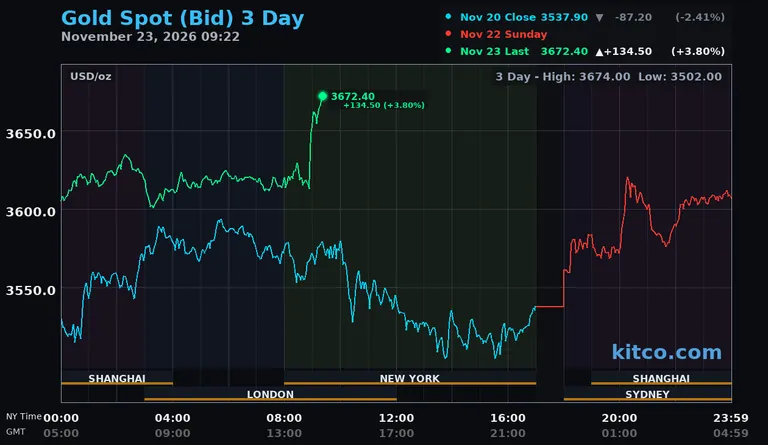
Technically, spot gold bulls' next upside price objective is to push prices above the $3,651.00 resistance level, with a sustained move targeting $3,695.00 and then $3,700.00. Bears' next downside price objective is a break below $3,595.00, with deeper downside targets at $3,503.00 and then the $3,500.00 area. First resistance is seen at $3,651.00 and then at $3,695.00. First support is seen at $3,595.00 and then at $3,503.00. Morrison identified the $3,500 area as former resistance turned potential support, although daily momentum has not confirmed a durable recovery.
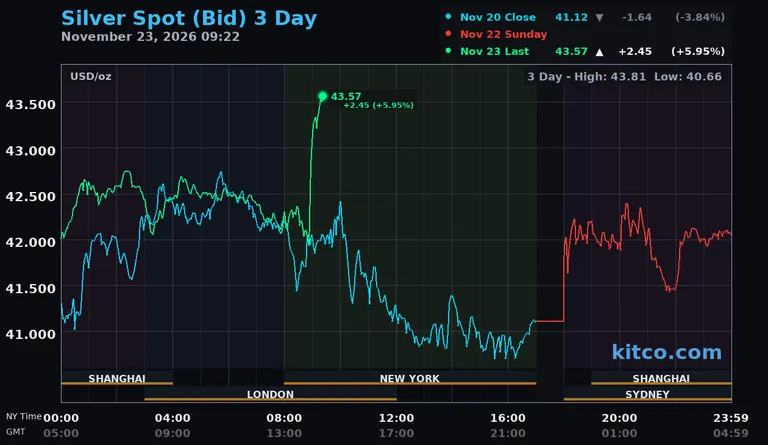
Spot silver bulls' next upside price objective is to drive prices above $42.57, with a sustained move targeting $43.12. The next downside price objective for the bears is a break below $41.89, with deeper downside targets at $40.77 and then $40.05. First resistance is seen at $42.57 and then at $43.12. Next support is seen at $41.89 and then at $40.77. Silver remains technically vulnerable despite improving momentum, with Morrison's extreme weekly MACD readings suggesting that selling exhaustion could support a more substantial recovery.
See live precious metals prices for gold, silver, platinum and palladium — in USD, CAD and 12 more currencies.

