

(Kitco NewsWire) - Gold and silver prices rebounded strongly Monday after last week's steep selloff, supported by bargain hunting and improving risk sentiment as global equity markets recovered. However, persistent Federal Reserve tightening concerns, elevated Treasury yields and geopolitical uncertainty continue to challenge the sustainability of the precious metals recovery. In late-afternoon trading, spot gold was near $3,635.10 an ounce, up 2.75%, while spot silver was around $43.020 an ounce, up approximately 4.62%.
U.S. economic data offered a mixed assessment of growth and inflation. November's flash composite purchasing managers' index declined to 54.6 from 55.9 in October, while services activity slowed to 54.7 from 56.1. Manufacturing eased to 54.5 from 54.9. The moderation suggests economic activity is cooling, although persistent price pressures complicate the Federal Reserve's policy outlook. Traders have reduced some expectations for a December rate increase following weaker economic indicators and declining inflation expectations, but further tightening remains a material risk. The next major test comes Wednesday with October's personal consumption expenditures inflation report, which could reshape rate expectations and Treasury yields.
North American equities staged a substantial recovery following last week's technology-led correction. The S&P 500 closed up 4.74% at 7,237.17, while the Nasdaq Composite gained 6.51% to 24,089.56. The Dow Jones Industrial Average advanced approximately 3.01% to 49,595.31. Canada's S&P/TSX Composite gained 2.69% to 34,081.44, supported by technology and mining shares. European stocks also rallied, with the STOXX 600 climbing 1.9% to 637.84, Germany's DAX advancing approximately 2.3% to 25,363.70, France's CAC 40 gaining 1.48% and Britain's FTSE 100 rising 1.35%.
The recovery followed renewed confidence in artificial intelligence stocks after Nvidia reinstated Jensen Huang as chief executive. However, recent volatility has exposed concerns over stretched technology valuations, extensive AI infrastructure spending and the returns on those investments. Gold has experienced conflicting pressures during the equity selloff. While deteriorating risk appetite increases its appeal as a safe-haven asset, investors have also liquidated precious metals to raise cash, reduce leverage and meet margin requirements. Monday's simultaneous rebound in equities and bullion suggests reduced liquidation pressure, although it does not establish that the broader correction has ended.
The Strait of Hormuz remains a significant geopolitical risk as the unresolved U.S.-Israeli conflict with Iran continues to threaten regional energy infrastructure and commercial shipping. Weekend attacks on Gulf vessels and reported Houthi strikes against Saudi energy facilities underscored persistent supply vulnerabilities. Nevertheless, recovering Middle Eastern oil flows and the restart of a Libyan pipeline weighed on crude prices Monday. WTI settled down 3.9% at $80.17 a barrel, while Brent declined 3.5% to $89.37. The conflict maintains an underlying geopolitical risk premium for gold, although immediate liquidity requirements and interest-rate expectations have recently exerted greater influence over bullion prices.
U.S. Treasury yields remain another significant consideration for precious metals. The benchmark 10-year yield finished near 4.92%, following its earlier advance above 5%. With federal borrowing continuing to expand, sustained elevated yields increase debt-servicing costs and raise questions about the long-term sustainability of U.S. fiscal policy. Higher yields increase the opportunity cost of holding non-yielding gold, but persistent deficits and rising refinancing requirements could eventually strengthen demand for bullion as an alternative monetary reserve asset.
Matthew Jones, co-founder and precious metals analyst at Britannia Bullion, believes last week's approximately 9% gold decline inflicted significant technical damage. His base case heading into 2027 is consolidation rather than an immediate return to previous highs.
However, Jones said that a sustained break below $3,500, followed by an unsuccessful recovery, would be a warning that the longer-term bullish structure is deteriorating. He also argues that falling real yields and a weaker dollar could support gold before the Federal Reserve begins cutting interest rates. (Kitco Global Index shows how much of today's gold move is the dollar versus the gold market itself.)
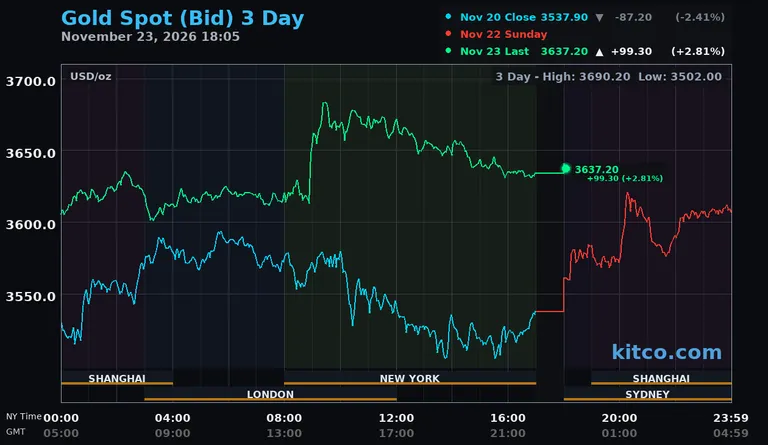
Technically, spot gold bulls' next upside price objective is to push prices above the $3,651.00 to $3,695.00 resistance zone, with a sustained recovery targeting $3,679.98 initially and then $3,700.00. Bears' next near-term downside price objective is a break below $3,595.00, with deeper downside targets at $3,503.00 and then $3,485.14. First resistance is seen at $3,651.00 and then at $3,679.98. First support is seen at $3,609.08 and then at $3,595.00.
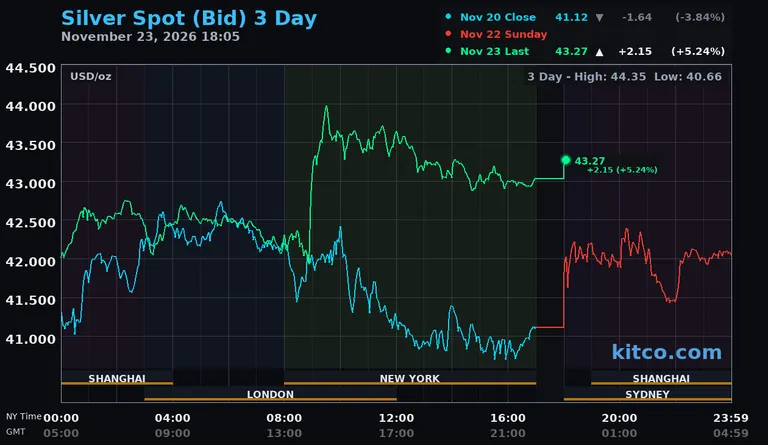
Spot silver bulls' next upside price objective is to drive prices above the $43.120 to $44.0527 resistance zone, with a sustained recovery targeting the session high at $44.350. The next downside price objective for the bears is a break below $41.890, with deeper downside targets at $40.770 and then $40.3158. First resistance is seen at $43.120 and then at $44.0527. Next support is seen at $42.6558 and then at $41.890.
See live precious metals prices for gold, silver, platinum and palladium — in USD, CAD and 12 more currencies.

