

(Kitco NewsWire) - Spot gold and silver prices were higher in late U.S. trading Wednesday, staging a recovery from steep morning losses as falling Treasury yields and a broad rebound in North American equities helped stabilize precious metals despite stronger-than-expected U.S. economic growth and persistent inflation. Gold recovered above $3,570.00 an ounce after briefly falling below $3,450.00, while silver rebounded above $41 after earlier testing its lowest levels in more than a year. The recovery coincided with a sharp reversal on Wall Street, where major indexes erased much of their early losses as technology-sector selling moderated ahead of the Thanksgiving holiday. Spot gold was trading near $3,576.30 an ounce, up $21.20, or 0.60%, while silver was trading near $41.120, up $0.320 or 0.78% on the session. Gold traded between $3,426.40 and $3,590.00 during the session, while silver's range extended from $38.090 to $41.590.
Wednesday's U.S. economic data highlighted the resilience of the American economy despite persistent inflation and concerns about slowing activity in selected sectors. The October personal consumption expenditures price index increased 0.3% on the month and 3.8% from a year earlier, compared with September's annual increase of 3.7%. The core PCE index, excluding food and energy, also increased 0.3% on the month, while annual core inflation accelerated to 3.3%, reinforcing concerns about underlying price pressures. Meanwhile, the second estimate of third-quarter gross domestic product indicated that the economy expanded at an annualized 4.3%, exceeding expectations near 3.6%. Personal income increased 0.7% in October, while consumer spending advanced 0.3%, although inflation-adjusted spending was essentially unchanged. Durable goods orders rose just 0.2%, indicating a more uneven picture of business investment. The combination of strong economic growth, persistent inflation and slower real consumer spending highlighted the increasingly difficult policy environment facing the Federal Reserve as it considers further monetary tightening.
Market positioning remained focused on the Federal Reserve's Dec. 8-9 policy meeting, with Wednesday's stronger GDP figures and elevated core PCE inflation reinforcing expectations for another 25-basis-point interest rate increase. Futures markets had assigned a probability exceeding 95% to a quarter-point increase ahead of the data, although the subsequent decline in Treasury yields suggested that demand for government securities was also reflecting concerns about equity valuations and the outlook for economic growth. The benchmark 10-year Treasury yield declined approximately 5.6 basis points to 4.845%, while the two-year yield fell around 3.5 basis points to 4.633%. The decline in borrowing costs helped ease pressure on precious metals after their sharp morning selloff, although the Fed's continued inflation concerns maintained uncertainty about the trajectory of rates into 2027. Investors will now assess the implications of Wednesday's data during the Thanksgiving holiday, with U.S. stock and Treasury markets closed Thursday and a shortened equity trading session Friday. Reduced liquidity could amplify price fluctuations in gold and silver, particularly if additional geopolitical or monetary policy developments emerge before regular trading resumes.
The Strait of Hormuz and U.S.-Iran situation remained unsettled Wednesday as continuing attacks on commercial shipping and stalled diplomatic negotiations maintained risks to petroleum exports through the strategic waterway. Recent incidents involving tankers and other commercial vessels highlighted the continuing security threats facing regional shipping, while the U.S. naval blockade of Iranian ports remained an obstacle to renewed negotiations. Military activity and the threat of further disruption have continued to support a geopolitical risk premium in crude oil, although recovering production and shipments outside the most affected areas have helped contain the broader supply impact. The continuing uncertainty has encouraged caution among shipping operators and energy traders, particularly ahead of the holiday period when market liquidity is expected to decline. For gold, the unresolved confrontation continues to provide a potential source of defensive demand, although Wednesday's trading indicated that interest rate expectations, financial-market positioning and changes in Treasury yields remained more immediate influences on bullion.
Crude oil prices recovered Wednesday as renewed concerns about Gulf shipping security and a smaller-than-expected increase in U.S. crude inventories supported the energy market despite expectations for a global petroleum surplus. Nymex WTI crude futures were trading near $84.07 a barrel in late-afternoon market indications, while Brent crude was near $89.62 in available futures data. The U.S. Energy Information Administration reported that commercial crude inventories increased by 1.1 million barrels to 418.9 million barrels during the week ended Nov. 20, compared with expectations for an increase of approximately 2.0 million barrels. Gasoline inventories rose 1.7 million barrels, while distillate stocks increased 700,000 barrels. Refinery utilization climbed to 97.5% of capacity, reflecting strong processing activity. The smaller crude build offered some support to oil prices, although expectations for growing global petroleum supply continued to limit the recovery. Investors now turn to the Nov. 29 OPEC+ meetings for further signals about production policy and the balance between recovering supply and uncertain demand growth.
North American equity markets finished mixed Wednesday after staging a substantial recovery from sharp early losses as selling in artificial intelligence-related companies moderated during the afternoon. The Dow Jones Industrial Average advanced approximately 164 points, or 0.33%, to close at 50,182.95, while the S&P 500 declined 0.25% to finish at 7,182.78. The Nasdaq Composite fell 0.62% to 23,585.80, and the Russell 2000 advanced 0.7% to 2,704.06. The S&P 500 had fallen as much as 3.2% during the session before recovering most of its losses, reflecting a sharp improvement in risk sentiment after the morning selloff. Technology stocks remained under pressure amid concerns about artificial intelligence investment, elevated valuations and prospective U.S. trade restrictions, but losses moderated as investors reassessed the extent of the recent correction. Eight of the S&P 500's 11 sectors finished higher, while advancing stocks outnumbered decliners on both major U.S. exchanges. The recovery coincided with renewed demand for precious metals, suggesting that gold and silver benefited from easing liquidation pressure as broader financial markets stabilized.
Canada's S&P/TSX Composite Index also staged a substantial intraday recovery Wednesday after declining nearly 600 points during morning trading as technology and resource-related shares came under heavy selling pressure. The benchmark had fallen to approximately 33,252.52 during the session before recovering above 34,100 in afternoon dealings to close near 34,178.91, up approximately 0.63% on the session. Canadian financial and energy shares contributed to the recovery, while selected technology and mining companies rebounded as U.S. equities stabilized and precious metals recovered from their session lows. The reversal illustrated the volatility affecting resource-heavy markets as investors weighed stronger U.S. growth and inflation figures against falling Treasury yields and improved risk sentiment.
European equity markets finished lower Wednesday, extending Tuesday's losses as technology, financial and industrial shares declined amid renewed concerns about artificial intelligence valuations and additional U.S. trade restrictions. The pan-European Stoxx 600 fell 1.06% to close at 626.03, while Germany's DAX declined 1.26% to 24,702.13. France's CAC 40 lost 0.75% to 7,980.57, and the U.K.'s FTSE 100 declined 0.38% to 10,426.94. Semiconductor and technology companies remained under pressure as investors assessed the implications of heavy artificial intelligence investment and potential restrictions on advanced technology exports. The U.S. administration's plans for additional tariffs on major trading partners, including China, Japan and the European Union, also weighed on sentiment. Germany's third-quarter economic growth slowed to 0.1% from 0.3% in the preceding quarter, adding to concerns about the region's economic outlook. Selected consumer and automotive shares demonstrated relative resilience, although the broader decline reflected continued uncertainty surrounding international trade, corporate profitability and restrictive monetary policy.
The key outside markets see Nymex WTI crude oil futures higher, with late-afternoon indications near $84.07 a barrel, while Brent crude was near $89.62 in the available futures data. The benchmark 10-year U.S. Treasury yield declined toward 4.85%, while the two-year yield eased near 4.63%. The dollar remained comparatively firm, although lower Treasury yields and the recovery in equity markets helped gold and silver rebound from their morning lows. Persistent expectations for additional Federal Reserve tightening continued to present a headwind for precious metals, but Wednesday's reversal indicated that easing liquidation pressure and improving risk sentiment could offset some of the immediate impact of stronger U.S. inflation and growth figures. (Kitco Global Index shows how much of today's gold move is the dollar versus the gold market itself.)
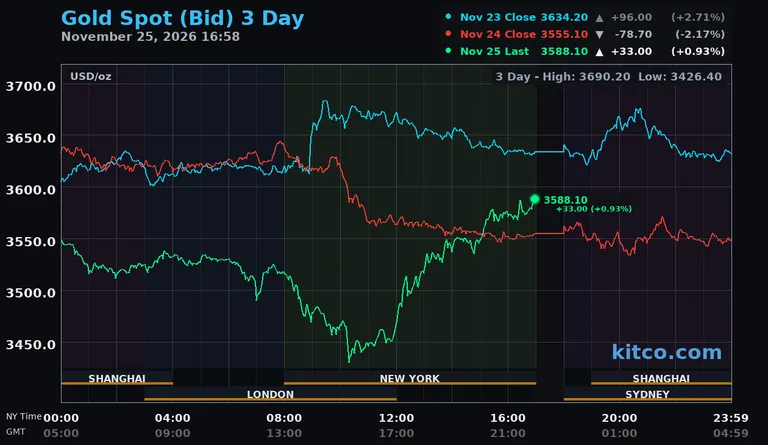
Technically, spot gold bulls' next upside price objective is to push prices back above the $3,592.11 to $3,637.59 resistance zone, with a sustained recovery targeting $3,700.00. Bears' next near-term downside price objective is a renewed break below $3,505.74, with deeper downside targets at $3,450.00 and then the $3,380.00 to $3,400.00 support zone. First resistance is seen at $3,592.11 and then at $3,637.59. First support is seen at $3,505.74 and then at $3,450.00.
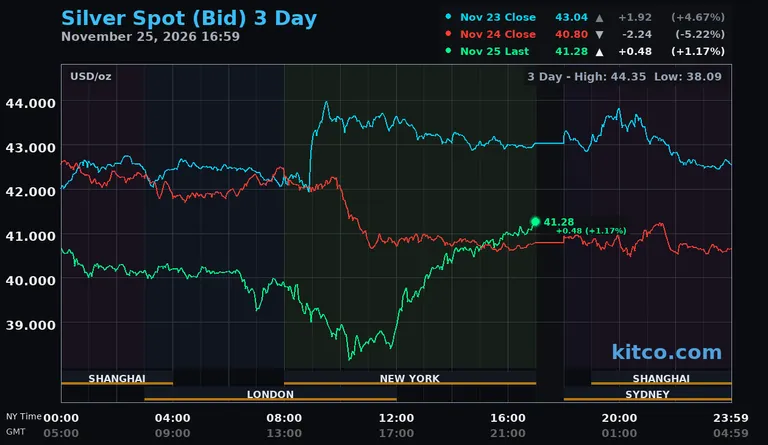
Spot silver bulls' next upside price objective is to drive prices back above the $41.879 to $43.074 resistance zone, with a sustained recovery targeting $45.000. The next downside price objective for the bears is a break below $39.732, with deeper downside targets at $38.000 and then $37.500. First resistance is seen at $41.879 and then at $43.074. Next support is seen at $39.732 and then at $38.000.
See live precious metals prices for gold, silver, platinum and palladium — in USD, CAD and 12 more currencies.

