
(Kitco News) - Gold and silver prices are expected to remain historically elevated through 2027, but investors should not expect a repeat of the explosive gains and volatility that defined 2026, according to the latest report from the World Bank.
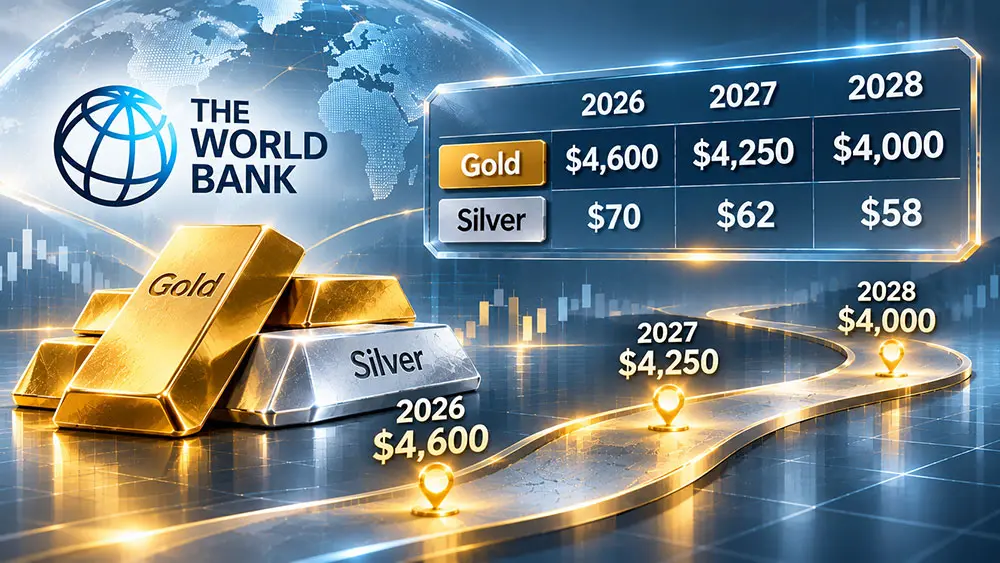
In its October Commodity Markets Outlook, analysts at the World Bank forecast gold prices to average $4,600 an ounce this year, a 33.6% increase from 2025. However, the bank expects prices to fall 7.6% to an average of $4,250 an ounce in 2027, followed by a further 5.9% decline to $4,000 in 2028.
The outlook is slightly more bearish than the bank's April forecast, which projected gold prices averaging $4,700 this year and $4,300 in 2027.
Silver is expected to face even greater downside pressure after significantly outperforming gold this year. The World Bank forecasts silver prices to average $70 an ounce in 2026, representing a nearly 76% annual gain. Prices are then expected to fall more than 11% to $62 an ounce in 2027 and another 6.5% to $58 in 2028.
Although the analysts expect both precious metals to lose some momentum, their forecasts suggest that prices will remain well above historical averages as geopolitical uncertainty and demand for portfolio diversification continue to provide long-term support.
The World Bank expects its broader precious metals price index to rise nearly 40% this year before declining 8.3% in 2027 and another 6% in 2028. Despite the projected correction, prices are expected to remain more than three times their average levels between 2015 and 2019.
The relatively cautious outlook comes as the gold market struggles to regain its footing following a historic rally that pushed prices to record highs earlier this year.
World Bank noted that gold prices fell 5% in the third quarter, with selling pressure continuing into October. The bank noted that rising government bond yields, expectations of tighter monetary policy and a stronger U.S. dollar have weighed on investor sentiment.
The Federal Reserve's September interest rate increase, along with similar moves by other major central banks, has created significant headwinds for non-yielding assets such as gold and silver. At the same time, a dramatic shift in bullish speculative positions has added to recent selling pressure.
However, the World Bank noted that gold's underlying fundamentals remain relatively healthy, particularly as investors and central banks continue to diversify their financial holdings.
According to the report, investment demand and central bank purchases accounted for roughly half of global gold demand during the first six months of 2026. Although both sources of demand are expected to moderate over the next two years, they should continue to provide a solid foundation for prices.
The bank also noted that central bank gold purchases have started to increase again after slowing earlier in the year, suggesting that official-sector demand could provide additional upside support.
However, not all segments of the gold market are expected to remain resilient. Jewelry demand has declined sharply since 2023, and the World Bank expects consumption to remain weak as elevated prices discourage buyers.
On the supply side, mine production is expected to increase only modestly, while higher prices should continue to encourage recycling. The bank expects gold prices to remain more than 75% above their average levels between 2021 and 2025, even after the projected declines through 2028.
While gold continues to benefit from strong investment fundamentals, the outlook for silver is more complicated because of its significant exposure to industrial demand.
The World Bank noted that silver prices fell 14% in the third quarter as physical market tightness eased and higher interest rates weighed on investment demand.
Looking ahead, the bank expects elevated silver prices to encourage industrial consumers to reduce their exposure to the precious metal, particularly in the solar energy sector. Manufacturers are increasingly looking at efficiency improvements and replacing silver with copper-based metallization in photovoltaic applications.
At the same time, higher prices are expected to weigh on jewelry and silverware consumption.
However, the bank noted that demand from electronics, data centers, automotive applications and power infrastructure should continue to grow, providing some support for the market.
Silver mine production is expected to increase only modestly, but recycling should expand as higher prices encourage consumers and manufacturers to recover more metal. Combined with weaker demand, these supply gains are expected to gradually ease market tightness through 2028.
Despite the projected declines in gold and silver prices, the World Bank noted that risks to its precious metals forecasts remain broadly balanced.
Escalating geopolitical tensions, particularly in the Middle East, could renew safe-haven demand. Increased financial market volatility and stronger-than-expected central bank gold purchases could also push prices above the bank's baseline forecasts.
The analysts said that the biggest downside risk remains tighter monetary policy, particularly in the United States. Higher-than-expected interest rates and a stronger U.S. dollar could further reduce investor appetite for non-yielding assets. (Kitco Global Index shows how much of today's gold move is the dollar versus the gold market itself.)
The bank also warned that weaker global economic growth could hurt silver's industrial demand, while renewed profit-taking and rapid deleveraging could amplify selling pressure across precious metals markets.
Looking at the broader commodity market, the World Bank expects prices to increase 23% this year, driven largely by energy supply disruptions and geopolitical uncertainty, before declining 7% in 2027. However, the bank warned that the outlook remains highly vulnerable to further geopolitical and weather-related disruptions, particularly as the Middle East conflict continues and a powerful El Niño threatens agricultural production. The report cautioned that the various risks could reinforce one another, creating a more difficult environment for global inflation and monetary policy.
“Setbacks on these fronts could mean persistently high energy prices and stress in food markets,” the World Bank said.
See live precious metals prices for gold, silver, platinum and palladium — in USD, CAD and 12 more currencies.

