
Every junior mining news release is written by two people at once: a geologist trying to report results accurately, and an investor relations team trying to get those results read. Most of the time the tension between them is invisible unless you know where to look. In thirty years running exploration programs across Zambia, Ethiopia, and half a dozen other countries, I've watched that tension play out release after release, and the gap between what a release says and what it actually means rarely comes from dishonesty. It comes from selective emphasis, and selective emphasis has a pattern once you've seen it enough times to recognize the shape of it.
Start with the interval, not the headline
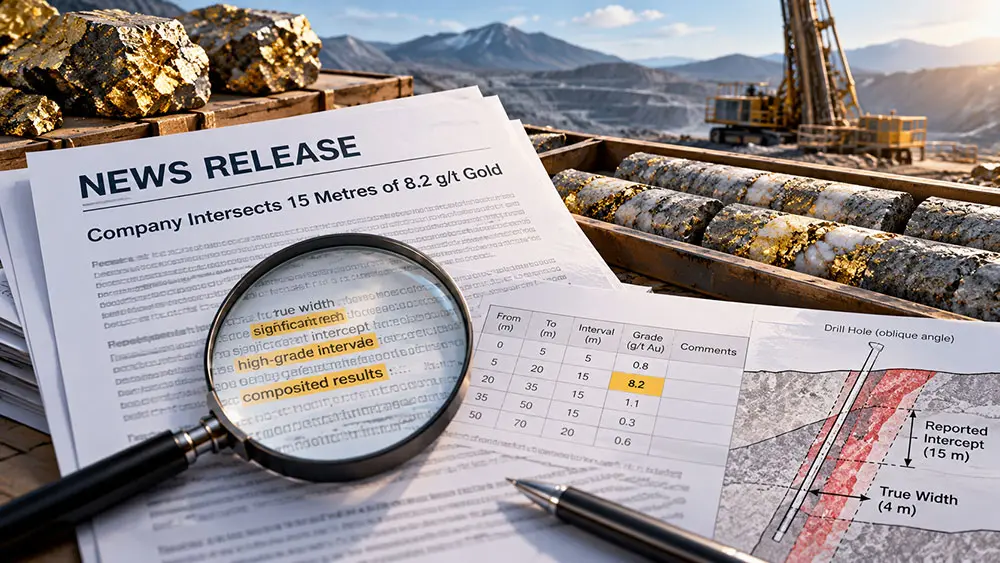
A headline like "Company X Intersects 15 Metres of 8.2 g/t Gold" tells you almost nothing on its own. The number that matters more is usually buried a few paragraphs down: true width. Drill holes rarely hit a mineralized zone at a perfect right angle, so the reported intercept, the length of core that assayed above cutoff, is often longer than the zone actually is once you measure it perpendicular to the structure. A 15-metre intercept through a vein that's genuinely 4 metres wide, hit at a shallow angle, is a very different rock than a 15-metre intercept through a 15-metre zone hit straight on. Companies aren't required to report true width until they've drilled enough to model the geometry with confidence, and plenty of early releases simply don't have it yet. That's a legitimate gap. The problem is when a release leans on the bigger, uncorrected number in the headline and leaves the caveat about geometry to a footnote, or skips it entirely.
"Significant intercept" is doing a lot of work
Watch for "significant intercept" or "high-grade intercept" attached to a single number pulled from a much longer, lower-grade interval. A release might report 1 metre at 42 g/t gold "within" a broader 20-metre interval averaging 1.1 g/t. Both numbers are real. But a single metre of high grade inside twenty metres of ordinary rock describes a narrow, possibly discontinuous vein, not a bulk-tonnage deposit, and the economics of those two things aren't in the same conversation. I've logged core where that one hot metre was a genuine nugget effect, real gold, real grade, sitting inside material that will never support a mine on its own. Read the full interval table before you read the number in the second paragraph.
One hole is not a trend
A step-out drilling program might include eight or ten holes testing the edges of a known zone. The headline will almost always lead with the single best result, the one hole that hit high grade over a wide interval, because that's the number that moves a share price on the day. What it won't tell you is how many of the other holes in that same batch came back at background levels or missed the target entirely. A company reporting one exceptional hole out of eight isn't lying about that hole. But a 12% hit rate on step-outs describes a very different deposit than an 80% hit rate, and the release almost never frames it in those terms. If you can get hold of the full batch of assay results rather than the one that made the headline, count the misses yourself before you decide what the trend actually is.
Composited results deserve a second look
Grade times width sounds like simple arithmetic, but how a company composites individual assay intervals into one reported number can flatter the outcome. Compositing across a short internal low-grade section to keep an interval "continuous" is standard practice with defensible rules behind it, but those rules vary by company and aren't always spelled out in the release itself. A common convention caps how much internal low-grade material can be folded into a single interval, often two or three metres, before the composite has to break. "Common convention" isn't "universal rule," though, and two companies reporting what looks like the same style of intercept can be applying different cutoffs entirely. If a table shows several thin high-grade intervals separated by unassayed or low-grade gaps, and the press release quotes one long composited number, go find the drill hole table. It's usually in the technical appendix or the SEDAR+ filing, not the release you'd read on a headline scan.
Watch the resource category, not just the number
When a release quotes total tonnage or ounces, check whether that number blends resource categories. Under the reporting frameworks most junior miners work within, a resource is classified as measured, indicated, or inferred, in descending order of geological confidence, and inferred material carries enough uncertainty that it can't be used in a feasibility-level economic study without further drilling to upgrade it. A headline that reads "2.1 million ounces" without breaking out how much of that sits in the inferred category is presenting the biggest possible number with the least possible scrutiny attached to it. The confidence level isn't a footnote. It's close to the whole story.
Historic versus current is not a technicality
Older properties, especially ones with a prior operator, often carry historic resource estimates calculated decades ago under standards that predate NI 43-101 or its international equivalents. A release citing a historic estimate has to label it as such and note that a qualified person hasn't verified it, and reputable companies do exactly that. But the label can be a single clause in a long sentence, easy to read past if you're moving quickly. A historic number is a reason to be curious, not a reason to treat the deposit as proven.
What actually tells you something
None of this means treat every release with suspicion. Most companies report responsibly, because the qualified person system exists precisely to keep disclosure honest, and getting caught cutting corners on it is a fast way to lose institutional credibility. The releases worth trusting are usually the ones that make it easy to find the numbers that complicate the headline: true width when it's known, the full batch of results rather than one highlighted hole, resource categories broken out rather than blended together, a clear label on anything historic. If a release cites a new resource estimate, remember that the technical report behind it is required to follow within 45 days under most of the frameworks junior miners report against, and that document carries the drill hole tables, the QA/QC data, and the assumptions the press release didn't have room for. It's not exciting reading. It's the only version of the story with all the numbers in it. If a release makes you work to find that information up front, that's not proof something's wrong. It's a signal to go find the technical report and read it yourself before deciding what the rock is actually telling you.
