
Strengths
- Securitize brings tokenized U.S. stocks to the Solana blockchain. Securitize announced plans to create digital tokens representing shares of 12 major U.S. companies, including Apple, Nvidia, Tesla and Microsoft, on Solana. Each token will be backed one-for-one by real shares and will keep shareholder rights such as dividends and voting. Trading will start on Securitize’s own platform, with trading firm Jump Trading helping keep buyers and sellers matched and transactions settling in USDC, a stablecoin pegged to the U.S. dollar. Pending regulatory approval, expanding to the New York Stock Exchange’s planned digital trading platform and the OKX-ICE tokenized securities venue could speed up Wall Street’s adoption of blockchain technology.
- Standard Chartered expands its crypto custody business with a planned Singapore launch. The London-based bank, which has a large presence in Asia, Africa and the Middle East, plans to begin safekeeping selected cryptocurrencies, stablecoins and tokenized real-world assets, such as bonds and real estate recorded on a blockchain, in Singapore by the end of 2026, pending regulatory approval. The service will build on its existing financing and securities services and expand its digital asset custody operations in the UAE, Luxembourg and Hong Kong. The move shows growing demand from large investors for regulated digital asset services and how blockchain-based assets are becoming part of traditional banking.
- The CoinDesk 20 Index, which tracks the largest digital assets, surged 52.7% in the third quarter, while Bitcoin gained 42.7%, far outpacing the S&P 500 (up 2.03%), the Nasdaq (up 0.85%) and gold (up 3.84%). The rally was supported by easier financial conditions, easing geopolitical tensions and renewed buying by large investors. U.S. spot Bitcoin ETFs, which hold actual Bitcoin, took in $6.36 billion in net new money during the quarter, reversing $4.67 billion in outflows in the second quarter.
Weaknesses
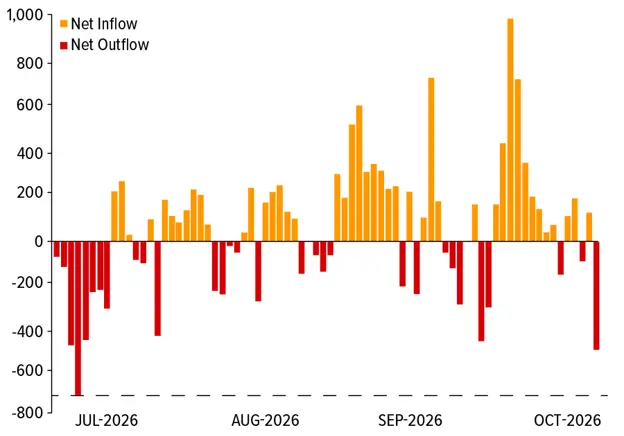
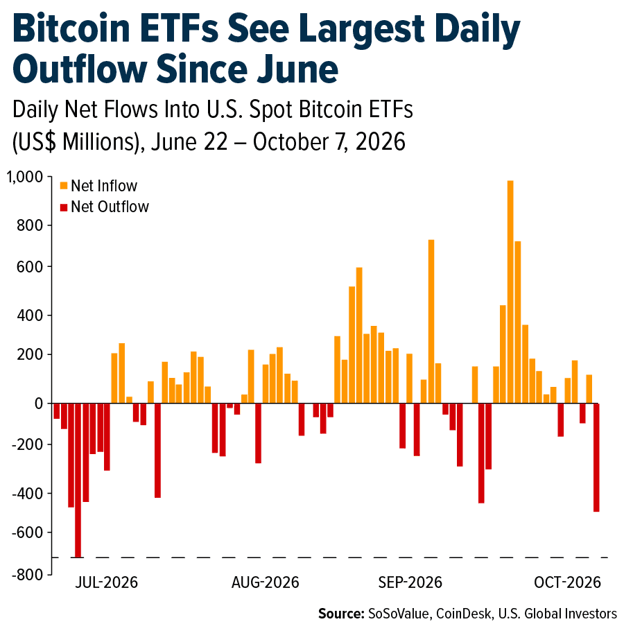
- U.S. spot Bitcoin ETFs saw $487.1 million in net outflows on October 7, the largest single-day withdrawal since June 25, according to crypto data provider SoSoValue. That follows about $2.65 billion in net inflows in September and leaves October’s net flows at negative $165.6 million so far. Net inflows for the year have shrunk to just $717 million, a sign of weaker investor appetite that raises concerns about Bitcoin’s near-term price outlook.
- Bitwise closes its Dogecoin ETF as demand for some smaller crypto funds falls flat. Bitwise CEO Hunter Horsley acknowledged that the firm’s spot Dogecoin ETF (BWOW) failed to attract enough investors, showing the gap between people who use cryptocurrency and traditional ETF investors. The fund, which launched on the NYSE in November 2025, will stop trading after October 14. It had just $725,870 in assets as of October 7 and only about $51,480 in trading volume in September. The closure shows how hard it can be for fund companies to turn a cryptocurrency’s popularity into lasting demand for a regulated investment product.
- Strategy shareholders face dilution risk despite higher Bitcoin forecasts. TD Cowen kept its Buy rating and $260 price target on Strategy (MSTR), the largest corporate holder of Bitcoin, even after raising its Bitcoin forecasts to $109,000 by the end of 2026 and $280,000 by 2029. Analysts warned that issuing more stock, paying dividends on preferred shares and building cash reserves could water down the benefit of rising Bitcoin prices for common shareholders. Strategy holds about 848,000 Bitcoin with $4.5 billion in paper gains, but the amount of Bitcoin backing each common share has grown more slowly as its financing obligations rise, highlighting the challenges of holding Bitcoin as a corporate treasury strategy.
Opportunities
- Grayscale sees new growth opportunities as crypto ETFs expand beyond Bitcoin and Ether. Grayscale, a leading digital asset manager, said the SEC’s generic listing standards, which let exchanges list qualifying crypto ETFs without a separate SEC approval for each fund, now cover about 15 cryptocurrencies. The firm’s Zcash ETF (ZCSH) drew more than $1 billion in its first 30 trading days, putting it in the top 1% of ETF launches over the past decade. Grayscale also filed under the SEC’s innovation exemption to tokenize two covered-call funds focused on Bitcoin and Ether, which generate income by selling options on their holdings.
- Samsung will bring USDC transfers to 82 million Galaxy devices in the U.S. Samsung plans to add transfers of USDC, a dollar-backed stablecoin, to Samsung Wallet and Samsung Pay using the Solana blockchain, letting eligible U.S. Galaxy users send money abroad starting in late October. Users will be able to send money to bank accounts in more than 60 countries, converted into local currency. The service will be powered by Bastion, with Coinbase safekeeping the digital assets. Building stablecoin payments directly into popular mobile wallets could speed up mainstream use of digital assets.
- Solana-based Orca and Loopscale merge to expand blockchain financing into AI, robotics and defense. Orca, a decentralized exchange that lets users trade crypto directly without a middleman, and lending platform Loopscale have merged to form Formation. The new platform combines trading, lending and investing to help finance emerging industries such as artificial intelligence, energy, robotics and defense. Orca has handled more than $550 billion in trading volume since 2021, and Loopscale has made more than $2 billion in loans and attracted more than $150 million in deposits. Over the next 12 months, Formation plans to roll out new tools for issuing assets and new investment strategies, working with firms including Securitize, Figure and Shinhan Asset Management to expand tokenized financing and access to regulated U.S. capital markets.
Threats
- EU regulators give crypto platforms three months to drop unauthorized stablecoins. The European Securities and Markets Authority (ESMA) told national regulators to make sure crypto platforms phase out stablecoins that don’t comply with the EU’s Markets in Crypto-Assets (MiCA) rules by January 8, 2027. The guidance affects major tokens such as Tether’s USDT and PayPal’s PYUSD, which aren’t authorized under MiCA. Platforms must stop letting customers buy, trade or add to holdings of these stablecoins, though they can still help customers close out existing positions. The restrictions could reduce stablecoin trading, raise compliance costs and reshape crypto trading across the European Union.
- AI advances raise new security concerns for Bitcoin and Ethereum. Ethereum researcher Justin Drake warned that in a worst-case scenario, rapid advances in artificial intelligence could break the cryptography protecting Bitcoin and Ethereum wallets within months, well before quantum computers become a practical threat. Millions of Bitcoin held in addresses whose public keys, part of the code that secures a wallet, are already visible on the blockchain could be at risk, along with Ethereum-based stablecoins and tokenized assets. No practical attack has been demonstrated, but the warning highlights growing cybersecurity risks and the possible need to speed up security upgrades.
- NFL joins the legal fight over prediction markets as regulatory uncertainty grows. The National Football League joined state governments, tribal groups and former regulators in urging the U.S. Supreme Court to decide whether sports-related prediction markets, which let users trade contracts on the outcome of events, fall under federal or state oversight. Platforms such as Kalshi and Polymarket argue that the Commodity Futures Trading Commission (CFTC) has sole authority, while opponents say state gambling laws should apply. Conflicting federal court rulings have added to the uncertainty and could expose prediction market operators to new restrictions, higher compliance costs and limits on growth.
